(Author: Gwynne Schrire, Vol. 70, No. 3, Chanukah 2015)
What are the Dardanelles, who was J Rabinowitz Drechsler and what is the significance of an old brown leaf?
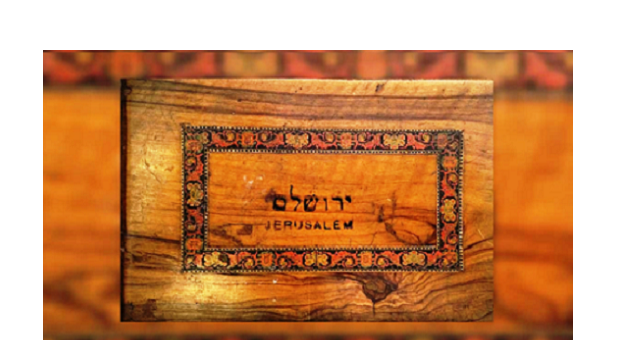
These were the questions that came to mind when opening the book Blumen von Heiligen Lande (Flowers of the Holy Land). Previously donated to the old Jewish Museum in Cape Town the book, which is in German, Hebrew and English, was taken over by the Cape Council SA Jewish Board of Deputies, the trustees, because it did not fit into the collection of the new SA Jewish Museum.1 It contains twelve thick plates, separated by protective tissue, of pictures made of pressed dried flowers, and has olivewood covers with the word Jerusalem inscribed in a rectangular floral parquetry border.
Books like this brought back by early 20thCentury tourists to the Holy Land can be found in museums, libraries and collections in many countries.2 There is something unique about ours. Glued onto the first page is a red, white and blue British military ribbon that would have held the miniature 1914-1915 Star Medal.3 The ribbon has been tied onto a small dried leaf with a few insect holes on the sides and the tip missing. Written on the leaf are the words Dardanelles 1915. That makes the leaf one hundred years old! Inside the book is stamped the name J Rabinowitz Drechsler.

Why did Rabinowitz Drechsler stamp his name inside? Who wrote the words Dardanelles 1915 on the leaf, using expensive gold ink? These questions set me on a trail to find some answers.
The Dardanelles Strait runs along the south of Turkey’s Gallipoli Peninsula and controls the entrance to the Black Sea. 2015 is the centenary of the Gallipoli campaign, which took place during the First World War when the Ottoman Empire, which included Palestine, sided with Germany and Austria. Winston Churchill, then First Lord of the Admiralty, thought that by seizing Gallipoli the Allies could knock the Ottoman Empire out of the war and obtain a clear sea route to their Russian allies.4 Unfortunately it did not work out like that and the Gallipoli, or Dardanelles Campaign was one of the great Allied disasters of the war. It took place between 25 April 1915 and 9 January 1916 and was a fiasco, poorly planned and badly executed. By the time it ended over 100 000 men were dead, including 56 000 – 68 000 Turkish and some 53 000 British, Commonwealth and French soldiers.5
Vladimir (Ze’ev) Jabotinsky, the writer Israel Zangwill, Mrs Vera Weizmann and Zangwill’s cousins Monty Eder and Joe Cowen had been trying to persuade the British to recruit a Jewish battalion, hoping to increase Jewish post-war influence in Palestine.6 In Alexandria in British-occupied Egypt were about 11 000 Jews, who had been deported from Tel Aviv and Jaffa by the Turks.7 In February 1915, Jabotinsky and Joseph Trumpeldor approached General Maxwell, the British commander, suggesting that they help recruit a Jewish legion among the deportees to fight in Palestine. Maxwell rejected the idea as the British Army did not accept foreign nationals into its ranks. However, knowing that most of the roads on the Turkish side were little more than cart tracks, Maxwell proposed instead that they form a ‘mule corps’ to serve somewhere other than Palestine.8 This in due course led to the creation of the Zion Mule Corps (ZMC). It would be the first time in British history that non-Britons or non-colonials would participate as a unit in the British forces.9 Other motives were at play. As General Sir Ian Hamilton, Commander-in-Chief of the Anglo-French Expeditionary Force in the Dardanelles, noted in his diary, “the Corps may serve as ground bait to entice the big Jew journalists and bankers to our cause; the former will lend us colour, the latter the coin.”10
Jabotinsky resented the idea that his proposed Jewish Legion would be a Mule Corps. “What a shocking combination,” he wrote, “Zion, the rebirth of a nation, the first really Jewish troop in the whole history of Exile, and ‘mules”’.11
Trumpeldor better understood the realities of war. After qualifying in law and dentistry, he served in the Russian army, losing his left arm in action and becoming one of only two Jews to be promoted to the rank of officer (and this by royal order). He responded, “We’ve got to smash the Turk. On which front you begin is just technique; any front leads to Zion.”12 He further told Jabotinsky, “Trenches or transport is practically the same – all so essential that you can’t do without it; and even the danger is often the same. You are just afraid of the word ‘mules’ and that is childish.”13
Jabotinsky refused to enlist in the ZMC but Trumpeldor began recruiting and training volunteers from the Alexandrian refugees along with other Jews hoping to assist the British in taking Palestine from the Turks. Was one of the deportees who joined the ZMC Rabinowitz Drechsler?
On 23 March 1915, in the presence of many local dignitaries, Grand Rabbi Raphael della Pergola administered the oath of obedience to the 650 new recruits, who swore obedience to the officer commanding the Corps and to such officers as should be placed over them. An emotional telegram of encouragement from Zangwill referring to a happy return to Palestine was read out. Zangwill later complained to the Jewish Chronicle that his “telegram had been toned down by the local military censor.”14 (In August, he contacted the War Office in London with funds to recruit Jews from other countries, especially Italy, into the ZMC. The War Office took them into the Italian army instead.)
Five British and eight Jewish officers were appointed – the latter were not permitted to eat in the British officers’ mess and received 40% less pay. The Commanding Officer was an Irishman, Lieutenant-Colonel John Henry Patterson, with Trumpeldor as Second-in-Command. Patterson later described Trumpeldor as “the bravest man I ever knew”.15 Intense training went on for only three weeks as the men were under orders to sail for Gallipoli to supply front-line troops with food, water and ammunition. Patterson wrote that “never since the days of Judah Maccabee had such sights and sounds been seen and heard in a military camp – with the drilling of uniformed soldiers in the Hebrew language.” Orders were given in English, Hebrew and Yiddish as 75% of the men were from Russia. (Petrov, the Russian Consul in Alexandria, demanded unsuccessfully that the latter be sent back to enlist in the Russian army.)
The ZMC was allocated twenty horses for officers and NCOs and 750 pack mules. Wooden carriers to fit the pack saddles were made locally, each designed to carry four four-gallon water-cans (also locally made). The Grand Rabbi was nominated Honorary Chaplain and for Pesach, Patterson obtained kosher food and matzah and attended the Sedorim. The badge of the ZMC was the Star of David, with a blue-and-white Zionist flag alongside the Union Jack. It became the first regular Jewish fighting force – with a distinctively Jewish emblem and flag – to take active part in a war since the Bar Kochba Revolt more than 1800 years before.
At the end of their training, on 17 April, the Corps marched three miles to the Alexandria Great Synagogue, where they were blessed by the Grand Rabbi and cheered by the local population before setting sail for Gallipoli.16 By 25 April, 562 members of the ZMC had been sent to join the Australian, New Zealand and Gurkha units on the Gallipoli Peninsula.
“The Zion Mule Corps went ashore under the deafening roar of artillery, machine guns and rifles… It took them three days to unload in the badly organized shuttle of lighters moving to and from the shore, and carrying ammunition boxes was made more difficult by the behaviour of the animals which, terrified by the gunfire, were running and stumbling into craters and over muddy beaches, having to be pursued and calmed before they were fit for service. By this time the Corps were badly needed to take up supplies to the front-line trenches holding the bridgehead, and once ashore they went straight to work, forming a human chain from ships to shore passing supplies and water onto land, all the while under enemy fire…The Corps worked all night and through the next day taking supplies up to the front, now in pouring rain and biting winds which made the rough paths into mud slides. Men and animals walked up and down wadis and hillsides, through thick bush and across rock strewn slopes, often unknowingly passing through the wire and trenches into the no-man’s-land between the Turkish and Allied lines and being shot at by both sides in the darkness, rain and constant shellfire. Yet by the following dawn, when they were stood down exhausted, only a few men and mules were found to have been wounded.”17
Patterson described to the Jewish Chronicle how “(t)hese brave lads who had never seen shellfire before most competently unloaded the boats and handled the mules whilst shells were bursting in close proximity to them … nor were they in any way discouraged when they had to plod their way… walking over dead bodies while the bullets flew around them … for two days and two nights we marched.” 18
While some slept, parties of men and mules took turns bringing up forage, water and ammunition from the beaches to the front throughout the day and following night. The Corps was the only transport available and was constantly at work. Brigadier-General Aspinall-Oglanden acknowledged that “(s)pecial recognition is due to the Zion Mule Corps for their untiring energy … bringing up ammunition and water to the forward positions and carrying back the wounded, under very heavy fire.”19On one occasion the men refused to unload sides of bacon until the Grand Rabbi granted dispensation – the Rabbi even allowed them to eat it if necessary. A New Zealand officer later wrote that the troops were amused to see the Jews of the ZMC returning to their cookhouse with little bags of bacon.20
The Times war correspondent wrote, “Water was severely rationed, every drop having to be carried to the front lines. Sanitary conditions were literally appalling; latrines consisting merely of holes in the ground, where the flies bred ceaselessly”.21 Dysentery became endemic. Cpl Riley described it as looking like a midden and smelling like an open cemetery.22 Almost as many casualties came from the intense heat and flies as from enemy action. By the end of July, casualties and illness had reduced the ZMC to less than half its original strength, although it had to carry out the same volume of work. By the end of the campaign, fourteen of its men had been killed and over sixty wounded (a hundred mules had also been lost) in action. In November, Hamilton wrote to Jabotinsky that “(t)he men have done extremely well, working their mules calmly under heavy shell and rifle fire, and thus showing a more difficult type of bravery than the men who were constantly in the trenches and had the excitement of combat to keep them going.”23
Hamilton later wrote in his diary, “I have here, fighting under my orders, a purely Jewish unit – the Zion Mule Corps. As far as I know, this is the first time in the Christian era such a thing has happened. They have shown great courage taking supplies up to the line under heavy fire” and proved “invaluable to us”.24Patterson said that everybody, from General Hamilton, the Commander-in-Chief, to the private in the ranks gave the ZMC unstinted praise.25 He wrote, “Many of the Zionists whom I thought somewhat lacking in courage showed themselves fearless to a degree when under heavy fire, while Captain Trumpeldor actually revelled in it, and the hotter it became the more he liked it”. (Trumpeldor was once shot through the shoulder but refused to leave the field.) Major F. Waite, wrote of “the risks run by the ZMC … they carried their lives in their hands … for the enemy had the range to a yard of every landing stage, dump and roadway” which they used.26
On 28 December, the order came through for the ZMC to be disbanded. They were among the last to leave. Before doing so in January 1916, they paid formal tribute to their dead comrades, and then, having slashed the throats of mules too ill to evacuate, departed – one of them taking with him a leaf. Did it fall in his pocket? Did it represent a near miss, the tree above him taking a Turkish bullet, leaves fluttering around him? Was it to remind him of the hell hole they had survived with their reputation flying high?
Sidney Moseley, a War Office representative, said that “the Zion Mule Corps became indispensable in Gallipoli.”27Despite this, Britain later refused to grant the men of the ZMC regular British army pensions and the Corps was disbanded. Trumpeldor and Jabotinsky moved to London and continued to lobby for a Jewish Legion. One of those he interviewed was General Smuts (whom he thought “a lovable personality of the continental type”). Smuts told him, “That Jews should fight for the Land of Israel is the finest idea I have heard in my life.”28
The British then decided to attack the Turks in Palestine and, being short of soldiers, to make use of Russian Jews in England whom they were not able to enlist before. No fewer than 120 of the ZMC re-enlisted in the newly formed Jewish Battalions of the Royal Fusiliers (38th- 42nd) who were to fight in Palestine as the Jewish Legion or ‘Judeans’,29 with Patterson commanding the 38th Battalion. This time Jabotinsky was prepared to join up, was appointed a Lieutenant and commanded a company, headed by Patterson, which was the first to cross the Jordan in pursuit of the Turkish forces.30 Some of its men later formed the core of what was to become the modern Israeli army.
As T H Huxley has reminded us, the great tragedy of science is “the slaying of a beautiful hypothesis by an ugly fact”.No Rabinowitz Drechsler is listed in the British Jewry Book of Honour as a member of the Zion Mule Corps and, as he was already living in Jerusalem in 1888, he would probably have been too old to enlist.31 If he was not the soldier who carefully preserved a leaf from the campaign knotted into his campaign ribbon, however, why is his name stamped in Blumen von Heiligen Landen?
Thanks to the Internet, we learn that J Rabinowitz Drechsler was living in Jerusalem in 1888, and that he was in financial distress. Charity in the form of halukah – distribution of funds collected for indigent ultra-orthodox Jews in the Holy Land – was common before the advent of Zionism (which opposed the system). Both the German Orthodox newspapers, Der Israelitin 1888, and the Israelit und Jeschurun in 1889, published lists of donations subscribed for him – two marks from Rosenthal in Holzappel, three marks from David Bauer in Frankfurt am Mein, five marks from Baum, etc.32
We also know that the Cape Council is not the only possessor of a book with J Rabinowitz Drechsler’s name stamped inside. The special collection library at the Yeshivah University Center for Jewish History in New York City has a copy of Blumen von Heiligen Lande with the identical stamp on a blank page.33 So has the Jewish Museum of Maryland’s Haggadah (published by S Zuckerman, Jerusalem, 1896).34Both books, like ours, havehandcrafted covers of cut, bevelled and polished olivewood with a rectangular parquetry border enclosing the word Jerusalem in Hebrew and English. So, did J Rabinowitz Drechsler publish them?
Books of pressed flowers with similar olivewood covers were such popular tourist souvenirs that they can be found in several international museums and libraries and are for sale on rare book and Judaica auctions. The educator and botanist John Edward Dinsmore worked in Jerusalem for a time, and there exists a photograph dated about 1920 showing such a book on a table surrounded by pages of pressed flowers and plants.35 The books have almost identical titles, although the languages can differ – Russian/ English or German/ Hebrew, and identical variants of pressed flower pictures. Strangely, though, the name of the publisher on the title page (when not absent altogether) differs. They include Ephtimi Freres, Jerusalem36; Avraham Moshe Lunz37; Gebr Baltinester38; A L Monsohn, Jerusalem39; Antoine Sfeir, Jerusalem40; O J Jerusalem41; N P,London42; “printed in Germany for the Editeur N. De Simini”and Atallah Frères43 (a Palestinian Arab company). Even the American Colony in Jerusalem – a utopian Christian commune that did charity work from 1881 to the early 1940s – published some. None bear the name J Rabinowitz Drechsler.
The production of such a book requires more than just a firm to publish it. It requires people to collect the flowers and ferns, dry and press them. Then there is the painstaking labour of delicately gluing the flowers according to a pre-selected pattern onto the pages, after which the pages must be bound together, the tissue paper between the leaves inserted and, of course, the cover attached – not just conventional cardboard covers, but ones beautifully made of olivewood.
We do find the name J Rabinowitz Drechsler in The Oshkosh Daily Northwestern newspaper from Wisconsin, America. On 29 March 1892, it reported, “WG Brauer received a unique gift from Jerusalem yesterday. It was a short branch of an olive tree neatly carved. The carver was Joseph Rabinawitz (sic) Drechsler, a Jew expelled from Russia. The gift was sent as a specimen of his work in the hope of securing orders.”44 From this we learn that his first name was Joseph, that he came from Russia, and that he carved olivewood and wanted to export his work.
In 1895 and 1896, Rabinowitz Drechsler sent a number of letters, in German, from Jerusalem to the Danish Chief Rabbi, David Simonsen.45 Three such letters are housed in the Royal Library of Denmark.46 The rabbi is thanked for sending five marks, with the hope expressed that the Almighty will likewise thank him. Three marks from the rabbi had also been received via Mr Gottlieb. The following month, Rabinowitz Drechsler sent Rosh Hashanah greetings, mentioned the steady Russian immigration and advised that he would be sending the rabbi an etrog container made from olivewood. A further letter also mentioned that he was working in olivewood. In April 1900, he also sent a letter from Jerusalem to Herr Leon Israel, Diedenhofen, Lothringen, in the former Alsace Lorraine – the envelope is on sale in philatelic auctions.47
A carved olivewood plaque of the Kotel Hamaaravi (Western Wall) advertised in an antique catalogue, bears the name “JOSEPH RABINOWITZ Drechsler JERUSALEM” imprinted in an oval stamp on the back. The catalogue illustrates the mark with a photo of a clearer impression from another item.48 This is the same oval stamp he imprinted onto a letter to Rabbi Simonsen on 9 October 1896. The name Drechsler is printed in small letters, while RABINOWITZ is in capitals. Drechsler means lathe operator in German, and olivewood covers could be made by lathes which can turn, sand and work in wood. Does the name thus indicate his profession, rather than an additional surname? Probably, because two similar olivewood plaques of the Western Wall, Jerusalem, offered for sale elsewhere have “Joseph Rabinowitz Olive Wood Productions in the Holy City of Jerusalem” printed on the back.49 (EBay offers a carving of the tomb of Absolom, Jerusalem, by Jacob Rabinowitz Drechsler – certainly a mistake.50)
With the influx of poor Jews into Jerusalem in the 19th Century, the Haskalah movement tried to break their dependence on halukah and hence, efforts were made to encourage the production of decorative and religious objects for sale to pilgrims, tourists and for export. By the 1870s, there were about one hundred Jews manufacturing olivewood souvenirs in Jerusalem.51 In the 1880s, the Alliance Israelit Universelle started a trade school, Hatorah Vehamelacha, to teach religion and trades like woodwork and goldsmithing. Gideon Ofrat has identified Rabinowitz as being one of the people who had an olivewood workshop making round plaques of the Holy Places.52
One of these ‘paper weights’ with a carving of Jerusalem was displayed in the Silesian Museum of Applied Arts and Antiquities by the Breslau Jewish Museum in a 1929 exhibition of ‘Judaism in the history of Silesia’.53 The exhibition catalogue states that on the back there is a stamp in Hebrew and Latin script stating that it was custom-made in Jerusalem by Drechsler Rabinowitz. It was probably turfed out four years later when Hitler came to power and Jewish history was erased.
With this knowledge, we can conclude with reasonable certainty that Joseph Rabinowitz, a Drechsler by profession, was an Orthodox Jew from Russia who had probably arrived in Jerusalem in the late 1880s as a penniless refugee, and that after subsisting on halukahfrom Germany, he started a business working in olivewood, manufacturing religious objects like etrog containers, curios, plaques and book covers for popular tourist souvenirs published by different publishers. He had enough entrepreneurial initiative to try to export these to contacts in America, Denmark and Alsace Lorraine, and had sufficient pride in his workmanship to stamp his name and trade J Rabinowitz Drechsler on some of the books and plaques.
Unfortunately, the brave soldier who owned the book and the leaf remains nameless, but thanks to the Internet we now know much more about the person who owned the stamp with the name. Whoever the owner, it is a unique souvenir of the Gallipoli campaign and of an enterprising woodcarver who left Russia to make a new life for himself in the Holy City of Jerusalem.
Gwynne Schrire is Deputy Director of the Cape Council of the SA Jewish Board of Deputies. She is a regular contributor and a member of the Editorial Board of Jewish Affairs and has written, co-written and edited various books on aspects of local Jewish and Cape Town history.
NOTES
- The Board has two copies, this one in Hebrew and German, and anotherin English and German,with a dedication dated1905. Both have the pages of pressed flower labelled in Hebrew, German, English and French. The Hebrew version opens from the right, the English from the left. Neither has the name of a publisher. The Australian War Memorial has a similar book of flowers bought by 1134 Private Hubert Arthur Lawler, a baker of East Davenport, Tasmania, who landed at Gallipoli on 12 September 1915 after training in Egypt, and was later invalided out. However, as our book was donated to the Cape Town Jewish Museum, not to an Australian or New Zealand institution, it seems safe to assume that the owner was Jewish and therefore very likely fought in the ZMC.
- University of Glasgow Library special collections: https://universityofglasgowlibrary.wordpress.com/…/new-acquisition-flo…Similar acquisition: Flowers and Views by Julie Gardham onSeptember 23, 2009 • ( 10 ) University of Liverpool Library, Special Collections & Archives, Flowers of the Holy Land, London: A Atallah Frères [1900?]. Classmark: Printed Books SPEC Y.90.3.379 Australia War Museum: Souvenir album with olive wood covers ‘Flowers from the Holy Land’: Private H Lawler, 26 Battalion AIF www.awm.gov.au/collection/REL34211/; The Center for Jewish History Museum. Dr. W. Martin Wadewitz Book Collection Ramsey Library, University of North Carolina at Asheville toto.lib.unca.edu/findingaids/books/…/default_wadewitz_flowers.htm, Dr. W. Martin Wadewitz Book Collection Ramsey Library, University of North Carolina at Asheville; Saint Augustine’s University, Raleigh; Saint; Columbia University Libraries, New York
- With thanks to Anthony Pamm, author of Honours and Rewards in the British Empire and Commonwealth: United Kingdom and Eire v. 1 (1995) and Honours and Rewards in the British Empire and Commonwealth: The Empire and Commonwealth v. 2 (1995) for this information
- Gallipoli”. HistoryLearningSite.co.uk. 2014. Web
- Gallipoli Campaign – Wikipedia, the free encyclopedia, en.wikipedia.org/wiki/Gallipoli_Campaign
- Schrire, Gwynne, ‘The Cousins Zangwill, Eder and Cowen – the causes they championed and the South African connection’, Jewish Affairs, Rosh Hashanah, 2014. Vol 69, No 2
- Formerly part of the Ottoman Empire, Britain occupied Egypt in 1882
- Monick, S, ‘Gallipoli: The Landings of 25 April 1915’, 26018340, South African Military History Society Military History Journal, Vol 6 No 4 – December 1984
- Sugarman, Martin, ‘The Zion Muleteers of Gallipoli’, (March 1915 – May 1916) www.jewishvirtuallibrary.org/jsource/History/mulecorp.html
- Sugarman, M, op cit
- Jabotinsky Vladimir, The Story of the Jewish Legion, Bernard Ackerman, New York, p 42
- Jabotinsky, op cit,. p42
- 13 Jabotinsky, op cit. p12
- Sugarman, op cit
- Jabotinsky,V, op cit p70
- Sugarman, op cit
- All of this from Sugarman, op cit
- Sugarman, op cit
- Sugarman, op cit
- Major F Waite, The New Zealanders at Gallipoli, (Auckland,1921), quoted in Sugarman
- Monick, ‘Gallipoli: The Landings of 25 April 1915’
- Monick, op cit
- Jabotinsky, op cit, p44
- Sugarman
- Patterson, Col., J, Foreword, in Jabotinsky, Vladimir, op cit, pp. 18-19
- Sugarman, op cit
- Quoted by Col John Henry Patterson, Jabotinsky, op cit, p19
- Jabotinsky, op cit p87
- Sugarman, op cit
- Musiker, Naomi, ‘Jack Rich’s career in the Jewish Legion 1917-1920’, Jewish Affairs, Chanukah, 2014
- Reverend Michael Adler Editor, British Jewry Book of Honour , 1922. London
- Der Israelit, Vol 29, Issue 2, s.n.1888m pp1451-1452., https:/books.google.co.za/books?id=hp8WAQAAIAAJ&q=rebinowitz…Der Israelit, Vol 30. Issue 1, p 732 Google Books, pp Israelit und Jeschurun, pp 978, https://books.google.co.za/books?id=DaAWAQAAIAAJ 2015/01/31, Both Google books, both in the University of California
- With thanks to the most helpful librarian, J.D. Arden, Genealogy & Reference Services Assistant Centre for Jewish History. The History Museum is a partnership between the American Jewish Historical Society, American Sephardi Federation, Leo Baeck Institutive, Yeshiva University Museum and YIVO Institute for Jewish Research. He put me in touch with Bonni-Dara Michaels, Collections Curator, Yeshiva University Museum, which has the book blumen des heil. landes – CJH Museum Collections – Center who provided this information by e-mail on 12.1. 2015. museum.cjh.org/web/pages/cjh/Display.php?irn=13470…%2Fquery:
- English translation, published by S. Zuckerman & Co jmmd.dashpointlabs.com/archive?page=1618. With thanks to Joanna Church, Collections Manager, The Jewish Museum of Maryland, e-mail dated 20.2.2015
- Flowers of the Holy Land -Blumen des Heiligen Lande, toto.lib.unca.edu/findingaids/books/…/default_wadewitz_flowers.htm, Dr. W. Martin Wadewitz Book Collection Ramsey Library, University of North Carolina at Asheville
- http://www.abebooks.com/
- Avraham Moshe Lunz, 1854-1918 http://aleph.nli.org.il/F/?func=direct&doc_number=002720417&local_base=NNLALL.
- http://primo.nli.org.il/primo_library/libweb/action/dlDisplay.do?vid=NLI&docId=NNL_ALEPH002667856
- Jerusalem: Fleurs de Terre Sainte – Flowers of the Holy Land www.klinebooks.com/cgi-bin/kline/28766.html
- http://dogbert.abebooks.com/servlet/BookDetailsPL? bi=57659658
- blumen Des Heiligen Lande – Jerusalem – Fleurs de la Terre Sainte. Flowers of the Holy Land. N. N. abebooks.com
- Flowers of The Holy Land – Fleurs De La Terre Sainte – Jerusalem. abebooks.com
- University of Liverpool Library, Special Collections & Archives Flowers of the Holy Land. London: A Atallah Frères [1900?]. Classmark: Printed Books SPEC Y.90.3.379
- Oshkosh Daily Northwestern – Oshkosh, Wisconsin – Mar 29 1892 All results for Rabinawitz in All Collections – My Heritage; www.myheritage.com/research?action=query…1…
- With thanks to Sonya Kirchner for translating the letters. Rabbi David Simonsen was the Danish Chief Rabbi from 1892-1902. During World War I, he acted as ‘communication central’, maintaining all the important contacts in Denmark and abroad, between organisations and individuals. He was also able to relay messages between relatives on different sides of the front, and after the war, he continued to be active in different relief organisations, both in Denmark and abroad.
- David Simonsen Archives, The Royal Library, National Library of Demark and Copenhagen University Library, letters dated 10.9.1895., 6.10.1895, 8.1.1896, www.kb.dk/letters/judsam.2011/mar/dsa/object6901 ,6902 and; 6904/en David Simonsen’s archives (acquired by The Royal Library, Denmark in 1932) reflect the history of several scientific disciplines over a full half century. The list of correspondents contains the names of leading scientists within Oriental and Jewish Studies, but also from other areas. From Wikipedia
- Envelope 9/4/00 to D.L. offered for sale. Philasearch com – German Post in Turkey online-auktionen.com/en/i_9367_2915/Old…/michel_11aI.html
- 48 Antiques Online Catalogue – IMEXCO General Ltd, www.imexco.com/antiques/imx-israeliana-bezelel-wooden.html
- Olive Wood Plaques with Relief of the Western Wall | Kedem.Description: Two wood plaques, souvenir from Jerusalem [early 20th century]. Carved and engraved olive wood; printed. Carved on both plaques is the form of the Western Wall and behind it three pine trees and another tree. On one of the plaques the words “Jerusalem, Western Wall” are printed in Hebrew. On their reverse sides are stamps of Joseph Rabinowitz – “Olive Wood Productions in the Holy City of Jerusalem”.Length: 12-12.5 cm, width: 11.5-12.5 cm. Good condition. There is a crack in one of the plaques.www.kedem-auctions.com/content/olive-wood-plaques-relief-western-wall
- www.ebay.com225 × 169
- Kalmar, Ivan Davidson and Penslar, Derek, (Ed), Orientalism and the Jews, Tauber Institute Series for the Study of European Jews, Brandeis University Press, 2004, p144; ttps://books.google.co.za/books?isbn=1584654112
- Reference in Hebrew, thanks to Hagai Dagan, gideonofrat. wordpress.com
- Exhibition of Judaism in the history of Silesia. Hintze, Erwin, 1929, Katalog der vom Verein “Jüdisches Catalogue of the association “Jewish Museum Breslau” in the premises of the Silesian Museum of Applied Arts and Antiquities www.sbc.org.pl/dlibra/plain-content?id=3938