
(Reviewer: Ralph Zulman, Vol. 72, No. 3, Chanukah 2017)
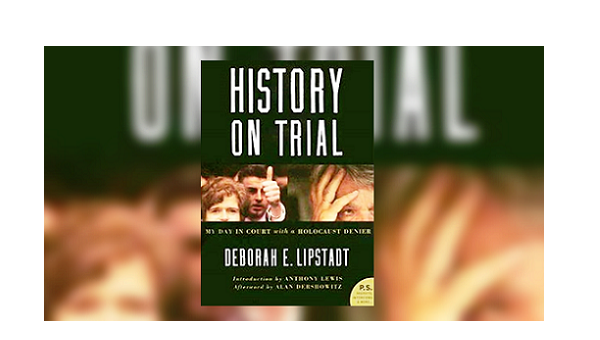
Deborah Lipstadt is currently the Dorot Professor of Modern Jewish History and Holocaust Studies at Emory University. She is the author of Beyond Belief: The American Press and the Coming of the Holocaust 1933-1945 (1986), Denying the Holocaust: The Growing Assault on Truth and Memory (1993), History on Trial: My Day in Court with a Holocaust Denier (2005)and The Eichman Trial (2011). In 2016, History on Tr ial was the subject of a major motion picture, entitled Denial. To coincide with its release the book, now entitled Denial – Holocaust History on Trial, was reissued in paperback.
In Denying the Holocaust, Lipstadt called David Irving “one of the most dangerous spokespersons for Holocaust denial”. Following its publication in the UK, Irving filed a libel suit against her and her publisher. She successfully defended the action with a first-rate team of lawyers, historians and experts. Denial: Holocaust History on Trial is a blow-by blow account of the singular legal battle that took place.
The book consists of, a Foreword, a Note to the Reader, a Prologue, 22 chapters divided into three parts (the Prelude, The Trial and the Aftermath), an Afterword by Alan Dershowitz, Acknowledgements, Notes, an Index and various photographs.
Lipstadt, whose father left Germany before the rise of the Third Reich and whose mother was born in Canada, grew up on Manhattan’s Upper West Side. Her Modern Orthodox home was “shaped by a dedication to Jewish tradition together with an appreciation of the surrounding secular society”. On a visit to Israel in 1968, she “understood the deep imprint of the Holocaust and Israel on the psyche of the Jewish people” and following her return began graduate work in modern Jewish history at Brandeis University. She found herself increasingly drawn to the study of the Holocaust, particularly to the question of how bystanders – Jew and non-Jews – reacted.
At the request of Professors Yehuda Bauer and Israel Gutman of the Centre for the Study of Antisemitism at the Hebrew University, she began conducting a research project on Holocaust denial. As her research proceeded, she was struck by the sophisticated camouflage tactics developed by the deniers. The Institute for Historical Review in California, for instance, depicted itself as a scholarly group driven by “a deep dedication to the cause of truth in history”. Its attacks on the Holocaust (described as the ‘Greatest Lie in all of history”) had both an antisemitic and anti-Israel bias.
The general media was equally blindsided by denial. Lipstadt’s concern about deniers was escalated in 1988 when she learnt that David Irving was now publicly denying the Holocaust. Although she was aware of Irving she did not pay close attention to him until 1977 when he published Hitler’s War, which alleged that Hitler did not know about the Final Solution. She believed that Irving’s conclusions could only have been as a result of willful distortions. A number of scholars wrote extensive critiques documenting how Irving had skewed historical evidence.
Well before becoming a denier Irving had argued that the Nazi wrongdoings were equaled, if not surpassed by Allied evils. In 1986, he told a South African audience that the British had bombed the Belgians, Poles, French and Dutch, killing millions. After the reissue Hitler’s War a number of leading British historians, including AJP Taylor, Hugh Trevor-Roper, Paul Addison and John Charmley praised Irving for his “indefatigable scholarly industry” but questioned his use of sources. Rainier Zitelmann, a conservative German historian, also praised Irving on his research on Hitler.
Some years ago Rodney Mazinter, vice-chairman of the Zionist Federation, Cape Council, and a frequent contributor to the press in defense of Israel, was attending a conference in Israel on the topic of antisemitism. He happened to sit next to a small, grey-haired lady and remarked that the role of the notorious Protocols of the Elders of Zion was often overlooked as a prime generator of antisemitism. The lady concurred. It turned out that she was Judge Had a different tone. He was troubled by those who praised Irving’s research and challenged them to check his sources. Had they done so, he argued, they would have found that that many of the references and quotations were not verifiable and that “unconvincing assertions abound”. Charles Sydnor carefully checked Irving’s sources and accused him of seriously misrepresenting and distorting the record of Hitler and the Third Reich.
Lipstadt accepts that respected Holocaust historians have markedly different views about many aspects of the Holocaust, such as that of Jewish responses to the persecution. Deniers, however, falsify and pervert the historical record and consequently fall entirely outside the parameters of historical debate about the Holocaust.
Denying the Holocaust: The Growing Assault on Truth and Memory appeared in 1993 and received widespread critical acclaim. Lipstadt considered her scholarly work on denial closed. Then, in 1995, came a letter from Penguin, followed by additional inquiries by its lawyers about the sources on which Lipstadt’s critique of Irving had been based. In September, Penguin’s lawyers wrote again informing her that Irving had filed papers indicating his intention to proceed with a lawsuit against Penguin and herself.
Although both she and Penguin were being sued, Lipstadt realized that their perspectives were different. She needed someone to formulate a legal strategy to suit her interests. On the recommendation of a friend she contacted Anthony Julius, a partner in the London firm of solicitors, Mischon de Reya. She knew him as the author of T. S . Elliot: Anti-Semitism and Literary Form. He was however better generally known as having acted as Princess Diana’s lawyer in her divorce case. Julius was delighted to represent her. He assured her that he would act pro bono if need be as she could not afford his substantial fees. Emory University agreed to allocate $25 000.00 to cover expenses. She received a ‘crash course’ in the British libel law, which presumes defamatory words to be untrue until the author proved them true. Julius assumed that Irving would drop his case. He was wrong.
Over the next few months Lipstadt’s strategy evolved. It was decided that the object was not to prove that the Holocaust happened – no court needed proof of that. Her job was to prove the truth of her words, namely that Irving had lied about the Holocaust and had done so for antisemitic reasons. It was decided not to call survivors as witnesses. She did not want Irving ridiculing survivors as he had done in the past. For example in an Australian radio show he asked a survivor how much money she had made after 1945 out of the concentration tattoo on her arm.
During the summer the lawyers pored over some 1500 documents discovered by Irving.
Richard Rampton QC, one of England’s leading barristers in the field of defamation, was selected to present the case. In his report Richard Evans, an expert defense witness, described Irving’s works as “a knotted web of distortions, suppress and manipulations” in every single instance which he and his experts examined and that “dishonesty permeated his entire written and spoken output”.
The trial commenced before Mr Justice Gray on 11 January 2000. Irving represented himself. Rampton QC began his opening address by saying: “Mr. Irving calls himself an historian. The truth is, however, that he is not an historian at all but a falsifier of history. To put it bluntly he is a liar”.
Irving showed a video tape to the Court of an interview that Lipstadt had given on Australian television in which she said about Irving (then trying to obtain an Australian visa) that “no historian takes him seriously”. Judge Gray tried, without much success, to get Irving to define the Holocaust. Irving insisted that he did not manipulate his sources. He concluded his remarks with the words, ‘The kind of hatred that this book has subjected me to [is] something intolerable, something unspeakable and which I would wish no other person to be subjected to”.
Rampton QC began his cross-examination of Irving by noting that he had denied being a Holocaust denier. He then read from a speech Irving had given in Canada in which he said, after referring to the trial of Ernst Zundel in which he gave evidence, that the story of the Holocaust “was just a legend”. Simple questions to Irving elicited long meandering responses. When asked how many innocent Jewish people the Nazis had deliberately killed Irving eventually, after shrugging his shoulders, said that he was not an expert on the Holocaust, and therefore his answer would be of no value. Rampton presented selected quotations from Irving’s writings, demonstrating how he had perverted and skewed the meanings of events that he wrote about.
‘The Trial’ section is dealt with in chapters 5 to 19. Chapter headings include ‘Exonerating Hitler’, ‘Excoriating the Allies’, ‘Lying about Hitler’ and ‘The Diary of Anne Frank: A Novel?’. Chapters 20-22 deal with the aftermath of the trial.
In this book, Lipstadt has shown us that “truth and justice are on our side” and that “freedom of speech is also on our side”.
Denial – History on Trial by Deborah Lipstadt, Harper Collins, 2016, 400pp
Mr Justice Ralph Zulman, a long-serving member of the editorial board of Jewish Affairs and a frequent contributor to its Reviews pages, is a former Judge of the Appeal Court of South Africa.


