
(Author: Gwynne Schrire, Vol. 64, No. 2, Rosh Hashanah 2009)
Early travelers’ tales often have to be taken with a pinch of salt. That pinch must be added to a kernel of truth, wrapped in a shell of plagiarised information and covered with a large dollop of reminiscences, misinterpretation and prejudice.
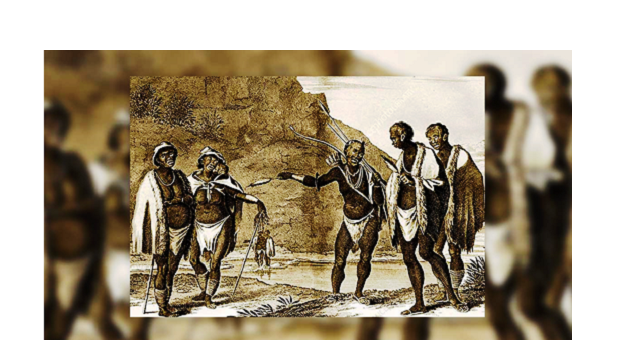
To the travelers of the 17th and 18th Centuries, the people in the Cape were strange indeed.
Where had they come from? Why were they so different from other men? What was the explanation for their strange customs, so unlike those of Europe? Many answers were proposed, but most of them served only to deepen the darkness that surrounded the image of Africa. At last, the Europeans resorted to an easy conclusion… Africans… were just savages, inferior beings and had always been so.1
At that stage of scientific development, it was all but impossible for people to have a non-Biblical concept of the world. The belief then was that the entire world had been repopulated by Noah’s sons Japhet in Europe, Shem in Asia and Ham in Africa. There were also the monstrous races described by Pliny in his authoritative Historia Naturalis.2
But then, Europeans rounded the Cape and came across the Khoisan. These did not look like the creatures described by Pliny, nor like the one-legged Sciopodes described by Bishop Isadorusa of Seville. Where, then, did they fit in? Willem ten Rhyne of Deventer, who stopped off at the Cape in 1686, mused:
Did these people spring originally from Ham, the son of Noah, with the exception of some Arabs of the stock of Shem who entered Africa later on? Or did the native races of Africa increase and multiply… frequently send out their youth in quest of new lands to settle until… these emigrants, spreading far and wide… finally settled in the remotest shores of Africa?3
President, took strong exception to Pliny’s descriptions of African people. Speaking at the United Nations University symposium, “The African Renaissance, South Africa and The World” on 9 April 1998, he cited some of them:
Of the Ethiopians there are diverse forms and kinds of men. Some there are toward the east that have neither nose nor nostrils, but the face all full. Others that have no upper lip, they are without tongues, and they speak by signs, and they have but a little hole to take their breath at, by the which they drink with an oaten straw … In a part of Afrikke be people called Pteomphane, for their King they have a dog, at whose fancy they are governed … And the people called Anthropomphagi which we call cannibals, live with human flesh. The Cinamolgi, their heads are almost like to heads of dogs… Blemmyis a people so called, they have no heads, but hide their mouth and their eyes in their breasts.4
These images, said Mbeki, “must have frightened many a Roman child to scurry to bed whenever their parents said, ‘The Africans are coming! The strange creatures out of Africa are coming!’”
Other Africans Pliny described were the trogolodytae, who could outrun a horse, the syrbota, who were more than 4m tall, and the minismini, who lived on milk.5
Pliny’s book became part of accepted knowledge and was handed down through the centuries. Modern anthropologists, however, have described Pliny as having drawn from every source of information, good and bad, with no powers of discrimination, no critical sense and no solid understanding of the meaning of the more serious works from which he drew; however, his apparent learning impressed his readers and saved them the trouble of acquiring information firsthand.6
The early visitors to the Cape shores would have had to fit the native inhabitants they met into the prevailing world-view according to the Plinian beliefs of African races. There was an accepted hierarchy, from bestial animals to people with divine souls. Christians like themselves, they knew, were the highest and the only ones assured of salvation. The Hottentots7, according to Sir William Petty (1677), were the “Most beast-like of all the Souls of Men with whom our Travelers are well acquainted.”8
It was not easy to find sufficient sailors and personnel willing to endure the harsh discipline of the Dutch East India Company, with the result that most of the latter’s employees were illiterate destitute peasants roaming the streets of Dutch cities when they were enlisted.9 Few would have met any Jews other than those in the pages of the Bible, and hence sailors and visitors rounding the Cape would probably have had little knowledge of either Hottentots or Jewish customs. It was therefore not surprising that, in seeking answers to these questions of origin, some concluded that the Hottentots must have descended from the Jews.
One of the earliest such linkage was made by Georg Meister, who stopped off at the Cape on the way to Batavia in 1677 and observed that ‘bestial men or animal-like” Hottentots used “a very sharp flint to shave the hair of their beards, as the Jews are said to do in their circumcisings, with which they can smooth their chins as neatly as if they had the best razors.”10 However Meister, did point out that, unlike Hottentots, “Jews, like the Turks, West- and East Indians, had a spark of knowledge of God and of His Will and [were] therefore as far from these savages as is the Sun from the Moon”.11
Twenty years later, more similarities between the Jews and the Hottentots were noted. In 1695, JG Grevenbroek wrote in a letter that it was:
…supposed that it is from the Jews that the inhabitants of the remoter parts have learned the practice of circumcision (although it is a more serious operation with the Africans, involving the cutting away not only of the prepuce, but of the skin right up to the base of the abdomen. From the Jews also the natives near us must have acquired the practice of removing the left testicle, if you will excuse the mention of it.) Indeed who is so blind as not to see that it is from the Israelites that both divisions of Hottentots have derived all their sacerdotal and sacrificial rites, which are redolent of the purest antiquity, although admittedly the lapse of so many centuries has obscured the connection.12
In addition, Grevenbroek noted a similarity in the names of Jews and Hottentots: “Here I think I should mention that among our natives the names of brother and sister are, in the Israelitish fashion, bestowed on cousins on the father’s or the mother’s side”.
Grevenbroek also thought Hebrew and the Khoisan languages were alike (“I am of the opinion that the language of the natives has something in common with Hebrew, for it seems to consist of guttural labials, dentals, linguals and other sounds that fall with difficulty from the lips and are hard for us to pronounce”.
Pierre Kolbe,13 regarded as the leading authority on the Cape for that period, used Grevenbroek’s work and established many more similarities between the two peoples. His Caput Bonae Spei Hodiernum, published in 1719, was highly regarded and was translated into many languages. As a result, the relationship between the Jews and the Hottentots became so accepted that as late as 1933 anthropologist I Schapera found it necessary to explain that there was no basis to any such theories: “Many of the early writers believed that the Hottentots were descended from or considerably influenced by the Jews or other Semitic peoples. This theory, a hardy perennial still often used to account for the origin of savage customs with a superficial resemblance to those recorded in the Old Testament, has no solid foundation in fact”.14
One of Kolbe’s followers was Gysbert Hemmy, who delivered a Latin oration, De Promontorio Bonae Spei, in the Hamburg Academy on 10 April 1767. This was the first published account of the Cape of Good Hope written by someone who had actually been born in the Cape and not just passed through it. He states that “Kolbe is of the opinion that the Hottentots are descended from the Jews. There is no lack of evidence to add considerable weight to this conjecture”.15
Hemmy then provides the evidence: There is the widespread tradition concerning the first parents of their race who arrived in this region of the earth through a window and a door. There are their wellknown sacrifices, through which they strive to correct anything that is evil. There is a great variety of practices which are known to be especially common among the Jews. They divorce their wives for the most trifling causes. In marriage, they never depart from the forbidden family relationships. Firstborn sons have special privileges regarding inheritance. Women who have just given birth or who are menstruating are unclean and their husbands are not permitted to have any relations with them. They abstain from eating pork and other food that Jews are forbidden to eat.
Hemmy did note one difference: “In squalor and uncleanness, they surpass the Jews”, adding, adding that there was “no doubt that the practice of excising the left testicle suggests imitation of the Jewish rite of circumcision.”
To Hemmy, the proof was overwhelming – to Jews it is ludicrous. The notes to the Latin translation states that Hemmy’s own knowledge of Jewry was probably confined to conditions in Hamburg where, in effect, the Jews were more tolerantly treated than in many parts of Europe. But if so, the conditions in Hamburg allowed the most peculiar beliefs to circulate.16 At the Cape, where he was born, there were neither Jews nor religious freedom.
Why did people know so little about Jews? After all unlike the Khoisan people, about whose very existence the Europeans had been ignorant until they started rounding Africa in the search for the fabled Spice Islands, the Jews had been living in Europe for centuries.
Meister and Kolbe were from Germany. They knew the Jews in the Bible, but not those in their homeland. This can be seen in Meister’s comment that the Hottentots used a very sharp flint as the Jews were said to do in their circumcisions. This shows his knowledge of the Bible – Zipporah used a flint to circumcise her son (Exodus 4:24-6) – but not of contemporary Jews, because already by Roman times metal knives were being used. When Meister and Kolbe went on their travels, Jews in Germany were still suffering from expulsions and restrictions. An unending series of laws and regulations, ordinances, decrees, patents and privileges circumscribed the entry and settlement of Jews, the length of their stay, their conduct of business, their moral behavior, their taxes and even the goods they had to buy.17
In 1670, Emperor Leopold 1 had “most graciously resolved that the Jews who are here shall be removed hence and from the whole country.” The Great Elector Frederick William in 1671 allowed fifty of the wealthiest Jews expelled from Vienna to settle in Brandenburg “for commercial and general benefit” for twenty years. In Berlin in 1716, it was resolved that “Jews, culpable killers, blasphemers, and thieves” were to be kept out.18 Prussian Jews were accorded religious toleration but not civil rights. First born children of protected Jews were allowed to settle, a second child could buy such a right and all subsequent children had to remain unmarried or emigrate. In 1750, Frederick the Great made those restrictions even more stringent.
Jews were scapegoats of the developing social and economic upheaval. With the general level of suspicion of and ignorance about Jews, it was understandable that Meister and Kolbe would not have known facts to contradict their credulous fancies. Dutch travelers like Willem Ten Rhyne and Johannes de Grevenbroek grew up in a more tolerant atmosphere than the German travelers. After overthrowing Catholic Spain in 1571, the Dutch declared that every citizen “should be accorded freedom of worship and no one should be molested on account of his belief.”19 Jews were not formally recognised as citizens but enjoyed religious freedom although were not allowed to intermarry or enroll their children in Christian schools, and were debarred from trades requiring guild membership until official emancipation was granted in 1796. Jews could not settle in some cities but Amsterdam accepted them, despite hostility from a minority of politicians. Most Amsterdam Jews were very poor Ashkenazi refugees from Eastern Europe, but there was a wealthy Sephardi aristocracy formed of earlier arrivals from Spain and Portugal, refugees from the Inquisition. Jews in the seventeenth century made up 10% of Amsterdam’s population and these exotic people became a tourist attraction. Visitors from all over Europe, especially from France and Italy, made it a point, when in Amsterdam, to go to the Jewish quarter to look at Jews and to attend a synagogue service where they could watch real live Jews at prayer.
“I came to Amsterdam. The first thing I went to see was a Synagogue of the Jewes (it being Saturday)” wrote the English diarist John Evelyn.20 Directions to the Jewish quarter were even incorporated in guide books. The synagogues were keen to make a good impression and instituted regulations to ensure that the worshippers behaved themselves before the tourists. These included instructions about when to stand or sit, no walking about when the Torah was being read, no fistfights to be allowed and no weapons were to be brought in – unless the person had a quarrel with a non-Jew and needed it for defense, in which case the committee was to be informed.21
Among the Dutch intelligentsia, scholarship on Jewish matters was an esteemed intellectual discipline in the belief that understanding Hebrew was essential for understanding the Bible and Dutch universities ran courses on Hebrew, Jewish belief and doctrine. This knowledge would also be of help in converting the Jews, a necessity for the anticipated Second Coming of the Messiah.22
“Of course this kind of philo-Semitic interest in Jewish literature and concern for the universal fate of the Jewish people should not be confused with a benevolent and sympathetic or even tolerant attitude toward Jewish individuals and communities. A reverence for Judaism as a religion, a body of texts, and a historical tradition is certainly compatible with a hostility towards actual Jews, particularly when they insist on living at the heart of a Christian society.”23
Travelers overseas did not necessarily share the same intellectual discipline or interests. Arriving in a strange land and confronting strange people, they would adapt the knowledge and prejudices at their disposal to make sense of the new. Not everyone believed all that they were told. Although Kolbe became the authority on the early Hottentots, and his work remained so for a century, he did face some harsh contemporary criticism.
Astronomer Abbe de la Caille, who was at the Cape fifty years later, called Kolbe unreliable and inaccurate, and claimed that everything he had written about the Hottentots came from Grevenbroek: “After his death, [Grevenbroek’s] papers were sent to Kolbe, who pieced them together without any skill or judgement.”24
De la Caille’s editor provided more details, asserting that Kolbe was sent to the Cape in 1705 to make astronomical observations but was so incompetent that he lost that job, was employed as a secretary in Stellenbosch, lost that job too and returned to Germany in 1713 where he:
…discovered that during his stay at the Cape he had done nothing but drink and smoke… Not knowing what to report in Europe or to show the fruits of his expedition, he applied to some residents of the Cape… who conceived the idea of dictating to Kolbe a description of the Cape and in order to make it seem more interesting they collected all the current popular beliefs and palmed them off onto Kolbe, who did not know the country, together with numerous marvelous details derived from their imagination… Kolbe, delighted… caused it to be printed in Holland as a translation from the German. The book was read with astonishing avidity, and the edition soon sold out.25
Kolbe’s work was read by Otto Fredrik Mentzel, who had lived in the Cape at the same time as he had. But unlike Hemmy, he did not swallow it hook, line and sinker. Mentzel was so dismayed at what Kolbe had written that he sat down and wrote his own account, accusing Kolbe of superficiality, slovenliness, affectation and plagiarism.26
Berlin-born, Mentzel was well read and a keen observer with an insatiable curiosity. He arrived in Cape Town in 1732 and lived happily there as a tutor for children until one unfortunate day in 1741, eager to catch the mail, he boarded a ship to deliver a last minute letter. The wind came up suddenly and prevented him from returning to shore that night so he had no choice but to sleep over. When he awoke the next morning, he found that the captain had forgotten he was there and that he was on his way back to Holland, sans all his clothes and possessions. He was never able to return. Back in Europe, he entered the Prussian Civil Service in the recently acquired Province of Silesia, rising to become Chief of Police at Neustädtel in Lower Silesia and dying there in 1801.
Infuriated by what Kolbe had written, Mentzel wrote his own book, A Complete and Authentic Geographical and Topographical Description of the Famous and (All Things Considered) Remarkable African Cape of Good Hope. many years after his unexpected return.27 He felt that his eight years spent in the Cape made him more qualified than those who had not been in Cape Town as long as he had and he did not hesitate to correct other writers when their statements conflicted with his own personal observations. Mentzel ends his author’s preface to the Second Volume as follows:
My work still has to be judged and I submit it to every intelligent and critical reader to whom I offer my best respects, and whom I commend to the grace and protection of God. O.F. Mentzel, 26 February 1787 on my 78th birthday.
I can say with certainty that everything that Kolbe and several others on his authority have written over and above what I have mentioned, is inconsistent with the truth, in so far as they have written down exaggerations of unimportant things to lengthen their accounts, and one can truthfully say of them: It is easy to tell falsehoods about distant countries… I do not wish to concern myself with any more refutations. It is enough that I have shown what Kolbe’s work is worth.28
Mentzel did not, like Kolbe, write for public success but out of a desire to spread the truth as he saw it. Unfortunately, unlike Kolbe’s work, Mentzel’s book attracted little notice and fell into obscurity. This is a pity, because his book is a primary source on what he saw and a critical commentary on the writings of his contemporaries. It is interesting and readable and he comes across as somebody who is sympathetic and the possessor of sound common sense, insight and humanity.29 He had enjoyed meeting and talking to all sorts of people and had a finely developed sense of curiosity. It is obvious from his work that he had read literature on the Hottentots, but that he had also obtained information from talking to them, as well as to people who knew them from elephant hunters to farmers.30
Mentzel has a long chapter on the Hottentots, which is essentially a criticism of Kolbe. Here, he looks at the question troubling all of the early visitors: “What is the origin of the Hottentots? From what nation are they descended? And how did they get to the most Southerly point of Africa?” Mentzel says that “up to now, only a great deal of silly nonsense has been the outcome of these questions”.
The practical Mentzel reasons that the Hottentots could not possibly have come down from Asia “where without any doubt man first lived after the Deluge” because the terrible deserts, mountain chains and big rivers that lay between these two continents “almost exclude the possibility of believing in an emigration to such a remote place”. He concludes that it would be futile to trace their descent, “but when a few scholars theorise about or even try to determine from which nations the Hottentots are descended, such as the Carthaginian tribes of Africa, or the troglodytes, or even the Jews; surely the few customs they have in common with these prove nothing: for these may have come about accidentally”.31
Mentzel spends considerable space demolishing Kolbe’s comparison between the Jews and Hottentots. “Kolbe takes great pains to prove that the Hottentots have much in common with the Jews; but this theory does not hold. I shall give his reasons and my opinion in parallel columns”.32
Mentzel then proceeded to draw up a businesslike table to refute Kolbe’s list of similarities between Jews and Hottentots, placing Kolbe’s statement on one side of the page, and his own rebuttal on the other. He balances Kolbe’s opinions with factual, and sometimes sarcastic, rebuttals that show considerable knowledge of the customs of both people. The whole table is included for interest.
Kolbe’s supposed evidence for the comparison was based on the following claims:
(1) Since they [Hottentots] often make offerings; (2) since they calculate their days and especially their festivals by the new and full moon; (3) since they are not allowed to cohabit with their wives at certain times; (4) since, if caught in non-observance of this custom, they have to sacrifice again; (5) since, just as the Jews often eat unleavened bread and unsalted food, they may never eat salt, unless they are among the Christians; (6) since they have to undergo a definite kind of circumcision; (7) since they eat nothing that has died of suffocation; (8) since they eat no scaleless fish; (9) since they never allow their wives to attend their meetings dealing with public affairs and (10) since they may divorce their wives.
To each of these, Mentzel responded as follows:
- Hottentots never make sacrifices in honour of a God; but for a different purpose, that is they slaughter cattle to cure a patient with the fresh fat. The meat, entrails and hide are eaten by the entire village as a common food, but none offered to the Gods by fire
- All Indian tribes reckon the seasons according to the changes of the moon. The Hottentots however have no festivals calculated and fixed according to changes of the moon; indeed, they have no festivals at all. Their dancing at or about full moon is no festive act which they have to perform, but merely a merry-making which they have in common with many tribes and which they omit if the weather is unpleasant or rainy
- At such times the men of no nation touch their wives.
- Not sacrifice, but present the kraal with ahead of cattle as at weddings or the birth of a child, especially a son.
- O! Sancta Simplicitus! Hottentots have no bread and are accustomed to lack of salt from their childhood since most Hottentots live in regions where salt is unobtainable. But when they visit the colonists, leavened bread and food spiced with salt taste excellent to them, and they may also eat it. Is it then in abstinence ordered by a law when I have to do without something I do not possess?
- The excision of a testicle and the practice of cutting out a testicle or the circumcision of the foreskin are radically different: and all the Hottentot tribes have at least nowadays done away with the initiation into manhood. Only the Great Namaquas still retain it.
- By suffocation the Jews mean anything thathas died a natural death, retaining its blood. If an animal belonging to a Hottentot dies, it is consumed.
- This (if true, but unknown to me) must originate from a natural aversion.
- Since, of all uncivilised nations, they think least of their wives; and I do not remember having read in a single book of travels, that women of other nations are permitted in such assemblies.
- This should read “may separate from them”or no longer cohabit with them. This is done by all uncivilised nations; they take wives and leave them again if they believe they have a reason. They are not married under oath and since the woman’s father reserves the right to take back his daughter (according to Kolbe’s own account), the man may also separate from her.
Mentzel concludes that “the reasons brought forward appear far-fetched” and points out that if one looked for similarities between people, one could just as easily find similarities between the Jews and the Germans!” He then lists the similarities of Jews and Germans. “We Germans too have a good deal in common with the Jews: we respect the Sabbath, we keep the Ten Commandments, we still retain much of what Moses prescribed in Marriage and Police matter; in a word we still have the Jewish Old Testament, Moses and the Prophets”, but ends by saying “but what intelligent person would on that account imagine that we are descended from the Jews?”
He then points out that the Hottentots could not have been descended from the Jews because no matter where Jews settle, they never forsake their customs and faith.
The Jewish nation has been scattered all over the world and has since then been divided into countless sections, but not one of these is known to have discarded or forgotten the laws of Moses. Even supposing there are descendants of Jews, who live in far distant lands without Rabbis and without any written code, and thus had forgotten the Mosaic Law in the course of time, yet they would never forget the holiness of the Sabbath, circumcision and the aversion to shedding blood. Besides, the Mosaic ceremonial law is so deep-rooted in all Jews in many respects that it would not be improper to say that it has become second nature to them. In additions one should only consider this, that the Mosaic law enjoins nothing more strictly than cleanliness, so that the Jews dare not touch anything which in the smallest way is unclean in their eyes, according to this law; or if needs must, they wash themselves again, purify themselves or even have to remain unclean for a definite period; thus there is no greater contrast between day and night than between the cleanliness of the Jews of the Old Testament and the filthiness of the Hottentots, who live in constant squalor like a dung-beetle in the dung… They not only touch but handle everything that is intrinsically unclean and eat animals that have perished of disease, even such as have already begun to putrefy.33
Mentzel concludes that the Hottentots are in all respects quite distinctive, with little in their national customs or religious rites comparable to others, and that they probably had separated from the rest of mankind “immediately after the Babylonish confusion of languages”. His own theory of their origins is that hundreds or thousands of years before, people were shipwrecked along with their cattle and sheep at the furthest point of Africa after they had been driven into the open sea by a storm. After all, “Carthaginians, Phoenicians from Tyre and Sidon, or even Solomon himself or King Hiram, had ships that sailed the seas.” What, he supposes, if the survivors then died, leaving behind some children who had not yet learnt to speak properly, and these orphans grew up without education. This could then explain the unusual language and lack of education of the Hottentots. He finally demolishes Kolbe by saying:
Almost all facts known about Hottentots have up to the present been taken from Kolbe, and Kolbe who in his time lived as long at the Cape as I did afterwards, namely eight years, describes this people to us as wearing long mustaches and whiskers like half-shaven Jews. It is impossible that he should never have seen Hottentots during his eight years’ stay, but to judge from this description of his, he cannot have seen any, for there are rarely any traces on their faces of the woolly hair of their heads, and as far as one can see their naked bodies and those of their women, not a single hair can be noticed. (I can vouch for the reliability of my account.)
Unlike Georg Meister, Johannes de Grevenbroek, Pierre Kolbe or Gysbert Hammy, Otto Mentzel’s statements imply a basic knowledge of Jewish beliefs and practices. Where would he have acquired such knowledge? Mentzel grew up in a cultured and intellectually stimulating home. His father was a Prussian Hofrat and Court physician, whose extensive library was later included in the Royal Prussian Library. It is possible that he met Jews in his parent’s home or read books about Jews in his father’s library. Neustädtel in Lower Silesia, where he became Chief of Police, is now known as Nowe Miasteczko in Poland, and there in his position and with his openminded curiosity about people, he would have come across many Jews, on both sides of the law. He probably learned about them, as he had previously learned about the Hottentots, by talking to them and observing their customs.
The truth is now out. The Hottentots have come from Africa. So have the Jews. Indeed, so have the ancestors of the Dutch and German travelers. Grevenbroek, Meister and Kolbe were right so far as that goes and Mentzel wrong. The Hottentots and the Jews are related, but then so are Grevenbroek, Meister and Kolbe. So, in fact, are all human beings. We all carry within our genes the same mitochondrial DNA that can be traced back to a single woman living in Africa over 150 000 years ago.34 Despite beliefs in racial superiority, 80% of modern Europeans are descended from the old African hunter-gatherers. So much for their much vaunted cultural superiority!
The writer of this article had her DNA tested. Her mitochondrial DNA shows that her ancestors left Africa, between 60 000 – 80 000 years ago, finding a foothold during the ice age in Asia, Australia and parts of Europe. It is the mitochondrial DNA associated with Eurasian groups and is shared with many people living along the Mediterranean, including many Ashkenazim.
To answer Willem Ten Rhyne of Deventer’s question 400 years later: The KhoiSan did not spring from Ham, with the exception of some Arabs of the stock of Shem who entered Africa later on. Ham and Shem sprang from the KhoiSan and exited Africa later on.
Gwynne Schrire is Deputy Director of the Cape Council of the SA Jewish Board of Deputies. She is a regular contributor and a member of the Editorial Board of Jewish Affairs and has written, co-written and edited various books on aspects of local Jewish and Cape Town history.
NOTES
- Basil Davidson, ‘African Kingdoms’, Great Ages of Man, A History of the World’s Cultures, 1967,17
- Andrew Smith, ‘Different Facets of the Crystal: Early European Images of the Khoikhoi at the Cape, South Africa’, In South African Archaeological Society Goodwin Series 7,1993,9-10
- William ten Rhyne of Deventer, ‘A Short Account Of The Cape of Good Hope and of the Hottentots who Inhabit that Region’, Schaffhausen, 1686 in The Early Cape Hottentots described in the writings of Olfert Dapper (1668), Willem Ten Rhyne (1686) and Johannes Gulielmus de Grevenbroek (1695) Van Riebeeck Society, 1933, 93
- Mbeki states that the quote was cited in: Africa: A Biography of the Continent, John Reader, Hamish Hamilton, London, 1997.
- From The Natural History of Pliny The Elder, book 7http:/ oaks.nvg.org/pliny.html. Smith op cit, 9
- Stanley Casson, The Discovery of Man: The Story of the Inquiry into Human Origin, 1940, 77-8
- Originally so called by early travelers because of the sound of their language, the term is now regarded as insulting and the preferred word is Khoisan. In this article the language used in the historical period under discussion is retained.
- Smith, op cit, 12
- Yvonne Brink, ‘Figuring the Cultural Landscape, Land, Identity and Material Culture at the Cape in the Eighteenth Century’, South African Archaeological Bulletin, 1997, 52, 108-109
- He was a gardener from Thuringia at the Duke of Saxony court, went on to Amsterdam and spent three weeks at the Cape, where he was taken on as a cadet
- Georg Meister, Orientalisch-Indisch Gartner, Dresden, 1692, translated, R Raven-Hart, R Raven-Hart. Cape Good Hope, 1652-1702, The First 50 Years of Dutch Colonisation as Seen By Callers, Cape Town, 1971, pp 203 and 206
- NG Grevenbroek, ‘An Elegant and Accurate Account of The African Race Living Round the Cape of Good Hope Commonly Called Hottentots’, from a letter written by JG Grevenbroek in the year 1695, Translated by B Farrington, Van Riebeeck Society, 1933, edited by I Schapera pp 209 and 287
- His name is variously spelled Kolb, Kolbe, Kolben and Kolbius. I have standardised it to Kolbe. His first name is given as Pierre or Peter.
- Schapera, ‘Introduction’, in The Early Cape Hottentots described in the writings of Olfert Dapper (1668). Willem Ten Rhyne (1686) and Johannes Gulielmus de Grevenbroek (1695) Van Riebeeck Society, 1933, v
- Gysbert Hemmy from Africa, Oratorio Latina, De Promontorio Bonae Spei 1767, transl KD White. SA Public Library, Cape town, 1959, 29-30.
- GS Nienaber and DH Varley, Ibid, 39
- Encyclopaedia Judaica, 1972, Vol. 7, 474
- Nahum Gidal, Jews in Germany from Roman Times to the Weimar Republic, Kõln 1998,112-113
- Franz Landsberger, Rembrandt, the Jews and the Bible, Philadelphia, 1946,15,17
- “I came to Amsterdam. The first thing I went to see was a Synagogue of the Jewes (it being Saturday) whose ceremonys, Ornaments, Lamps. Laws and Scholars afforded matter for my contemplation” ( John Evelyn 1641). “Here in this congregation, no good order, no great zeal and devotion here appearing much time spent in singing and talking.”(Sir William Brereton 1634), “There was no good order. We observed some of the Jews to bow at times, they seemed very careless, discovering and laughing with strangers in the midst of the service” (Philip Skippon, 1663). “There was too much laughing, talking and idly wandering, as if about prophane Affairs, though in a Presence so sacred” (John Northleigh) IN Steven Nadler, Rembrandt’s Jews, University of Chicago Press, 2003 168 -174
- ibid, 173-175
- ibid, 90-91
- ibid, 93
- De la Caille was at the Cape from 17513 I Shapera, Foreword NG Grevenbroek, op cit, 162-4
- Ibid.
- HJ Mandelbrote, Introduction, in Mentzel , A Complete and Authentic Geographical and Topographical Description of the Famous and ( All Things Considered) Remarkable African Cape of Good Hope, Part 11, Van Riebeeck Society, 1925, xx1
- Glogau, 1787, translated by GV Marais, Van Riebeeck Thabo Mbeki, then South African Deputy
- OF Mentzel, Author’s Preface, Part 111, in Mentzel, VanRiebeeck Society, 1944, 9
- An example of his even-handed humanitarianism: “It isquite true that the Hottentot is lazy, idle, improvident and soforth… But when it is said of the Germans that they are fondof drink, the question arises: Are all the Germans thereforedrunkards? … in the same way there are exceptions to therule among the Hottentots.”
- HJ Mandelbrote, Introductory Note in Part 111, in Mentzel, Van Riebeeck Society, 1944, xxv
- He also states that “the Hottentots do not form part of theKaffir nation has been competently proved by the learnedLudolf… and he has shown that the word Cafar was derivedfrom the Chaldean language in which Cafar means aninfidel. This being the reason too, why the Jewish rabbis callthose who deny G-d or abandon their religion Cafar. TheArabs have actually given this name to the entire Eastern partof Africa since it was inhabited by people ignorant of the trueGod and call them Cafers or Caffers.”, Mentzel, op cit, 266-267
- Mentzel, op cit, 267-269
- Mentzel, op cit, pp 206-271 He adds that he does not want totake the trouble to analyse Kolbe’s comparison of theHottentots with the troglodytes.
- Stephen Oppenheimer, The Real Eve: Modern Man’s JourneyOut of Africa, New York, 2003
[/vc_column_text][/vc_column][/vc_row]


