
(Author: Masha Geer, Vol. 70, No. 3, Chanukah 2015)
Editor’s Note: A typed version of this letter, translated from the original Yiddish, was found in the archives of the Beth Din by Isaac Reznik, a former Director of the Union of Orthodox Synagogues and noted historian on South African Jewry. From the context, it appears to have been sent sometime in 1947 by Masha Geer, then living in Kovno (Kaunas), Lithuania, to her cousin, identified only as ‘Gershon’, in Johannesburg. It records the almost total annihilation of the Jewish population of her home village – unnamed, although the reference to Zelenaya Street and other clues suggest it may have been Budslaw in the Wilno District of what was then Poland and is today part of Lithuania. It further records the names of various gentile neighbours who collaborated with the German occupiers in the massacres.
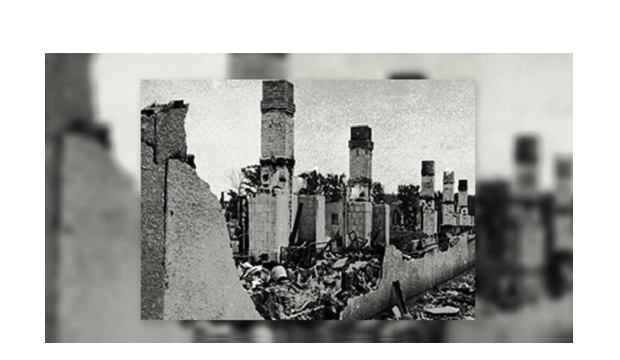
Feature image: Ruins of Kovno ghetto
Dear Gershon,
Your letter came some time ago, but I had no time to answer it. Some changes have occurred in my life. I can well understand your grief, but it is not so difficult for you, because it did not happen in your presence. It is hard for you to believe it. You think you will still meet your dear ones. You did not live in the German inferno. You cannot imagine what we have suffered and how we lived through it all.
I have told you in my last letter that I stayed with your people till the last days of their lives. Your mother (God rest her soul) was afraid to go to sleep without me. If I happened to be late, she used to sit up and wait for me. I used to tell her, that there was no danger, that all stories were invented, that soon we would be safe. Then only would she quieten down and go to sleep.
On the 26th of May, 1942, I happened to be away. That’s how my life was saved. My mother was in the hands of the murderers. The family Markman lived with your people. They all perished on the 27th of May, 1942, at four o’clock in the morning. Opposite the cemetery of the Roman Catholics on the field adjoining the wood all were brutally murdered, except for a few, who managed to escape and lost their lives avenging the wrongs.
Your wife Sonya worked with my sister. They were killed in the autumn of 1942. Sonya worked on the iron bridge. She saw the murderers approaching and guessed their purpose. She jumped in the river… the butcher shot her, while she was in the water. Workers who were present then dragged her body out of the river and buried her near the bridge.
In the summer of 1945, my father and I transferred the bodies of my ill-fated sisters and other young girls to the Jewish cemetery. We tried to dig Sonya out, but the water had flooded the place. We could not get at her body. We decided to fence in the place.
Fruma and Leah Silber are alive. They are in Poland. Beines Blachman, Sarah Katz, the daughter of the blacksmith, Kleiner Leiba and Sheeah Katzovith, Nathan and sons Shleima and Juda and Meim, the son of Utzefich Meisha, have survived. They live in Vilna and the sons of Sonya Lidahi Israel and little Simcha Sachick, Abraham and * Lieberman. That is all. At this time in our village are only alive my father and Sarah Katz. She is teaching school.
The people, who used the house next door to you, are now owning your property and working your ground. All your belongings are with the Lushinovitches, the washerwomen from Zelenaya street, and the washerwoman Rene (I don’t know her surname). They all ran to Poland, when the Russian occupation was expected. Gleb has Sonya’s fur coat and many other things. My father asked them to give up the things, but they refused. Father wanted to sell the things and use the money for fencing in the cemetery. A tombstone is needed for the common grave, and he is not in a position to do it himself. So the old man went to the woods, cut down some trees and brought them to the cemetery. He put a wooden fence up temporarily.
We thank you for your offer to help us by sending us parcels. We appreciate it greatly, dear Gershon. Thank God we live well materially, and are not in want of anything.
I was married nearly two years ago. My husband is a good lad. Only his health is bad. He served on the front for four years and was twice heavily wounded. He is working now and earns good money. Our son was born on the 26thDecember, 1946. We named him Faivka.
We live together with Shifra. Meer works on the old job. Their son is a good boy. They were evacuated to Kazakhstan during the war, so they missed most of the horrors.
I went through untold sufferings. I have told you about it. When everybody else was killed I managed to run to the partisans in the woods. For some time I participated in their activities. Then I was called up in the army. I was on active service for two years. After demobilization
I worked in the factory. So you see, I have an eventful life.
We live in Kaunas. It is the Lithuanian U.S.S.S. My father visits us often. Eli David is in the army. He is serving the fourth year. Father and Eli David were partisans too.
Eugenie Kaminsky was with the Germans. She has brought upon us dreadful sufferings. Edya Kosach was commandant. His Lieutenants were the butcher Tolya Kotkovitch, Peter Ostpovitch and his family. Anya Kotkovitch, Vera and her brother (I don’t know his name) May he be damned, Kopsovitch, Petchack, the younger Kotkov Peter, Basil’s son, Kostevitch Ches, son of the cook of the Manor house, the son of Andreiki with his prostitute sisters. They are the ones, who brought the Germans to us. Please, remember the names well. They are the executioners of the ones, who were near and dear to you. It is a pity that they are all alive and live well in Poland. They escaped there before the Russian occupation. Your “Kamenik” played his part, damn him. A lot of your things are in his possession and the Matsulevitches, Marissa the midwife. I cannot count the lot. They are all to blame.
I am sending you Sonya’s photograph. I have cut it out from the one, where she is together with my sister Chaika. It was taken in Vilna at the time she ordered her fur coat.
I am closing this letter. My son is awake and is calling me.
Keep well and may you be happy. Write to us often. Don’t wait for an answer. Let us know everything about yourself. Everybody is sending you the kindness regards and we all wish you the very best.
Your cousin
Masha


