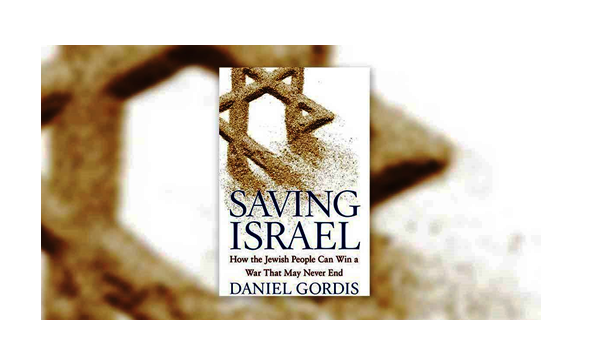
(Reviewer: Gary Selikow, Vol. 64, #3, Chanukah 2009)
In this pivotal contribution to the discussion about Israel’s fight for survival and about that country’s essential nature, Daniel Gordis takes the bull by the horns, grappling both with the seemingly insurmountable challenges facing Israel today as well as how Israel can win what seems to be an unwinnable struggle.
In essence, Gordis argues, Israel needs to rediscover its Jewish roots and values while reconnecting faith with nationhood.
The last decade has made it painfully clear that “Palestinian nationalism” has no interest in working towards statehood and a better life for the Palestinian people but is aimed solely at the destruction of Israel. This glaring reality destroys the illusion that territorial compromise can bring the conflict to an end. The issue is not achieving Palestinian statehood but the continuation of Israeli statehood.
Gordis points out that the so-called ‘Intifada’ of 2000-2005 was not at all a “popular uprising” that the international media had fooled the world into believing but rather a terror war launched and directed by terror chief Yasser Arafat and the PLO leadership in opposition to Israel’s very right to exist. (These realities can be further explored in such excellent works as Right to Exist by Yaakov Lozowick, Myths and Facts by Mitchell Geoffrey Bard, History upside Down by David Meir-Levi, The Rape of Palestine by Lionel Casper and Israel: Life in the Shadow of Terror by Rabbis Shraga Simmons and Nehemiah Coopersmith).
Every time Israel withdraws from land, this has the polar opposite result to the peace it is intended as bringing about. Israel’s Arab enemies see this as a sign of weakness and respond with further aggression. Thus, the comprehensive peace offer by Ehud Barak of Judea, Samaria, Gaza and East Jerusalem at Camp David in mid-2000 resulted in the 2000-2005 Palestinian terror war. Likewise, that year’s withdrawal from Southern Lebanon led not to peace but raids and continual missile fire into Israel. The 2005 withdrawal from Gaza, accompanied by the forced removal of Gaza’s 8 000 Jewish residents, led to the election of the extremist Hamas movement, the pounding of Israel by thousands of Kassam rockets and the killing or kidnapping of Israeli soldiers in cross-border raids. Israel was finally forced to retaliate, through the 2006 Israel-Hezbollah War and the 2008-2009 war against Hamas.
Israel has become the victim of venomous, and bottomless, hatred the world over, which has been compounded by its abandonment by many Diaspora Jews. A recent survey revealed that a full 50% of American Jews under the age of 35 said that they would not regard Israel’s destruction (and the accompanying annihilation of its Jewish population) as a personal tragedy.
Added to this must be the overwhelming support of American Jews for Barack Obama, whose attitude to the Jewish state verges on open hostility and who is exerting relentless pressure on Israel to act against her own interests. This goes hand in hand with a determination to ingratiate the USA with the Islamic world, including its most radical elements, such as Iran and Syria. This is already leading the world (including the Obama administration) to refuse to take action to prevent Iran’s acquisition of nuclear weapons, even in the face of Iran’s President Mahmoud Ahmadinejad’s stated intention to “wipe Israel off the map”.
The denial of Israel’s right to exist, not only by Islamic extremists, but also by a myriad of left-wing opinion makers such as Tony Judt and Noam Chomsky, puts the existence of Israel in very real danger. This is because delegitimization and demonization paves the way for physical annihilation, as the Holocaust testifies.
Gordis examines the injustice of the bizarre questioning of Israel’s right to exist:
Through the years of this gradual but relentless examining of Israel’s right to exist, it has never been lost on Israelis that the only country subjected to this question in respectable circles was Israel. North Korea, in violation of widespread international demands, attained and tested a nuclear weapon. There is strong evidence of widespread human rights violations in North Korea and it is well known that it starves its own population, but no one has suggested even for a minute that North Korea ought to be dismembered.
When Russia committed genocide against the Chechnyans, no one raised the issue of Russia’s right to exist. When Turkey denies the genocide against Armenians, no one asks whether Turkey should be dismantled. When China threatens to overrun Taiwan, or puts down the Tiananmen Square uprisings, the only questions raised are how to respond. Nor did the Chinese repression of Tibet, repeated again in 2008, arouse calls for China’s dismantling. The question of whether China, or Argentina under Peron, or Cuba under Castro, or Iran under Ahmadinejad, has a right to exist is never raised”.
Many Diaspora Jews (and even some Israelis) are comfortable with the idea of Jews as defenceless victims, rather than as a strong nation ready to fight back whenever the need may arise. Gordis puts forward the premise that for Israel to survive its people need to rebuild their will to survive. Secular Jews must rebuild some kind of connection to their faith and traditions, and religious Jews to the Nation of Israel as a whole.
Jewish and Zionist values must be imbibed and Jews need to realize that warfare in defence of survival of the Jewish people is not in contradiction to Jewish values but rather a necessity according to those very values, given that the alternative would mean national suicide and a second Holocaust.
Israel is the embodiment of the Jewish people’s survival, recovery, identity and future. Jews in Israel and the Diaspora need to embrace this and rediscover a sense of people-hood for Israel and world Jewry to survive. Israel cannot simply be the recreation of a mini-America, but must be governed according to Jewish norms and values. This could have been explored further by the author.
During the 1960s and 1970s, no child in Israel went hungry or without shoes. Binyamin Netanyahu’s dismantling of Israel’s welfare state, in an effort to imitate a US-style laissez faire economy, has widened the gap between rich and poor and created much poverty in Israeli society. What Israel needs is not a Thatcherite free market economy but a social market economy that combines the best of Jewish innovation and entrepreneurship combined with Torah precepts of social justice and kindness.
This book is vital reading for all concerned about Jewish survival, which can never be divorced from the survival of Israel.
How the Jewish People Can Win a War That May Never End by Daniel Gordis, Wiley, 2009, 272pp
Gary Selikow is a researcher and media activist. His reviews of books of Jewish and Middle East interest appear regularly online and elsewhere.