
(Reviewer: Beverley May, Vol. 71, No. 1, Pesach 2016)
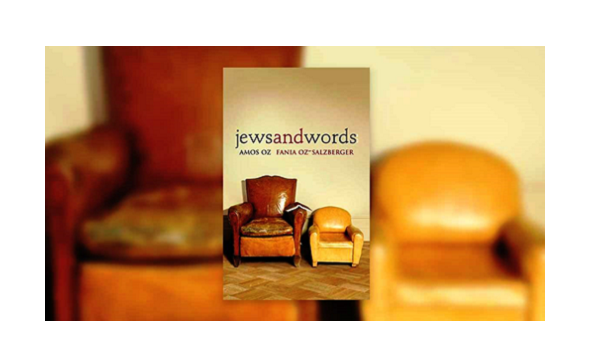
Jews and Words is described by the authors, Amos Oz and Fania Oz-Salzberger, as a “speculative, raw, and occasionally playful attempt to say something a bit new on a topic of immense pedigree.” They describe themselves as secular Jewish Israelis and “a father and a daughter. One is a writer and literary scholar, the other a historian. We have discussed and disputed topics relevant to this book ever since one of us was about three years old.”
Carefully crafted, this book will challenge and delight. Natasha Lehrer’s review (Jewish Chronicle – UK) described it as a “provocative, playful, speculative journey thought the rich, centuries-old heritage of Jewish literature. Father and daughter Amos Oz and Fania Oz-Salzberger propose a ‘textline’ rather than a bloodline – a notion of Jewish lineage that is etched not in blood but in words.”
Irreverent reverence is a theme that runs through the book: “Argumentativeness and humor breed that other Jewish trait, irreverence. Rather peculiarly for a people of staunch faith, and certainly untypical of other monotheistic religions, Jewish chutzpah targets prophet and rabbi, judge and king, gentile and coreligionist. Its earliest recorded target was the Almighty himself.”
A national survey of the South African Jewish community (Shirley Bruk, Milton Shain – Kaplan Centre, 2005) reported that 12% of all adult South African Jews were secular and that 23% believed that the Torah is an ancient book of history and moral precepts recorded by man. Empirical evidence suggests that this demographic falls, to some extent, outside of the organised South African Jewish community and perhaps even outside of our consciousness.
This book is a reminder that secular Judaism falls squarely within the Broad Tent.
Discussions on the topic include the following: “Secularism is not permissiveness, nor is it lawless chaos. It does not reject tradition, and it does not turn its back on culture, its impact and its successes” (quote from The Courage to Be Secular by Yizhar Smilansky, pseudonym – Sameach Yizhar).
This father and daughter team present their secular approach to the biblical texts as follows: “To secular Jews like ourselves, the Hebrew Bible is a magnificent human creation. Solely human. We love it and we question it. Our kind of Bible requires neither divine origin nor material proof, and our claim to it has nothing to do with our chromosomes. The Tanach, the Bible in its original Hebrew, is breath-taking. Its splendour as literature transcends both scientific dissection and devotional reading.”
They also describe their approach to the interpretation of ancient verses: “For us, the rules are something like this: Read in growing circles around your quotation rather than pluck it out of context. Cherish discovery and surprise more than your own agenda. Acknowledge the shortcomings of texts and authors you love, and the merits of those you dislike. Look hard to see the inner logic of a paragraph, a page and a chapter.”
Of Talmud the authors say, “Much of the Talmud is alien to us Israeli-born seculars. It holds vast inaccessible stretches, either because they are in Aramaic, or simply because they seem atavistic, legalistic, or nitpicky. But the Talmud steered a dramatic new road, shifting away from biblical intimacy with divine intervention. While Abraham argued with God and Moses reiterated God’s words, the Mishnaic and Talmudic rabbis are in the business of unravelling, elucidating, explaining and counter-explaining God and Abraham and Moses.”
The book also explores the Jewish model of collective memory shared from generation to generation. The authors quote Mordecai Kaplan: “No ancient civilization can offer a parallel comparable in in intensity with Judaism’s insistence upon teaching the young and inculcating in them the traditions and customs of their people.” They explain that there is one amazing characteristic of Jewish history – that every boy was expected to go to school from the age of three to thirteen and that this imperative was administered and often subsidized by the community. Through the ages, while other cultures left their boys in their mothers’ care until they were old enough to work, Jews started “acculturating their youngsters to the ancient narrative as soon as the tots could understand words, at two years old, and read them, often at the ripe age of three.”
In the chapter entitled ‘Time and Timelessness’, that explores Jewish dealings with time, the authors find a way to link a prophet and modern day Jew: “Consider two truly timeless Jews, the prophet Zechariah and Albert Einstein. Zechariah foresaw a day coming near, only God knows when, which shall be neither day nor night, both evening and noon, both summer and winter. Albert Einstein, for his part, changed our grasp of time by incorporating it as a factor in his special theory of relativity, and quipped: ‘The only reason for time is so that everything doesn’t happen at once.’”
A chapter entitled ‘Vocal Women’ includes a discussion on current affairs in Israel, with specific reference to the role of women in Jewish society. It contains the following: “We must revisit those strong female Israelites talking and singing their way up and down the Hebrew Bible, because they offer cutting-edge significance to twenty-first-century Israel and present day Jews. As this book is being written, a vociferous debate is ablaze in Israel over the ultra-Orthodox Jewish demand to silence women’s voices and erase or blur female images in the public sphere. The Bible is teeming with women ‘going on the streets.’ Sorry, Maimonides. And it has a great many women singing outdoors, to mixed audiences. Miriam sang, drummed, and possibly also danced in front of a whole people. Deborah sang her own lyrics from the very seat of government, performing a duet with her chief of staff.”
In addition to dealing with challenging topics such as our textline, time, secularism and feminism, Jews and Words also takes on the very notion of Jewish disputation:
The Jews chose God and took his law
Or made God up, then legislated.
What did come first we may not know
But eons passed, and they’re still at it:
Enlisting reasoning, not awe,
And leaving nothing un-debated.
To conclude, the style of writing is conversational, frank and entertaining, moving seamlessly from one idea to the next. The discussions have the feel of Shabbat dinner conversations sewn together into a rich tapestry of argument, debate and agreement. The book is also full of wry humour, punctuated with stories and parables, often masquerading as jokes.
As readers of Jewish Affairs, we ourselves are a reflection of the ‘textline’ discussed in Jews and Words – confirmation that we do, in fact, put great store in our heritage of words.
Jews and Words by Amos Oz and Fania Oz-Salzberger, Yale University Press, 2012
Beverley May is deputy-chairperson of the SA Jewish Board of Deputies (Western Cape). She has an MBA from the University of Cape Town, specializing in economics and finance, and has been running her own investment business in Cape Town since 2000


