
(Author: Lana Jacobson, Vol. 64, #1, Pesach 2009)
On 25 May 2009, the Spiegel/Stein-Lessing Wing for African Art in MuseumAfrica will be dedicated to honor two distinguished German Jewish pioneers of African art. After their marriage in the mid-1940s, Dr. Maria Stein-Lessing and Leopold Spiegel combined their skills to produce an important legacy in the field of African and South African art and artifacts. As a result of a bequest by Spiegel, an exhibition of art and artifacts which were collected by himself and Stein-Lessing, his first wife, will form the first exhibition in the area entitled l’Afrique. A book of the same title will be launched simultaneously in memory of Stein-Lessing.
Between 1933 and 1939, approximately 6000 German Jews came to South Africa to escape Nazi tyranny. Traveling by ship, the majority docked at Cape Town, and while some remained there, the majority moved on to different destinations, in particular to Johannesburg”.1 One of the new arrivals was Leopold Spiegel, who came to South Africa in 1935, at the age of 24. Maria Lessing arrived the following year. She had left Germany in 1933 for London, where she was awarded her Doctorate from the University of Bonn for the thesis she had been working on in Germany (1934). In South Africa, she made a name for herself as a lecturer at the University of the Witwatersrand.
The book l’Afrique was edited by Natalie Knight, who also contributed the introduction and the essay ‘Hidden Treasures’. It has several essays by Jewish writers – Esmé Berman, Dr. Paula Girshick, Prof. Andrew Spiegel, Phyllis Woolf and Nessa Leibhammer. The publication has proved to be a celebratory revival. Deep and enduring memories keep flooding in from many parts of the world from art luminaries whom Stein-Lessing shaped, including Esmé Berman, Cecil Skotnes, Judith Mason, Elizabeth Rankin, and Professor Eric Fernie.
Fernie, who went on to become Director of the famed Courtauld Art Institute, has vivid memories of his Wits lecturer: “It wasn’t the idiosyncrasies, the chain smoking, the dog tethered during lectures. What I remember is her intensity. I knew nothing about medieval cathedrals, but when Dr. SteinLessing had given us a lecture on them, it just seemed as if they were the most fascinating things in the world.”
Maria Lessing was born in Germany in 1905. Her personal life is a blank until 1933, when she moved to London and gained employment at its Courtauld Art Institute. On coming to South Africa, she was appointed Head of the Art Appreciation Centre at the Pretoria Technical College. She became fascinated by African art and artifacts, becoming a committed collector. She was assisted by the Jewish community and in particular by Richard and Frieda Feldman.
Scrupulously private, she married and divorced in a short space of time. At some point, her surname changed from Lessing to Stein-Lessing. Typically, there is no record of her first husband or of their time spent together. She then met fellow émigré and refugee Leopold Spiegel, who was in the army at the time (he would attain the rank of sergeant and receive two medals before his discharge in 1946).
The two were diverse in character. Leopold was a socially sophisticated European, with style and courtesy brought up by upright proper German parents. Maria was intellectually sophisticated. But there the similarities ended.
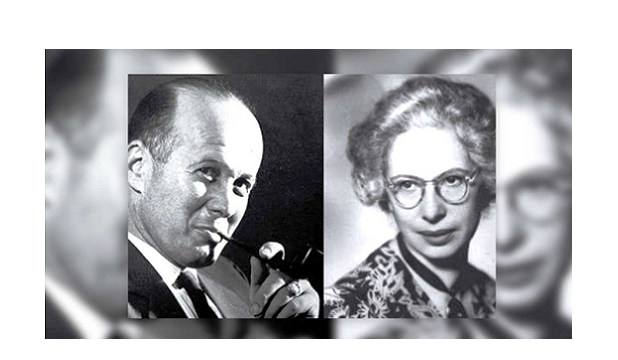
While Leopold was polite, she was forthright, sometimes even downright rude. He was lean; she sturdy. Social class was an integral part of his life, as was etiquette (like standing when a woman entered the room and not sitting until she did, or eating fruit or bread with a knife and fork). Propriety was an anathema to her. When she entered the lecture room, her impatient spaniel dog would skid ahead, dragging Maria’s inelegant body along by the leash. She would then bend in her sensible Dr. Clark look-alike shoes and tether him to the desk leg.[/vc_column_text][/vc_column][/vc_row] Leopold Spiegel, 1912-2006 Leopold was dapper. He rather fancied himself as a ‘ladies man’, sporting a pipe and army uniform, and had a taste for imported clothes and shoes, which he matched with a hat or cap from his varied collection. Maria, by contrast, was disheveled – she did not devote herself to being decorative, insisting on wearing outdated calf length suits over tightly buttoned blouses leaving no exposed flesh. The soft curtain of hair above her lip was yellow tinged at the cupid bow from smoking. It was her frizzy salt and pepper hair that drew most attention, springing from her scalp like a wild thorn bush. She wore owl-shaped glasses, except for special occasions, when she donned post- war era cats’ eye art deco fashionable spectacles and a hat. Unsurprisingly Spiegel’s first impression of his future wife was unfavorable. Of their first meeting, he recalled: “In the army, I didn’t have much social life, therefore I was very pleased when an acquaintance invited me to join his family for a Friday night meal. But, can you imagine my surprise when I was fetched by a woman driver? This was not etiquette in Germany”. They went to dinner, and Maria remained in the driver’s seat, literally and metaphorically, throughout their courtship and marriage. He was in total admiration of her. ‘M’ and ‘L’, as they fondly referred to one another (and became known as to both friends and enemies) married shortly afterwards and moved to an apartment in Yeoville. The couple had several important commonalities. Both were Jewish émigrés fleeing extermination in Germany. They were both lonely. Stein-Lessing particularly must have led an achingly solitary existence, as she never mentioned family; the only parental link one can find, after wading through mounds of research, is her father, who once lived at Our Parents Home. Leopold’s family managed to escape Germany. His parents and one brother joined him eventually in South Africa. His other brother Klaus lived and died in Palestine. Maria’s high qualifications as an art historian enhanced Leopold’s own not insubstantial interest in art. At this time, he struggled to find employment, but he made up for it later in life by investing wisely, and accumulating a fortune. Because L was unemployed M opened a small shop, l’Afrique, in central Johannesburg. Maria joined the staff of the Fine Art Department of the University of Witwatersrand in 1946. It is from then onwards that she garnered fame, and notoriety, for her Bohemian persona and mannerisms, her teaching and her collections. Esmé Berman was one of her first students at Wits. They liked each other immediately, and later Maria became Esmé’s mentor and friend. She recalls: Maria Stein-Lessing was something of a sorceress; puffs of smoke from an endless chain of cigarettes clouded the air of the lecturetheatre, and out of the fog Maria somehow conjured up a vital image of the past. She gave luminous life to the periods with which she dealt and endowed them with permanent meaning for her students. Ironically, back then most South Africans were completely unaware of indigenous art and its invaluable future role on the world stage. They were dismissive, labeling it mere ‘ethnography’, or “crude crafts.” However, M and L had both been exposed to European and African cultures, to Primitivism and Expressionism. They knew that African masks had inspired the great masters of the 20th Century art in Europe, including Picasso, Gauguin, and Matisse. In additional to masks and items from Central and Western Africa, L and M collected Zulu, Ndebele and Tsonga art items. They focused on something completely overlooked in South Africa. They found beauty in carvings and beadwork. Commented Egon Guenter, a fellow émigré and major African art collector: In my opinion Stein-Lessing and Spiegel, who was inspired by her, were important to South Africa because they were amongst the first people who tried to create an interest in indigenous art as early as the 1940s. The contribution of the German immigrants was that they recognized the value of African art at a time when others, especially South Africans, were completely unaware of it. Paintings and sculptures include work from artists who befriended them – Irma Stern, Elza Dziomba, Walter Battiss, Alex Preller, Cecil Skotnes, and many others. Dr. Maria Stein-Lessing, 1905-1961

In 1949, the couple relocated to London, where Stein-Lessing lectured in art at the University of Cambridge and curated an exhibition Art in South Africa at the Wakefield City Art Gallery, Yorkshire. Three years later, they returned to South Africa, where she organized festivals and exhibitions on South African Art and artefacts and resumed her post at Wits University.
M was always ardent about teaching, but by the late fifties, she grew disillusioned. As the months passed, she grew more irritable. What appeared as deep personal strength and an air of invincibility was in reality despair.
The illustrious artist Judith Mason remembers M vividly:
She was already in her mid fifties, but she looked like a different generation to other women her age. She had the life of Jewish refugee written across her face, and one got a good idea of what her life must have been. She was very highlystrung and extremely intense, which was demanding. We were just young and blind to the value of African art, which Europeans had the eye to see. They formed part of the intellectual hub of society. We were intellectually slovenly with our limited South African education; we were grumpy ill-bred little sods. We were so busy being ‘cool’ we were frozen in a coma.
One day, Stein-Lessing pounced on a blank faced Judith in class. She had been talking about ‘the Venerable Bede’: “Vel, who da hell VAS BEDE? Go back to your schools, get your money back!”
Continues Mason: “I never saw her buoyant. She was very angry a lot and she looked worn. I always had a sense that she was happy at home, though she looked like L’s mother. She was six years his elder, but she looked much, much, older. His behavior was quite juvenile in a way. She was positively the boss”.
South African politics compounded M’s mounting despair. Wits University has always been a highly politicized environment. The Nationalist regime had come into power, and apartheid was entrenched. South Africa had been excommunicated from the British Commonwealth. She feared neo-Nazism taking hold of the country. Artist Cecile Sash recalls her saying, “The Nazis are going to get me.”2
Additionally, M was Acting Head of Department of Art in 1961. The responsibility was overwhelming, and her attitude towards her colleagues was decidedly underwhelming, which didn’t inspire them to offer assistance. She turned helplessly to her long-time pupil and friend Esmé Berman, asking for assistance in creating tutoring models.
Esmé, who was heavily pregnant at the time, had watched helplessly as her mentor navigated into helpless depression and she recalls warning M, “If you don’t watch it you will get a knife in your back.”
The turning point was when very close friends of hers, fellow German émigrés, left South Africa for the United Kingdom. M felt betrayed by life itself.
Aware of her declining mental condition Prof Douglas MacCrone, Professor of Psychology and Deputy Chancellor of Wits at the time, visited her one afternoon in 1961 and tried to comfort her. L was not home at the time, and M confessed that she wanted to die. But he calmed her and firmly believed when he left her a few hours later that she would not do anything rash. That evening she gassed herself.
Maria Stein-Lessing’s death came as a huge shock to everybody. To L, whose family had already been so disrupted by the Holocaust and war years, this was the cruelest blow of all.
Berman presented a eulogy and a memorial at Wits honoring Maria Stein-Lessing in March 1965. For his part, L faithfully preserved her memory, and continued collecting artefacts, with works of artists and friends such as Walter Battiss; Cecil Skotnes, Gordon Vorster, Maggie Laubser and Irma Stern adorning his walls. The collectables grew and when he remarried several years later, his bride Minna persuaded him to sell 600 pieces to the Museum of Man and Science, which then passed on the items to MuseumAfrica (then the Africana Museum). Seven years later, Minna died from a stroke and L was alone yet again. Later, he married Hilda ‘Ginger’ Woolf, and in doing so was thrust into a fully-fledged family with two daughters, one living at home, the other married with three small children. They were happily married for thirty years.
Ginger’s death left L bereft and mourning deeply for a very long time. In the process, he became increasingly isolated and less able to interact socially with other people.
Nonetheless, he retained, the gentleman style and courtesy instilled in him by his upright parents. He died in 2006 aged, 94, at Randjeslaagte Estate, a retirement complex in Johannesburg. Through his generous bequest, the names of Spiegel/Stein-Lessing will be a permanent feature in the African art world.
Lana Jacobson is a freelance journalist and author who contributes regularly to a wide range of South African newspapers and magazines, as well as international publications.
NOTES
- Hellig, Dr. Jocelyn, Seeking Refuge German JewishImmigrants to Johannesburg in the 1930s, SA Jewish Boardof Deputies, 2005, p30
- Bernard Sachs interviewed Maria a month before her death, later observing: “The nightmare of Nazi Germany is alwaysthere in the background. Every once in a while, as I spoke to her, it kept suppurating upwards from the wound of memory. And I noticed that the present condition of South Africa wasn’t so soothing to this wound”, SA Jewish Times, 4/8/1965


