
(Reviewer: Naomi Musiker, Vol. 69, No. 2, Rosh Hashanah 2014)
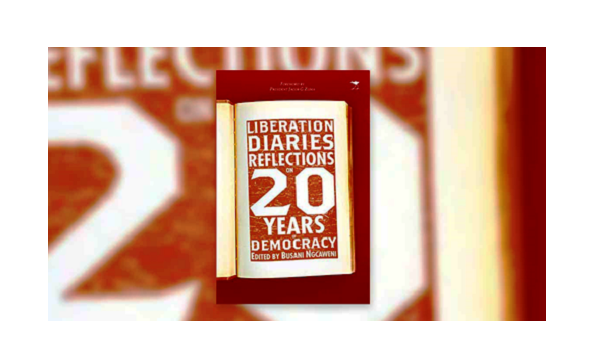
Liberation Diaries: Reflections on 20 Years of Democracy is a collection of essays by fifty diverse South Africans ‘from all walks of life’ who reflect on South Africa’s process of democratization and transformation since the demise of the apartheid system. According to the editor, Busani Ngcaweni, the idea for the book was first conceived in 2013, the centenary of the 1913 Natives Land Act, a legislative measure which ‘balkanised South Africa, eventually turning the black majority into subjects with no land rights and the white minority into citizens who owned the majority of the land and the wealth beneath it’ . The compilation of this volume coincided with the death of Nelson Mandela, first President of a democratic South Africa. It was therefore decided to extend the scope of the book to an overview investigation of the twenty years of democracy since 1994 as a tribute to Mandela’s humanity and leadership.
The main aspects covered and analyzed are the progress in achieving non-racialism and national unity, the advances in non-sexism and women’s rights and the establishment of a true democracy so that South Africa, so deeply divided over centuries was able to embark on a policy of national reconciliation and development without retribution. The contributors are mainly members of the government and civil service, civil rights activists, researchers and academics.
The original editorial plan was to arrange the essays by theme. This idea was abandoned in favor of alphabetical arrangement by surname of author. The editor admits that a division by theme, though attractive, was problematical because there would have been a ‘disproportionate allocation of essays under certain themes, while others would have featured no more than two or three essays’. Alphabetical arrangement presents certain difficulties for the reader as there is no connecting narrative, cohesion or link between the various essays. Often, essays dealing with important aspects such as education and health are scattered throughout the book, separated by vast passages of text dealing with other subjects. This is disappointing for those anxious to have a comprehensive picture of what has been achieved in various fields during the twenty years of democracy since 1994. This is compounded by the lack of an index and comprehensive bibliography. There is considerable variation in referencing systems although the brief was to use end notes, not formal academic reference systems.
Despite the intentions of the editor, there is a certain bias of choice in the selection of contributory themes. Aspects of development such as agriculture, health policy, education, employment and business development could have been expanded to provide a more overall survey. For example, there is an emphasis on tertiary and university education at the expense of primary and secondary education. (Mpho Tshivase: ‘In Education, Money still matters’. Sipho Ngcwangu: ‘Higher education and training 20 years into democracy’). It would have been useful to know what is being done to remedy the problems of primary school education from the point of view of the educator.
In view of the fact that the Land Acts were the springboard of apartheid legislation, the reviewer feels there should have been more contributory essays on the subject of agriculture. The subject is discussed at length by Professor Herbert Vilakazi (‘Breaking the post socio-economic impasse’), who considers that “the underdevelopment of African rural communities – and their off-springs in urban areas – is now the heavy drag that is pulling down the entire South African economy”. He goes on to propose that an Agricultural Revolution is needed in South African rural areas, maintaining that the error in present day governmental policies is to encourage the production of successful individual commercial farmers in order to create a black middle class at the expense of the small subsistence farmer. Vilikazi laments the continued existence of communal land under the sovereignty of traditional leaders where the rural poor are forced into self-subsistence agriculture with no help of bettering their condition. Quoting examples of the Agricultural Revolutions which occurred in England, France, Russia and China he advocates a similar process for South Africa. He is particularly impressed with the Chinese rural model of the post 1978 era initiated by the Deng reforms, which resulted in the production of food for over a billion people and the creation of subsidiary non-agricultural economic activities in rural areas.
It would have been interesting to have other points of view on the subject. For example, are there any instances of black commercial farmers who have brought benefits to their impoverished districts?
Sweeping reforms in rural areas potentially impact on deeply engrained traditional customs. Lawrence Matemba describes one such experience as a trainee Catholic priest confronting community protest at Thembalihle Township in Vrede, Free State, where he witnessed the clash between African tradition and Christianity over the question of the chief’s right to have more than one wife. Another aspect, discussed by Nkululeko Nxesi, is traditional initiation in democratic South Africa. This custom was abused by the apartheid government as a “training ground for cheap labor”. In the post-apartheid era it is controlled largely by “young people who do not have the much needed experience and knowledge”. Various corrupt procedures have had disastrous consequences for many initiates. The support of traditional leaders is needed to uproot these malpractices.
As in the rural areas, the rising black urban middle class comes in for a great deal of criticism by several writers (Evan Mantzaris: ‘The black middle class: Food for thought on goodness and greed’; Zuki Mqobomba: “Excuse me Miss, I’m Khanyi Mbau: The post-apartheid cultural schizophrenia”). The views expressed are closely linked to criticism of government failings and nepotism. Perhaps a more balanced view would have been to provide representatives of the black middle class with an opportunity to counter the accusations of materialism, indifference, subservience and self- enrichment leveled against them. There are examples of entrepreneurs who have benefited the lives of the poor and provided employment and training to many unemployed workers.
Many of the contributions regarding democratic progress in South Africa are based on the personal experiences of writers. Of interest are the views of the young, post-apartheid generation including students and second-generation exiles returning to South Africa. Despite the benefits of education and overseas experience, not all are fully satisfied with what has been achieved in the new South Africa. Many have struggled to obtain financial support during their tertiary education period and cannot find satisfactory employment thereafter. Others consider that the dream of a democratic South Africa has not been fulfilled (Zosa de Sas Kropiwnicki-Gruber: ‘Reconciling myths and realities: The return of second-generation exiles to post-apartheid South Africa’; Amanda Dlamini: ‘I write for the invisible ones’; Mzukisi Qobo: ‘Memory, race and denial: the unfinished journey towards restorative justice’). Sakhiwe Kokela (‘To be young and hopeful in a democratic society’) describes the use of illicit drugs such as woonga among the younger generation which has a disastrous effect on victims with resultant crime and violence. This problem has escalated to an alarming effect since 1994.
The greatest sense of achievement and purpose occurs with those few who have reached their goals after great struggle, such as the women who have achieved success in the diplomatic service (Nomfanelo Kota, ‘Twenty years for women cadres in diplomacy’), or have participated in the National Development Plan (Josephilda Nhlapo-Hlope, ‘To me, freedom means hope and opportunities’).
There are quite a number of essays dealing with the experiences of women in the new South Africa. These vary from a sense of frustration (Matshepo Seedat. ‘My miniskirt, my freedom), to an optimistic view of the future for women in the workplace and in the professions (Khanyisile Kweyama, ‘Coming full circle: my diary of liberation in corporate society’). Kweyama was the first black female to hold the position of Executive Director of Anglo American South Africa.
An interesting view is expressed by Dr Edith Phaswana, in her essay on transformation in South African universities. She regrets the increasingly reported incidents of sexual harassment at universities and the fact that twenty years into democracy the participation of black and women academic staff has not increased much, particularly at senior management level. This is particularly disturbing when women occupy senior positions and unconsciously or consciously perpetuate the system of male domination.
Cheryl Uys-Allie, film maker, maintains that liberation is based on economic freedom and that the power of women acting collectively and mobilizing actively should be Africa’s agent of change. In South Africa, while there has been a significant accommodation made for women in leadership positions, both in business and government, the statistics of rape, domestic violence and abuse are unacceptably high (‘Changing narratives of race in the new South Africa’.)
Nomonde Xundu, who now serves as South African Health Attaché in Washington, provides a fascinating account of her role in Public Health in the early years of the AIDS epidemic from 1996 to 2011. She pays tribute to Dr Manto Tshabalala-Msimang for the help and encouragement she received during this period. Jean Elphick, national manager of Afrika Tikkun’s empowerment programme for children with disabilities, has given an inspiring description of the work achieved at Madwaleni District Hospital in the former Transkei and at Orange Farm north of Sebokeng.
Some writers express concern about the prevalence of ethnic divisions in South African society (Jeffrey Mathete Sehuma, ‘The unrelenting specter of ethnicity in South Africa’; Dan Tlhabane Motaung, ‘Nationalism in post-apartheid South Africa: Observations’). Raymond Parsons seeks to remedy this situation through cooperation by means of social-economic dialogue. To this end he is a great proponent of NEDLAC, which was set up in 1995 and the resultant National Development Plan (Social Dialogue in South Africa).
The views of the English and Afrikaans minorities of South Africa are not prominent in this volume. There are few examples of individuals overcoming the racial divide and co-operating harmoniously to produce the kind of society so passionately advocated by the inspired leadership of Nelson Mandela. David Saks has provided an excellent overview of the post- 1994 contribution of the Jewish community to South Africa’s transition from white minority rule to multiracial democracy, mainly from the point of view of the SA Jewish Board of Deputies. It’s a pity that more is not included about the role of Jewish activists, many of whom were members of the Communist Party of South Africa, who made great sacrifices to further the cause of democracy. It would have been gratifying to mention the role of Rusty Bernstein and Alan and Beata Lipman, who were among those responsible for the compilation of the Freedom Charter, while distinguished jurists like Justice Arthur Chaskalson and Albie Sachs ensured the establishment of the Constitutional Court.
A rather sour note is introduced by Chengiah Ragaven (‘Meditations of the geopolitics of South Africa’s freedom’). A former SRC activist of the University of Natal-Non European Section, he departed for London in the 1960s where he carried out ANC propaganda and received various degrees from Oxford, Cambridge Sussex and Durban-Westville, becoming vice-rector at the Durban University of Technology after the unbanning of Mandela. During his student years, he was influenced by speakers such as Kadar Essack who berated the National Union of South African Students (NUSAS) as a liberal, albeit non-racist movement representing the elite of the South African white English and Jewish society, whose parents and grandparents were the ‘owners of the means of production’. Ragaven expresses deep disappointment in the condition of South Africa after CODESA. He blames various foreign agencies for the failure of CODESA, including the World Bank, Wall Street, the IMF, Washington, Brussels, the CIA and Mossad.
Ragaven has great admiration for Muammar Gaddafi, whom he lauds as a great African nationalist. He supports the view that the CIA, Mossad and Britain trained the Sanussi as Jihadists to cause the revolution which overthrew him in order to control the wealth of Africa.
Ragaven’s views are thankfully in the minority. The book is largely free of such diatribes and the various writers attempt on the whole to be more balanced and objective in their opinions. The pervading mood of disappointment and criticism may be due to the fact that the book was written too soon after the establishment of the democratic dispensation. Twenty years is a short time in the history of a nation. If, for example, the history of Johannesburg had been commemorated twenty years after 1886, it would have been a story of a nation still devastated by the Anglo-Boer War and by the onset of economic depression. Fifty years later, Johannesburg was commemorated as the ‘City of Gold’, in a handsome volume, lavishly illustrated. However, today many would maintain that this wealth was unevenly distributed.
Liberation Diaries: Reflections on 20 years of Democracy; edited by Busani Ngcaweni. Johannesburg: Jacana Media, 2014.
Naomi Musiker, a veteran contributor to Jewish Affairs and long-serving member of its Editorial Board, has contributed numerous biographical articles for the Dictionary of SA Biography and the Standard Encyclopaedia of Southern Africa and, as an indexer, has worked for some of South Africa’s leading publishers and indexed many important reference works. She has held the position of archivist at the SA Jewish Board of Deputies since 1992.


