
(Author: Barbara Rigden, Vol. 70, No. 2, Rosh Hashanah 2015)

A brief introduction is necessary to understand the complex events that preceded the 1948 Israeli War of Independence and formation of an independent state of Israel, born out of self-sacrifice, perseverance, ingenuity, blood and loss of precious lives.1
Six weeks before the expiry of the British Mandate, the Zionist leadership, in desperation, sent the frail, unwell Chaim Weizmann as their representative to New York to try to meet with President Harry Truman. Because of a previous meeting between Truman and a Zionist delegation led by Rabbi Abba Hillel Silver, who made disrespectful gestures and demands on Truman regarding taking action on Palestine, the President, although sympathetic to the plight of the Jewish refugees and victims of the Holocaust, had resolved never again to have an audience with any of the Zionists and washed his hands of Palestine. This incident with Rabbi Silver more than anything sank all hope for the establishment of a Jewish state!
In view of a close friendship of more than forty years between Eddie Jacobson and Truman, B’nai B’rith chairman Frank Goldman urgently approached Jacobson to appeal to Truman to grant an off-the-record emergency meeting to discuss the fate of Palestine and the Jewish people. Jacobson did so and the meeting took place. Thus was a very delicate situation, with the fate of the Jewish state in the balance, miraculously rescued by a Diaspora Jewish friendship with the American President – Jewish geography in operation!
Soon after the unfortunate Rabbi Silver meeting, the Irgun bombed Jerusalem’s King David Hotel, killing 92 people including 26 British soldiers. This was the last straw for the British, who announced their intention to terminate their mandate and hand Palestine over to the newly-formed United Nations to deal with. After deliberating for seven months, the UN proposed a solution to partition Palestine into two equal regions, one Jewish and one Arab. The Jews accepted gratefully while the Arabs totally rejected the proposal. This led to an escalation of violence between the Jewish and Arab populations. For the partition proposal to succeed there would have to be a vote by the UN General Assembly, consisting of 56 members, which would take place on 29 November, 1947. A two-thirds majority was required to adopt the resolution.
Eddie and Harry’s eleventh hour ‘friendship meeting’ of 28 November resulted in Truman reviewing the situation regarding how close the Zionist camp was to achieving the necessary majority vote. It could be achieved by persuading five or six rather insignificant non-aligned countries with their own specific agendas, namely Liberia, Greece, Haiti and the Philippines, as well as France. As a direct result of this meeting, Truman instructed his Secretary of State General George Marshall to put pressure on the above five countries. The next day – 29 November, 1947 – the UN General Assembly voted in favour of partition by 33 votes to 13, with ten abstentions.
Resolution 181 was successfully carried!Resolution 181 called for the partitioning of Palestine into two states, one Jewish and the other Arab. The Jewish state was to comprise of disconnected sections of land, militarily indefensible and economically unviable. Jerusalem would be an international city. The Zionists worldwide were nevertheless overwhelmed with joy, and in Palestine, David Ben Gurion accepted the proposal without reservation. The resolution was not accepted by the Arabs, who threatened to wage war against the fledgling Jewish state if it was implemented. On Friday, 14 May 1948, the independence of the State of Israel was declared by David Ben Gurion. United States recognition of Israel followed immediately.
The following day, with the encouragement of the Grand Mufti of Jerusalem, Mohammed Amin Al-Husseini (an ally of Hitler), Israel was attacked by six Arab armies, confident that they had overwhelming numbers of fighters and armaments with which to drive the Jewish people ‘into the sea’ in a war of extermination. The UN, together with other Western powers, had an arms embargo on the Middle East, while Egypt and Jordan had been militarily well equipped, and to a certain extent trained, by Britain.
Four compelling reasons motivated volunteers from around the world to answer Israel›s call in her time of greatest need:
- The legacy of the Holocaust
- Britain›s shameful deportation of refugees back to the death camps of Europe and to Cyprus, Mauritius and elsewhere.
- The Arab threat to totally annihilate the Jewish population of Palestine.
- Jewish communal unity at times of major crisis.
In 1947, the word ‘on the grape vine’ sent out a message for Jewish ex-service men and women to volunteer for service for the largely non-existent Israeli air and armed forces. 3000 volunteers came from around the world, of which 810 were from South Africa. 150 were qualified and experienced aviators, many having recently served in World War II. They answered the call, not only to fight for Israel, but to obtain funding, armaments and in particular aircraft by whatever means necessary. South Africans comprised the largest contingent of machalniks (as the volunteers were called) per capita of population! One such machalnik was Jack Weinronk of Port Elizabeth, who ran the pilot training camp at Rome’s Urbe Airport. Another was Lt-Col Cecil Margo, a highly decorated SA Air Force veteran of World War II, who played a crucial planning, advisory and organisational role in the establishment of the fledgling Israeli Air Force (IAF).
Non-Jews from around the world also played an important role, either as volunteers or as mercenaries – they provided 30% of the machalnik pilots in the IAF at the time. They included ‘Butch ben Yok’ (née Milton ‘Butch’ Bottger)2 of Johannesburg, who enlisted as a volunteer with two of his Jewish friends, Phil Kemp and Dennis Gochen. He had been friends with them for years in Doornfontein, where he went to school and even attended cheder(Hebrew school) with them. When Butch heard that his Jewish pals were queueing up at the Zionist Federation offices for applications to join, there was no stopping him. With his experience in the SA Air Force during World War II (as a radio operator and air gunner serving in the North African and Italian campaigns), Butch had the perfect credentials. Although a Christian, he was close to his Jewish childhood friends and totally dedicated to the cause and plight of the Jewish people. He was welcomed at the Zionist Federation with open arms by Phil Zuckerman, at that time the recruiting officer.
Machalniks included close to 200 medical doctors and nurses and 95% of the new IAF pilots. Of 425 flying crews, non-Jews comprised 21.6 % of the total. Machalniks established the foundation of what was to become the Israeli air force, army and the navy (whose first commander was an American machalnik, Paul Shulman). During the war, English was used as the lingua franca of the IAF. David (Mickey) Marcus of the US was in charge of the ‘Burma Road Project’ to relieve the siege of Jerusalem, which was cut off from supplies of armaments, food and water , and was a mere thread away from falling into enemy hands4
Ben Dunkelman, a highly decorated officer in the Canadian army during World War II, led the 7th Brigade which captured and liberated the Upper Galilee, an operation known as ‘Operation Hiram’.
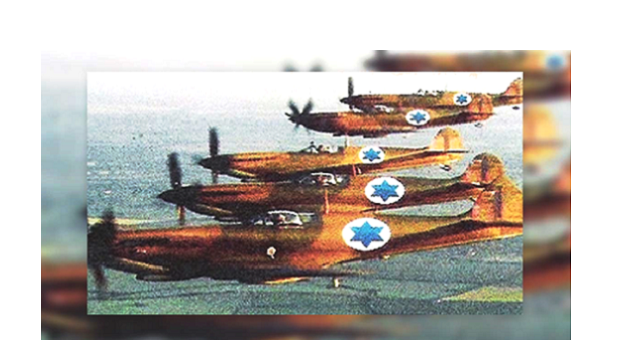
In an amazing mission, Al Schwimmer and Swifty Schindler, two American machalniks, managed to smuggle into Israel four B-17 Flying Fortress bombers, ten C-46 and C-47 commando transport aircraft and three constellation aircraft out of the US. Together with the Spitfire aircrafts retrieved and purchased from Czechoslovakia, these played a crucial role and were instrumental in helping to win the war. They were the foundation of the IAF.

Members of the famed Squadron 101, 1948

Insignia badge of 101 Squadron
Outstanding among the machalnik pilots was South African-born Jack Cohen. He had been a fighter pilot in World War II after initially being conscripted into the infantry. He was one of the early members of Squadron 101, which was a jewel in the crown of the IAF. When initially approaching Israel for a planned landing at Haifa, their flight was warned that the town was bristling with UN officials. Hence, they changed course and headed for Herzlia, which happened to be the airbase of Squadron 101.
On landing, Jack got the most wonderful surprise. The first two boys to greet him were Sydney Cohen and Arnold Ruch, who had been with Squadron 101 for some two months.
Sydney and Jack had flown together in 4 Squadron SAAF, and Arnold was on the same base in 40 Squadron – a photo reconnaissance set-up. The next person Jack was to meet was Ezer Weizmann (a future President of Israel). A feeling of being at home and one of the family, with a great spirit of camaraderie and unity, permeated throughout the unit!
The IAF had, among others, a few Dakotas, a Bonanza, Tiger Moths, a few Piper Cubs and various hybrid reconstructed planes, such as hybrid Spitfires and Messerschmitts. The Dakotas were used either for carrying passengers or freight, or were converted into night bombers when necessary. Bombs were sometimes even thrown overboard manually at targets, after being carried on the lap of the bombardier (4 x 25 lbs each). The fighters suitable for combat were Messerschmitt 109s (Czechoslovakian versions) or Spitfires. Up to this time, the Egyptians and Syrians had had it all their own way, with complete superiority of the skies, in particular bombing Tel Aviv mercilessly and with impunity.
Israel had negotiated a deal with the Czechoslovakian authorities for the purchase of fifty Spitfires, which the British had given them at the end of World War II. Jack, together with Sam Pomerance, was assigned to bring them back to Israel from Zatec, a short ride from the village and approximately 50 kms from Prague, as soon as possible in a mission termed ‘Operation Velvetta’. Pomerance was an American pilot as well as an aeronautical engineer, and was highly qualified to do this job. The two became close friends, in addition to Sam making an excellent partner for Jack!

Jack Cohen
The Spitfire’s flying range was approximately one and a half hours, yet they had to be adapted so as to stay aloft for at least six hours in order to reach Israel. Hence, they had to be stripped of all non-essential components, even guns, cannons, oxygen bottles, radios, armour plating, so as to lighten their weight as much as possible, and provide whatever additional space possible for extra fuel tanks (internally and also in cigar-shaped tanks attached beneath the wings, and belly of the planes). All personnel at the airfield, including the Czech ground-staff, assisted in these conversions, under the able guidance of Pomerance. After the ground crew completed the servicing and getting the aircraft ready for testing, Jack took over and test flew each machine as they came out of service. Meticulous care was taken to ensure that each aircraft was working perfectly. Also part of the team was a highly skilled American mechanic by the name of Bob Dawn, who hailed from Little Rock, Arkansas. And he was worth his weight in gold! Not only was he very good company, but he was also an outstanding technician. Everyone concerned with the operation, including the manager of the airfield, engineer Novak and the Czech ground staff, went all-out to assist in the operation.
The pilots responsible for flying the six Spitfires to Israel were Jack Cohen, Sydney Cohen, Sam Pomerance, Modi Alon (a charismatic Israeli who was trained in the RAF and commanded squadron 101), Boris Senior and Tuxie Blau. The Spitfires would be led by the ‘mother ship’ Velvetta, and would be guided by following closely behind in formation. This strategy was used for both Velvetta 1 and 2.
Operation Velvetta 1 was not without incident, with two planes being rescued from Rhodes island after emergency landings, and one abandoned after crash-landing. However, in spite of this the mission was an absolute epic achievement in aviation history, and the remaining three spitfires landed at Telnof airbase with just about a few drops of fuel in their tanks.
Operation Velvetta 2 followed. Two groups of six Spitfires left Zatec in extremely bad weather – it was snowing quite heavily. Having no oxygen with them, the pilots had to watch their altitudes very carefully. However, tragedy struck when Sam Pomerance crashed the plane he was piloting into a mountain and was killed. It appears that in a severe storm that got steadily worse, he lost sight of the other planes, including the ‘Mother ship’, in dense cloud flying over Yugoslavia. He apparently inadvertently gained altitude, probably trying to fly above the storm, and blacked out because of lack of oxygen, resulting in the fatal crash. The tragedy was confirmed by the Yugoslav authorities.
In Operation Velvetta 3, the remaining planes were dismantled, put into crates, and shipped to Israel, where they would be re-assembled. Jack Cohen was involved in all three operations, which was to be the South African air drama of the Israeli War of Independence!
On 3 June Squadron 101 CO Modi Alon, flying a Messerschmitt, shot down two Egyptian DC 3s which had been bombing Tel Aviv. Five days later, Israel launched its first bombing raid over Damascus, Syria, using a borrowed South African civilian DC 3. A further bombing raid was conducted, by Jack Cohen and Sydney Cohen and the American Rudy Augarten, on the Egyptian’s most forward air base of El Arish, from which constant attacks on Israel were being launched. The pilots initially flew out to sea. Turning inland at low level, they then bombed the runways, rendering them unusable, strafed planes on the tarmac and, flying almost at ground level, fired into the hangers. The base was demolished, probably never to be used again, after the ground forces moved in to finish the job.

Rudy Augarten
Between 22 December 1948 and 7 January 1949, the climactic battle against the Egyptian forces in the Negev and Sinai was fought. Noteworthy were aerial dog-fights between Israeli Spitfires, and Egyptian aircraft in the southern Negev, and subsequently by the IAF against Spitfires manned by British pilots over the Sinai (a case of former comrades-in-arms in World War II fighting one another). Three out of four of the British Spitfires were shot down. This victory over the RAF provided a most dramatic and spectacular conclusion to the war. On 8 January, a cease-fire was brokered by the UN Security Council.
Machal veteran Harold ‘Smoky’ Simon believes it fair to say that machalniks played a pivotal role in Israel’s victory over its Arab enemies. At the 60th anniversary of independence in 2008, he made the following observation: “Considering that 1 300 000 to 1 500 000 Jews worldwide served in the Allied forces during World War II, had just another 15 000 to 20 000 WWII veterans volunteered to help Israel, there would probably not be a West Bank or East Jerusalem problem today. Unfortunately, History is unforgiving, and so today the State of Israel is faced with these intractable and irreversible problems!”
Prime Minister David Ben Gurion honoured the South Africans first in his tribute to the IAF volunteers:
Pioneers of the air force in the earliest period were sons of the land of Israel, and the part played by Israeli pilots in the operations, victories, and battles of the air force is not small. But we would not have reached and maintained an air force that, in a short period, became one of the decisive forces in the War of Independence without volunteers from abroad, professionally trained and experienced in the armies of the Allies during the Second World War – never has the unity of Israel been revealed in so tangible and clear a manner, and there has never been, it seems to me, a body of Jews which has so embodied so fully an ingathering of exiles as the defence force of Israel – but in no fighting force did the volunteers from abroad fulfil so important, responsible and blessed a role as in the air force of Israel, since this force demanded more expertise, professionalism and experience than any other branch in our armed forces and from the midst of the Jews of South Africa, England, America, Canada, and other countries, were forthcoming the experts and men of experience who volunteered their lives to the war of independence in our land.
Victory very rarely comes without a high price in human lives. In the 1948 war, 121 machalniks were killed – the flower of our youth whose lives were tragically truncated before they could properly be live.3 Among those killed were eight South Africans, who are remembered on the memorial wall at the Sha’ar Hagai Forest near the “Burma Road”. The writer of this article was given the honour of laying a wreath in their memory at the 60thanniversary ceremony. May their memories be for a blessing, and may their families be comforted in their loss and grief. They were swifter than eagles and stronger than lions –
They gave up their lives and their futures so that Israel and the Jewish people should survive!
May Israel prosper and find Eternal PEACE.
Acknowledgements:
In writing this article, important sources used included South Africa’s 800 (Henry Katzew, SA Zionist Federation, 2003), ‘Harry and Ed’- Notes in preparation of a play (based on true facts ) by Victor Gordon, Smokey Simon’s speech of 7 May 2008 and ‘My Story’ by Jack Cohen (http://101squadron.com/101real/people/jcohen.html). My thanks, also, to Wilfred (Wilf) and Eddie for help with typing and computer preparations.
Barbara Rigden, by profession an Estate Agent, has researched, written and spoken on a wide range of historical subjects, Jewish and general. Her academic studies have been in the Arts field, and in this regard she has for many years been an Art promoter.
NOTES
- Of Israel’s Jewish population of approximately 650 000 in 1948, over 6500 (1%) were to lose their lives in this War of Independence!
- After Ben Gurion called for the ‘Hebraisation’ of volunteers’ names, Butch Bottger proudly adopted the name ‘Butch Ben Yok’ (‘Yok’ being South African Jewish slang meaning ‘Christian’ or ‘Gentile!’).
- Nine non- Jewish fliers lost their lives, and are buried in the Christian military cemetery in Haifa. May their souls find eternal peace and blessing for the supreme sacrifice they made!


