
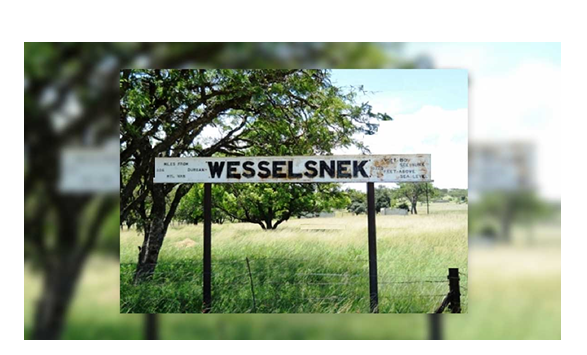
(Author: Bernard Duchen, Vol. 65, No. 3, Chanukah 2010)
I was born in Johannesburg, in December 1941, but grew up in Wesselsnek, a little coal mining village in the district of Kliprivier, in the Dundee/Newcastle/Ladysmith triangle of Northern Natal. From around 1840, this had become a rich coal mining area. My grandfather Naftoli Dukhen (subsequently Anglicised to Duchen) arrived in Natal from Lithuania in about 1868, a young lad less than twenty years old. He returned to his native village of Yolokai some five years later, where he married and in time ensured that his sons came to South Africa. My father’s older brothers, Willie and Abie, arrived sometime between the two Boer wars. Harry, my father,arrived in 1904, aged fifteen.
This branch of the Duchen family began a process of ‘colonization’of Northern Natal. Others followed, from both Lithuania and Latvia, so that by the mid-1930s the family collective owned many mine concession stores, some hotels, a milling company and a number of farms throughout the area, from Elandslaagte to Vryheid. The Duchens and their close relatives were to be found at Glencoe, Wesselsnek, Elandslaagte, Dannhauser, Ballengeich, Hlobane, Wasbank and Vryheid. In later years, some moved to Gravelotte in the old Transvaal, to Witbank and, of course to Johannesburg.
Initially living and working at Ballangeich near Newcastle in the mid 1930s, my father took over the concession rights and farms at Wesselsnek, as well as the store at Elandslaagte. His brother Abie had married and moved elsewhere while Willie had suffered a stroke and was bedridden. Willie remained at, and died, while living at Wesselsnek. Under my father’s guidance, Harry Duchen Wesselsnek grew to become an impressive business complex.
Wesselsnek was the site of a profitable coal mine belonging to the Natal Steam Coal Company. About thirty white families lived in the village. Generally, they were engineers and technicians on the mine, but some also worked for Harry Duchen Wesselsnek while others ran their own little small holdings, either around the area or at Waschbank, which was only about three miles over the hill, as the crow flies. There were also about forty Indian families.
Wesselsnek station lay on the main Johannesburg-Durban railway line, about four miles on, on the Helpmekaar road. Our two farms were located about two miles beyond the station, on either side of the line as it wended its way through to Elandslaagte and Ladysmith and then on through the Natal Midlands to Durban. This area had been the scene of many battles between the Zulu people and occasional British and Boer armies and we would often find assegai heads and .303 rifle shells lying in the veld.
I have only good memories of my childhood, despite some freak accidents which left me partially blind in my left eye at the age of four and the near loss of my fingers in a mangle a year later. By age five I could drive the steam engine. At seven, I had learnt to drive a tractor and strip down its engine and transmission – of course needing some considerable help in loosening or tightening the bolts and lifting off the really heavy bits. But I knew where the parts went and generally what they did. No wonder, then,that I grew up to be an Engineer.
Early Schooldays
As a child, I was known amongst the locals as “Umfaan umHlope” – the White Umfaan. I spoke Fanagalo and most times ran around in a Zulu ‘muchi’, except, of course, when my mother deemed it necessary for me to be more civilized and presentable!
In January 1947, it wastime for me to start school and my mother had to find somewhere where I could be civilized, taught European manners and learn to speak adequate English. My sister Natalie – 17 months my senior – was then attending Elandslaagte school as a day scholar, but my mother chose instead to send us both to Ladysmith Convent. We became weekly boarders, together with the two Karpul girls (whose father, Joe, had by then taken over the Elandslaagte business from Harry Duchen), making up the four Jewish children at the Convent. Every Friday afternoon, our parents would take us home for the weekend, returning us to school on Sunday afternoon.
Ladysmith Convent accommodated 37 boys, from Grade One through to Matric. About eighteen of us were boarders. We shared a single dormitory, with beds on each side. At the bottom, there was a curtained cubicle where Sister Mary slept. My bed was next to her cubicle and every night she would take me in for an hour or so to teach me English and basic European deportment (like not eating putu with my fingers). Of course, my disappearing into her cubicle every night always led to a lot of guffaws and ribald comments from the older boys, but in my innocence, these just passed me by. So effective was her tuition, however, that at the end of my first year I won the Grade 1 prize for English.
I loved the Conventandwas incredibly happy there. However,two incidents occurred that had a fundamental effect on me and eventually led to my mother having to remove and send me elsewhere.
The first incident occurred about halfway through that first year,when Sister Rose-Anne began handing out pencils to the class, preparatory to our learning to write. Being a natural ‘lefty’, I picked up mine with my left hand, and idly began chewing on it to wile away time while she completed her task. Returning to her desk, Sister Rose-Anne turned around -and all hell broke loose!
Some may know that the Latin for right is dexter and for left sinister, so imagine the horror facing poor Sister Rose-Anne when she saw this little Jewish boy holding his pencil in his sinister hand. She hurtled back down the aisle, screaming “the Devil, the Devil, the Devil” over and over again and smashed my left hand away. The pencil was drawn across my palate (the dull end, fortunately) and left a painful bruise in my mouth that hurt for days. To add insult to this injury, she absolutely forbade me to use my left hand, to the extent even of tying it to my side with a ribbon until I was writing right-handed. To this day, despite having reverted back to my left hand, my handwriting is an illegible disaster.
It goes without saying that the older boys were quick to capitalize on the situation.“Because you’re left handed, you have to go to church next Sunday so that Jesus can exorcise the devil”they said, adding “because you are Jewish, you will have to take an extra helping of holy water”.
And so it was. That coming Sunday evening, I entered the church for the first time. The holy water was held in a bowl nestling in the cupped hands of a full size statue of Jesus that hung on the wall in the vestibule. While everyone else dipped a finger in the bowl and crossed themselves, I dropped my whole hand in and literally washed myself across my chest, to nods of approval and much sniggering from the other boys.
This notwithstanding, I was so enthralled by the music and the awesome environment of the church that it became an important feature of my life. Now, every Sunday, my parents had to return me to the convent early enough for me to bath and be in church in time for the service to begin. The ritual of the holy water became ingrained in me and continued well into Grade two, but disaster struck again and led, calamitously, to incident number two.
One Sunday evening, about March 1948, we had a puncture while returning to Ladysmith. By the time my father had changed the wheel, we were late and as we drove up the hill towards the Convent, I could hear the church bells ringing. The car had barely stopped at the Convent when I rushed to the church and into the vestibule. I plunged my fist into the bowl of holy water, but my fist stuck in the bowl, much like the monkey who reaches into a bottle and will not release its grip. I panicked and wrenched my hand upwards. The whole statue came crashing down and broke into pieces.
The choir stopped singing and a congregation of devout Catholics turned around to see the little heathen smashing their relics.
To say that this incident was dramatic is an understatement. I never entered the church again and was promised such terrible heavenly retribution by the other boys that I began to suffer nightmares. A month later, my parents had to remove me from the Convent.
My mother moved quickly. A week after my leaving, we went for an interview with the headmaster at Michaelhouse, an Anglican school and one of the Natal Midland’s great country institutions. In my mind’s eye, I recall the Michaelhouse scene as if it was happening now:
Headmaster is seated behind a huge oak desk, with an application form in front of him. In his right hand he holds a genuine quill pen and as he proceeds down the application form, every now and again he dips the quill into an elegant glass inkwell.
At last he comes to the critical question. “Religion?” he asks as he raises the quill once more from the inkwell. My mother suspects nothing. After all, where could the problem be? Did not young John Schlesinger go to Michaelhouse?
“Jewish” she replies, whereupon headmaster, with a mighty force, launches the quill like a javelin into the application form. It sticks into the oak desk and he rips the paper out from under it, crumples it up and throws it into his waste basket. “Please leave, Madam” he barks, “we do not take Hebrews here”.
Perhaps, this is the point where my mother is supposed to hint at the possible building of a new wing for the school, as the Schlesingers apparently did, or something equally persuasive. But she understands that Harry Duchen, although comfortable, is not quite a Schlesinger. So she simply stands tall (she is nearly six feet in height), vomits across his oak desk and as it spills onto his carpet, she strides out head high, with me in tow.
By May of that year I found myself a boarder at Herber House in South Street, Berea, and attending school at King David, Linksfield. In time, my sister was transferred to Maris Stella Convent in Durban, where she finished her schooling.
Commercial Travelers
In those days,there were many Jewish traveling salesmen who used to visit country stores, usually on a two or three week circuit. They would travel by road as representatives of the big wholesalers and generally would stay overnight at the country hotels in the small towns. For many Wesselsnek, although lacking a hotel, was a prime weekend destination. Not only did we have the butcher shop, which was restocked daily with beef and lamb slaughtered on our own farm, but we also had a dairy herd that yielded copious volumes of milk, from which my mother made cream cheese and blintzes. At Wesselsnek,they stayed free of charge. Here,my mother was renowned for her hospitality and her kneidlach. H Duchen Wesselsnek was famous for the huge meaty dinners and breakfasts. My father also owned the largest pig farm in Natal and as a member of the Eskort Bacon Cooperative, his 3000-pig holding ensured that there was always a plentiful supply of Eskort products for breakfast (H Duchen Wesselsnek was not a kosher establishment).
Travelers would start arriving on Friday afternoon. It was not unusual for there to be eight or more of them for the weekend. It never rained at night and even in winter it was warm, so they slept under a long covered verandah which ran the full North and West perimeters of the house. Because Friday was a busy day, it was 8.00 pm by the time the day’s cashing up had been completed. Friday evening was therefore a late but extremely sociable affair. Dinner would start at 8.15pm and would include listening to the Frank Brathwaite Racing Report for the coming weekend. Discussion centered onthe expected winners (Cocky Feldman and Tiger Wright being the favorite jockeys), which horses were ‘puddlers’or which had “no legs” and had to be avoided.
At 9.00pm, the poker games began. My parents possessed a magnificent poker table, which held pride of place in the lounge, a room that I recall seemed to have had no other purpose. A second poker school was set up in the dining room. Once started, the games never stopped. Players left or joined on a continuing basis, taking breaks for tea in the huge kitchen with its grand AGA stove, or ablutions, or just plain leg stretching. On Saturday morning, my cousin Edward, Uncle Abie and my father had to get back to work but the poker continued. At 1.00 pm they were back again after close of business.
The games continued well into Sunday finally coming to an end on Sunday afternoon, when the travelers had to leave to be ready for their next call on Monday morning. Occasionally, some diehards would stay on until the early hours of Monday morning, when they would finally stagger on to their next stop.
So invasive was the poker game that I think that I took my first steps at the table and my first spoken words were “chip – double”.
The Influence of Herber House
Although we were an Orthodox Jewish family, we were not religious. My father and Edward had eschewed religion after the war, having lost much of their family in Lithuania during the Holocaust (we learnt in 1952 that some had in fact escaped and were living in Tel Aviv and Rechovot – their name was anglicized to ‘Duchan’).
One of the results of my time at Herber House and King David was that I forced some religion back into the life at Wesselsnek. At Herber House, I attended daily Shachrit, Mincha and Maariv services and, of course, Shabbat was always an occasion. By the end of 1948, I was versed in the Shabbat ritual so, on returning to Wesselsnek for the year-end holidays, I put appropriate pressure on my parents to become more observant.
My mother tried her best to achieve and maintain a reasonable standard of Jewish life and in all fairness to my father, Edward and Abie, they responded well. Friday nights were changed so that we would now have an early, simple family Shabbat dinner in the kitchen, with candles, wine and Kiddush. Sometimes a traveler or two would also join us. Although I never had my way with daily prayers, at least we now had Shabbat and we also began to celebrate Pesach and Rosh Hashanah.
To ensure that there was sufficient meat for sale in the butchery, we would generally slaughter two cattle each Monday to Thursday and three on Friday. Sheep were slaughtered twice weekly. The slaughtering was managed by a huge-muscled mountain of a man named Magamphela, who was quite capable of wrestling the occasional recalcitrant ox to the floor. When I began to insist that our animals be killed by a shochet, Edward rose quickly to the challenge. One afternoon, he took us all to the farm,where he dressed Magamphela in a yarmulke and a shawl (to serve as a tallit) and, reading from his siddur, he performed a little ritual, taught Magamphela a simple Hebrew prayer and, instructing him to always say the prayer before dispatching the animal, proclaimed him Rabbi Magamphela
Of course, I cannot say whether the full ritual was performed when I was not at Wesselsnek, but it clearly satisfied me at the time.


