
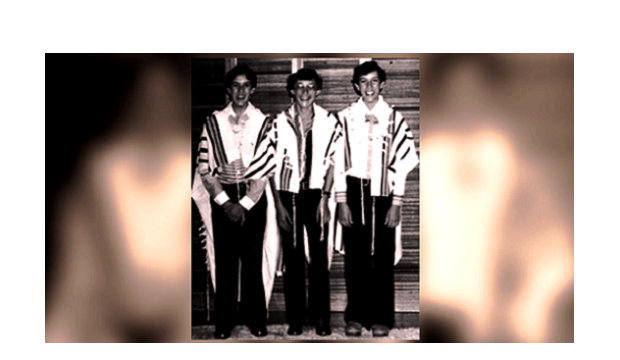
Author: Lionel Slier, Vol 74, #1, Pesach 2019)
“A five year-old boy is ripe for the Bible, a ten year-old boy for the Mishnah, a thirteen year-old for the fulfilment of the Commandments”. So it is written in the Ethics of the Fathers (Pirkei Avot), 5:24.
From here, we see that at the age of thirteen a Jewish boy assumes full responsibility for the observance of all the precepts and commandments of his religion. He is now “bar mitzvah”, literally, “son of the commandment” (from the Aramaic word bar = son) and has all the responsibilities that go with this. This status is usually formalised in a shul ceremony wherein the boy’s father gives up the burden of his son’s religious duties. This takes place most often on the Shabbat after the boy’s thirteenth birthday. The bar mitzvah boy is called to the bima to read the final aliyah (maftir) and also a passage from the Prophets (Haftarah).
The word ‘Barmitzvah can be used as a noun’. The boy himself is referred to as “the barmitzvah”, and so too is the actual ceremony. As an adjective he becomes “the barmitzvah boy” and the word can, somewhat ponderously, even be used as a verb (e.g. “he was barmitzvahed”).
In ancient Hebrew sources (Soferim 18:5) there is reference to the custom in Jerusalem of parents taking their thirteen year-old boy to the elders of the city to be blessed. Scholars have pointed to evidence that the age of thirteen is a turning point in a boy’s life. At that age, Abraham rejected his father’s idols. In Genesis 25:37, Jacob parted from his brother Esau and undertook the study of the Torah. In Genesis 34:25, Levi, the son of Jacob, is called ‘ish’ (a man). In Isaiah 43:21 we read, “This people have I formed for myself; they shall pronounce my praise”, which has been interpreted as Isaiah having reached the age of thirteen.
Yet there was no particular ceremony for a boy who had turned thirteen (actually, thirteen plus one day). It merely meant that the boy now had full responsibility for his own religious behaviour. He could now pray as an adult, don tefillin and be counted in a minyan. This acceptance crystallised in the post-biblical period and was clearly established by the Second Century C.E. Strangely, then, the practice remained unchanged for over a thousand years. There is very little comment about it in Jewish writings of the period.
There is some uncertainty about when barmitzvahs began to be celebrated with a formal ceremony – or even where or why this happened. It seems that either in Italy and/or in France Jews in the 14th Century began to emulate the Christian confirmation ceremony, which then became an established practice, widespread throughout the Diaspora (although, strangely enough, not in Yemen). Birthday boys were given the honorific aliyah, the maftir.
Aliyot were not given to girls because they were not considered to be knowledgeable enough or sufficiently versed in Hebrew learning to be able to recite from the Torah on the bima. According to Jewish tradition and belief, a girl’s duties lay in the home with the family. Furthermore, establishing and keeping a Jewish home and a Jewish way of life was as important as learning the Torah. This perpetuated Judaism.
A Johannesburg rabbi once told me that regardless of whether a Jewish boy has a formal ceremony or not, he is still regarded as barmitzvah; he has reached religious maturity as a Jew. There are circumstances when a boy cannot have a ceremony in shul. He may have been ill. A family situation may have made it impossible. There could be other pressing reasons.
Asked what the attitude of the rabbinate would be to a boy who declined to have a ‘proper’ barmitzvah, the rabbi was very tolerant: “That is his choice. He is still considered barmitzvah. He is still an adult Jew, and is not outside the community. But it is his loss.” Another rabbi has written, “It is a common mistake to imagine that in the absence of a barmitzvah ceremony the boy is not fully Jewish. The plain fact is that every male Jew becomes automatically responsible”.
One must recall the havoc that World War II wreaked amongst Jewish boys turning thirteen. All over Europe, formal barmitzvah ceremonies simply could not take place. Young boys who survived the war were certainly not lesser Jews!
Prior to the establishment of the Jewish day schools, many South African boys aged eleven years and up had to undergo (to them the torment) of having to learn their barmitzvah portions by heart. Only a very few could read Hebrew. After learning by rote, coupled with intensive coaching in cheder for anything up to two years, they generally managed to get by. Since the coming of the day schools, most Jewish boys of barmitzvah age from those schools can read Hebrew without too much difficulty.
In more Orthodox ceremonies, it is usual for the boy to deliver a discourse (drasha) on his parsha, showing that he has understood it. For the less religious or secular, the barmitzvah boy is expected to make a speech at the luncheon or dinner. For many a youngster, this has been the most frightening part of the whole affair.
In 1922, the Reconstructionist movement in the USA introduced batmitzvah ceremonies for girls. The rabbis had always reckoned girls to be more spiritually mature at an earlier age than boys, and therefore they could celebrate their batmitzvahs at the age of twelve. In Progressive and Conservative/Masorti congregations, girls perform exactly the same as the boys do. Gender differences are not recognised. The Orthodox introduced batmitzvah ceremonies for girls at a later date. They have multi-batmitzvahs wherein a whole class of girls celebrate in shul simultaneously. As long as the form of celebration is not in violation of halachah, there are no objections to this.
In his book To be a Jew: A Guide to Jewish Observance in Contemporary Life (1991), Rabbi Hayim Donin has written, pertinently, “The nature and extent of the festivities which accompany the barmitzvah are a matter of local custom, and a ref lection of the personal taste and/or the means of the family…….Where the festivities are held in such a way as to violate not only the spirit of Judaism but also its specific precepts and values, the celebration only tends to secularize the event, cheapening the religious significance ……As the years go by, a serious and intelligent young man will rightly look back upon such a celebration as a religious mockery. It also behooves parents to resist the temptations to turn a Bar-Mitzvah into a gala, ostentatious birthday party for a thirteen year-old.”
Rabbi Donin was writing about American barmitzvahs. Could he just as well also have been referring to South African ones? Here, the boy’s speech at the party will begin with the usual thanks to the rabbi and Hebrew teacher, going on to reading messages of congratulations from the various aunts, uncles and cousins in Israel, Toronto, Sydney, San Diego, Atlanta, London and points north, east and west. Our divided families and diminishing community give a particular South African twist to the proceedings.
Finally, some tips for the post-barmitzvah speech:
What to include:
• Thanks to the rabbi for his patience and indulgence.
• Thanks to the Hebrew teacher.
• Thanks to parents (a little joke may be included).
• Thanks to bubbes and zeides (Consider yourself lucky if any of them are there).
• Thanks to all relatives and friends who have come.
• A special mention of anyone who has come from outside South Africa.
Never say:
• You will not see me inside a shul again.
• Now I can go and play football and cricket with my friends.
• I won’t have my mother nagging me about Hebrew lessons anymore.
• My mother won’t have to schlep me to Hebrew classes anymore.
• I can’t wait to get home to open the presents.
• Unaccustomed as I am to public speaking….
• I suppose that now I will get three copies of Jewish Pathways.
• Thank goodness all this is over.
• Despite what my mother thinks – to-day I am a man!
Lionel Slieris a veteran contributor to South African Jewish publications, including Jewish Affairs and the South African Jewish Report.

Irma Stern, Arab R12 000 000 – 16 000 000
Thinking of buying or selling your art?
For a confi dential valuation please contact us.
JOHANNESBURG | 27 (0) 11 728 8246 | jhb@straussart.co.za
CAPE TOWN | 27 (0) 21 683 6560 | ct@straussart.co.za
www.straussart.co.za
Strauss & Co: The global leader in the South African art market


