
(Author: Leon Levy, Vol. 70, No. 2, Rosh Hashanah 2015)

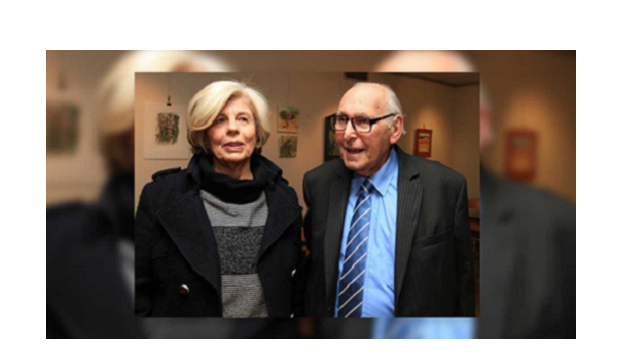
Leon Levy at the SAJBD’s 60th anniversary of the Freedom Charter event, held at the Rabbi Cyril Harris Community Centre on 23 June 2015. With him is Joy Coplan, a long-serving ANC City Councillor who was also present at the original Congress of the People in Kliptown.
Thank you for inviting me to share with you the 60th anniversary of the creation and adoption of the Freedom Charter on 26 June 1955, as well as my memories of the two-year campaign for the “Call to a Congress of the People” which led to the great gathering at Kliptown.
I gladly agreed to speak this evening because I was much involved in the Congress of the People campaign and personally witnessed the acceptance of the Freedom Charter. At the time, I was President of the South African Congress of Trade Unions and an activist in the liberation movement. The Freedom Charter was at the center of the subsequent four year-long Treason Trial and [as one of the accused in the trial] I can bear witness to the incredible legal effort to brand it as subversive. It was not – and in its own right, it endures as a democratic beacon which proudly belongs to all of us.
Sixty years is a very long time, and one would expect an historic occasion like this to have gathered many myths, which future historians would have to sift for fact and fantasy.
This is not necessarily so in this case. For, unlike any event of this nature, the Freedom Charter and especially the campaign leading up to it, has been the subject of intense recording and political and legal scrutiny both before it was adopted and for many years afterwards.
I shall explain this a little later in this thumbnail sketch of the occasion, but first, I want to try and transport you to the event at Kliptown.
Sunday, 26 June, was a bright and clear winter’s day. Early in the morning delegates from every province in the country began to arrive, at first in small numbers and then in large groups. Those who came from outside Johannesburg were accommodated the night before by Congress volunteers in the townships or elsewhere. The site – a fairly large strip of veld – was well-prepared with what seemed endless rows of benches and a well-constructed raised platform in front.
The size of the assembled crowd rose to between 2000 and 3000 delegates. Many busloads of delegates from all over the country were stopped by police and prevented from attending.
Nevertheless, there was much for those present to discuss about the future type of society for South Africans. There was the draft of a ‘Freedom Charter’, which was crafted from thousands of demands written on scraps of paper at hundreds of meetings held in factories and farms, townships, rural areas, universities and wherever people lived or worked.
They talked in many different languages and in their own way – about the right to vote and stand for election, equality for all national groups, sharing the wealth of the country and the land for those who work it, equality before the law, human rights, work, and education, housing, peace and friendship and so on.
There were scores of detectives who came to take notes of what was being said, but we were used to this and carried on without allowing ourselves to be distracted. I remember clearly the final acceptance of the Freedom Charter. I was standing on the platform with other speakers and suddenly saw what seemed like hundreds of police, mounted on horses, swooping into the meeting area and surrounding it so as to cut off any opportunity for exit.
The chairperson asked the people to stay calm and remain seated while a police major told the meeting that it was believed that a treasonable act had been committed and no one was to leave before all the names of the delegates, officials and volunteers were taken. We had been expecting some police action to prevent the Congress of the People from adopting the Charter and were wary of possible violence and bloodshed and, of course, mass arrests. But this was a hazard we had to accept, while relying on the discipline of those present. The people remained calm and dignified, singing freedom songs and also composing their own. The name and address of each person present was taken before all were allowed to leave – but not before the police confiscated whatever poster or private letter they could lay their hands on.
The next seventeen months saw police raids on the homes and work-places of hundreds of the people who voted for the Charter, as well as those of officials and activists of the liberation organisations. Thousands more documents, books and posters were confiscated – all for the purpose of proving that there was indeed a treasonable conspiracy.
On 5 December 1956, police swooped on 156 Congress leaders and activists – black and white – who had led the Campaign for the Congress of the People and arrested them on charges of conspiracy to commit high treason. This was a capital offence punishable by the death sentence. The prosecution was determined to link all the accused in a conspiracy to overthrow the state by force and violence and replace it with a Communist state.
The trial lasted for over four years. Twenty thousand documents and speeches made at hundreds of meetings by the accused were put before the Court and examined for mention of any suggestion of violence to overthrow the state. Every word and paragraph of the Freedom Charter was examined and argued. The state presented experts on Communist philosophy. The accused were acquitted and the full story of the Freedom Charter, its meaning and aims and objects as well as the role of the people who made it, is available on record.1
Leon Levy is a veteran anti-apartheid activist and trade unionist. As President of the SA Congress of Trade Unions, he was much involved in planning the Congress of the People, held in Kliptown, Soweto, on 26 June 1955, and was one of the five original signatories to the Freedom Charter, adopted at that gathering. This article is adapted from the address he gave at a commemorative function to mark the 60th anniversary of the Freedom Charter, held under the auspices of the SA Jewish Board of Deputies on 23 June 2015.
NOTES
- Soon after Nelson Mandela was released from prison, he was presented with bound copies of the record by the Treason Trial’s presiding Judge Frans Rumpff.


