
(Author: Zmira Cohen, Vol. 69, No. 3, Chanukah 2014)
There is a Ladino saying that goes: Cuando gan‘eden esta‘acerrada, guehinam esta‘ siempre abierto – ‘While the Garden of Eden may be closed, Hell is always open’. It well describes the situation of the Jews of Rhodos – the Greek word for Rhodes Island – in the summer of 1944.
Fast forward seventy years. My husband, Eliakim, and I, are walking in the footsteps of Eliakim’s paternal grandparents, who did not return after that fateful day of 23 July, 1944.
The day is very hot, as it was then. The blue/green/turquoise sea washes mini wavelets onto the shore. It is just a few seconds of gentle ascent from the water’s edge to the beach road that surrounds the island. The sea sand is speckled with elliptical stones of all sizes and shades. They are called sheshos or sheshicos (Ladino uses a diminutive whenever it can.) The bigger stones were used to ‘pave’ the roads, the smaller ones to decorate inner courtyards and floors in the mosaic patterns that are so ubiquitous on Rhodes. On a clear day, the coastline of Turkey is visible.
How could it have been that the Jewish citizens of this island – men, women, children, young, old, ailing or healthy – could have been forced from their homes, made to gather at a place designated by the Nazis and stripped of all their rights to life?
I shall try to sketch a general outline of the history of this community and describe some aspects of our visit on the seventieth anniversary of the Deportation. Rhodes has a complex history, having been conquered in turn by many different powers. The earliest allusion to a Jewish presence there is in the 1st Book of Maccabees. In the 12th Century, the famous Spanish Jewish traveller Benjamin of Tudela visited the island and reported that it was home to some 400 Jews. In 1309 the Knights of St. John, after their expulsion from Jerusalem, were successful in their bid to conquer the island. Rhodes had been part of the Byzantine Empire, and its Jews spoke Judeo-Greek. They followed the Romaniot minhagim i.e. the customs of the Jews in the eastern parts of the Roman Empire.
n 1522, the Knights were in turn defeated by the Turks under Suleiman the Magnificent. Thirty years earlier, the Jews had been expelled from Spain. Sultan Bayezid II welcomed into his domain many of these literate, ambitious and industrious refugees, and regarded the Spanish King Ferdinand as foolish for having “impoverished his own country and enriched mine!” With the Turkish conquest of Rhodes, the islands of the Dodecanese as well as mainland Turkey became home to significant numbers of Sephardic Jews, and Judeo-Spanish (Ladino) gradually superseded Greek as the local lingua franca of the community. Romaniot customs faded. From the style of prayer and food choices to the melodies and romanzas that were sung in the cortijos (courtyards) of Jewish homes, virtually all modes of daily life began to resemble Sephardic patterns.
The next major shift in the life of the Rhodislim was the influence of the Italians, who took over the island after a bloodless coup on the Shabbat of 4 May, 1912. At first the Italian presence was benign, even friendly. When Benito Mussolini first came to power ten years later, this was viewed positively by a significant sector of Italian Jewry. Mussolini publically condemned racism, had met Chaim Weizmann (in 1926) and seemed to be open to the Zionist dream. Mario Lago, appointed by Mussolini as governor of Rhodos, followed a far-sighted policy that respected the ethnic and cultural identity of the colony’s inhabitants. His term was remembered for its co-operative nature and produced a sense of well-being in the Juderia (Jewish Quarter). A rapid process of Italianization occurred, and is the reason why so many descendants of Rhodisli families still hold Italian citizenship.
Largely due to Lago’s influence on Mussolini, a Rabbinical College was established, opening its doors on 1 January, 1928. When Meir Dizengoff, mayor of Tel Aviv, visited Rhodes three years later, he congratulated Lago on his part in establishing and sustaining the yeshiva.
By 1936, however, the tide had taken a turn for the worse for the Jewish population. That year Cesare Maria De Vecchi, Count di Val Cismon and Commander General of the Fascist Blackshirts, was appointed as the colonial administrator of the Italian Aegean Islands. Mussolini began to develop closer ties with Germany and some Arab lands, at the same time accusing ‘International Jewry ‘of being enemies of Fascism. Cismon began to introduce harsh anti-Jewish laws.
On Erev Yom Kippur 1938, an article appeared in the local paper in which Cismon attacked the residents of the Juderia, saying that they should all be sent al inferno (to hell). In November, Jews were forbidden to close their shops on Shabbat and Yamim Tovim.
Shechita was prohibited. Italian citizenship was withdrawn from those who had come to Rhodes after 1919 and consequently those people became stateless overnight.
In 1939, Fascist Italy and Nazi Germany signed a Pact of Friendship and Alliance. However, when Admiral Campioni took over as Governor in 1941, conditions improved for a while. Campioni, to his credit, removed some of the anti-Jewish regulations. Then, in July 1943, Mussolini fell from power. The Italian army surrendered in September and, after bitter fighting, Germany wrested control of the island on the 15th of that month.
Until 14 July 1944, the ‘only’ added measures against Jews were that they were forbidden to own radios and to send or receive letters or parcels from anyone not living within the war zone. During this time, Britain had been bombing the island. This resulted in the deaths of a number of Jews in February and in April, on the second day of Pesach. The residents of the Old City were compelled to seek refuge in the surrounding villages outside the town walls. There were dire food shortages.
Deportation and Death: July-August 1944
n the first week of July 1944, the Gestapo arrived. This was the beginning of the end for the Jews of the Juderia, of the jewel of the Mediterranean, on the Isle of Roses. The Jews had no country to call their own, no protector, no capabilities for defence, no protective magic garment to act as a shield. They were easy prey to any malevolent force that wished to destroy their tranquil presence and wipe them off the face of the earth, simply because they were Jews.
From archival evidence and personal testimonies, we know that the Nazi administration demanded that all Jewish males over sixteen report to the Naval Institute by the 18thJuly with their identity documents and work permits. This seemed to imply that they were to be deployed for some type of labour, but on arrival, all documents were confiscated and the men herded into the building basement. Next came the order for the women and children to present themselves with their valuables at the same venue the following day. They were warned that failure to do so would result in their closest male relatives being executed. On the arrival of the women, their valuables were immediately confiscated.
Some of the German soldiers on Rhodes showed reservations about the tasks they were expected to perform. They were threatened with dire consequences should their orders not be complied with, but nevertheless, a few tried to help. One even offered to take the child of one of the deportees to Europe, to ‘safety.’ The offer was rejected by the tearful parents.
The prisoners were held with no food other than that which they had brought with them, very little water, inadequate toilet facilities and no bedding until 23 July – the date of their deportation. It is not difficult to imagine the hopelessness and fear that must have engulfed them. To prevent curious or even sympathetic islanders from observing their pitiful march to the harbour that day, a siren was set off so that the villagers, believing that an air raid was imminent, would remain indoors.
The journey, by cattle boat to Piraeus via Kos and Leros, took eight more days of hell, during which about 95 other Jews were hurled on board. Several died on that journey. Only one incident of humanity is recalled – the provision by the captain of a nearby ship of some water and bread for the prisoners, who had been given no other supplies. Arriving in Athens, they were kept in the Haidari concentration camp till about 2 August, when they were loaded onto cattle trucks. Destination: Auschwitz /Birkenau.
On 16 August 1944, the prisoners arrived. All those deemed ’useless’ were immediately gassed, my husband’s grandparents among them. In all, 1673 Jews were deported. 151 survived.
Selahattin Ülkümen – Righteous Gentile
One of those active in processing the deportation and annihilation of the Jewish population of Greece and the Aegean islands was Kurt Waldheim. After the war ended, strangely enough, these brutal deeds seem to have been forgotten. He came to hold the position of Secretary General of the United Nations and was elected President of Austria.
On the other hand Selahattin Ülkümen, the Turkish consul on Rhodos at the time, proved to be a man of great courage and compassion. By his own efforts, he saved some fifty people (the exact number is not certain; two of the group were known to the writer) through acquiring Turkish passports for them in many ingenious ways. As Turkey was neutral, a Turkish passport enabled one to travel freely. What was his reward? The Nazis deliberately bombed his house, killing his wife who had just given birth to a son. The boy, Mehmet, survived, and went on to work for the United Nations. About twenty years ago, the Sephardic community brought him to Cape Town, where he was honoured for the person he had become and for the great human being who had been his father. Selahattin Ülkümen has been recognised by Yad Vashem as one of the Righteous among the Nations.
July 2014 – Remembrance and Renewal
Fast forward to July, 2014, when over 400 Jews from South Africa, Israel, the United States, the United Kingdom, Europe and a sprinkling of other places have come to Rhodes to participate in a Memorial Week marking the 70th anniversary of the Deportation.
We were on Rhodos for five days and each day became a journey of optimism for me. A full programme of activities had been planned, with the University of the Aegean hosting a three-day symposium with academic presentations from Yad Vashem, mainland Greece and the universities of London, Newcastle, Limerick, Hartford USA, Milan, Calabria, Florence and Naples. Lectures and documentaries covered various historical aspects of the Holocaust in the Dodecanese, as well as proposed pedagogic models for teaching this history in schools in light of the resurgence of fascist movements in the region. It also probed methods for assessing the value of verbal and written archival data for accuracy and referred to the existence of material available but not yet studied, which could throw light on many gaps in existing knowledge on the period.
Parallel to the symposium were other events. On the morning of 23 July – seventy years ago to the day when the Deportation commenced – two large busloads of attendees were taken to a ceremony where a plaque was unveiled on the exterior walls of the entrance of the old Aviation Institute. This had been known as the warehouses of Chemelnik (its Turkish name). It was where the community had been forced to assemble and been held before being forced to march down to the beach in the early hours of the morning, through ‘la puerta de la mar ‘ (the gate to the sea ) to the three filthy boats that were to take them to Athens.
After the ceremony, the buses drove to the new Jewish cemetery where, in a beautifully tended area in a large plot of land, white graves were set above ground in rows on one side of along avenue of steps. Some survivors participated in a moving programme where different speakers shared information about the events in the months leading up to the arrival of the Gestapo, and told us that not all the names of victims of the Allied bombing raids could be identified. Due to the turmoil of those days, some of the graves have remained unmarked.
The community had been so brutally weakened and terrorized during these tragic times, that long before the final order to quit their homes and assemble at the old Aviation Institute had been issued, fear coupled with despair had filled their hearts. Their physical and mental strength to rebel against their captors had been relentlessly diminished by each successive draconian measure imposed upon them.
The atmosphere at this ceremony was electric. It seemed to contain both infinite grief and tremendous pride – pride in the resurgence of a new generation of descendants of Jews, whose legacy and heritage lay here, on this little island. Their memory had not been obliterated. These were Jews of all ages, lifestyles and nationalities, who spoke English, French, Greek and Hebrew, who held different opinions about almost everything, yet they had come together to pay homage and declare who they were and where their allegiance lay. It seemed to me to meld all of us there, at that moment, into a strong segment of Jewish Oneness.
The candle lighting, the El Male Rachamim for the victims, the prayer for the soldiers in Israel again being called upon to defend the citizens of the Holy Land, the blowing of the shofar, the recording of one of the women survivors singing in Ladino to the melody of Hatikva as they did in the camps in an attempt to raise their spirits, the communal singing of Hatikva in Ivrit – it was all so very powerful, I do not have the words to describe the experience. Time seemed to stand still. Nothing had changed….except our ability to respond and not passively submit to a fate that those who are not our friends may again wish to impose on us.
The following day, Thursday 24 July, another remarkable event occurred when the 60-something son of a Shoah survivor went through a rite of passage that had not happened at the designated age of 13. His mother (she is in her nineties, the tattoo clearly visible on her arm) had hidden her identity after the war and he had, therefore, not been aware of his Jewish heritage while growing up. Here on Rhodes, he had asked to be called up to the Torah in the Kahal Shalom for a barmitzvah before his mother’s eyes and before the rest of the congregation in the synagogue of his forbears. Not a dry eye was to be found as he, haltingly but proudly, pronounced the Hebrew blessings before the Torah reading. Afterwards, a lovely table was set out for the guests in the upper courtyard-cum-coffee bar, above the synagogue.
The conversation between the visitors, the connections between families re-discovered and old friends recognized after decades of absence – it was all fascinating. New strands of Jewish memory were being woven into the tapestry of our present lives in every shared phrase.
That night, three haunting documentaries were shown in an amphitheatre near to the shore. The first, produced in Uruguay, was a ballet with the performers dressed as faceless figures in black skin-hugging costumes with no dialogue. Background music accompanied the movements of the dancers. The choreography simulated the history of Jewish life, the destruction of the Shoah and the rebirth of Israel, hope reinstated. I keep re-seeing this wistful, wry and very Jewish response to tragedy.
The second documentary employed a very different technique. It was created by Barry Salzman, a photographic artist formerly of Cape Town, now of New York, whose mother’s family is Rhodisli. He and his cousin, Lisa Capelouto, used photographs of survivors, some of whom we knew, set in square frames, sometimes in silence, sometimes with audible voices, sometimes with multiple voices being heard simultaneously. Long after the screen shut down the images remained with us.
The third documentary was all the more powerful for its producer being a Christian Greek man, born elsewhere but who completed his schooling on Rhodes and taken it upon himself to research the reasons behind the many boarded-up, partially destroyed, uninhabited buildings there about which no one spoke. He discovered the stories about the former Jewish communities in the Dodecanese and mainland Greece, about their contribution to the worlds they had inhabited and their pitiful demise. This film was the result of much painstaking research and distinguished by the most illuminating photographic detail.
All three documentaries were powerful in their observation of human behaviour and the choices that people are able to make, some intrinsically malevolent, others humane and elevated – and about the consequences that follow such choices.
Part of Friday morning was spent on a tour of the Juderia. We were shown a place used as a Beit Midrash, one of many which had existed, a communal baking facility and the geniza where damaged or worn-out prayer books, scrolls and out-of-date personal documentation had been stored prior to burial. Had we not been shown, we would not have known where to look but as we were, we were able to marvel at the many inscriptions on buildings, some in Ladino in Hebrew characters, some in Hebrew, with the Jewish calendar date, with newer wall plaques in Italian or French. Every plaque alluded to a personal story, as they described their donors, the purpose of the donated property and – usually – something about how that community asset was to be managed. In one of the restaurants, we saw a plaque on the archway of an inner wall. It was dated 5624 (corresponding to the secular year 1864) and recorded the donation by the Rothschild family of this building for use as a place of study.
All of the activities of the residents of the Juderia were interlinked. Everyone knew everyone else and for the most part were linked by close family ties. One could have spent many hours learning about the homes, places of prayer and learning, places of entertainment, the school, parks and open spaces, where people had met and spoken and lived out their lives.

The author outside the Alliance Israelite Universelle school, established in 1904 by Baron and Baroness Edmond de Rothschild.
On Erev Shabbat, the restored synagogue was filled to capacity – possibly 400 people – and at least half had to sit outside on the veranda for lack of seating. It was again very hot. Arvit started after 19h30 as the sun sets late in the Mediterranean in July. As the rabbi, who had especially come from Athens for this week, chanted the familiar prayers in the same way that generations before him had done, I wondered, could it be that somehow the disembodied souls of this ‘Chica Yerushalayim’ (‘Little Jerusalem’) were aware that their holy places were once more being used by their descendants for thanksgiving? Walking back to our Shabbat supper through the winding streets and alley ways, I had the incongruous feeling that amidst the sound of partying revellers from every corner of the world, their souls were suspended somewhere empowering us, accompanying us.

The Kahal Shalom synagogue, view from the Women’s Gallery
On Shabbat morning we participated in the traditional service, not as well attended as on Friday night but with almost all the seating being taken up nonetheless. It was particularly special to me to hear my husband Eliakim join with his brother Jo and some others in saying the Birkat Ha Kohanim.
The last of the public events that I will describe took place in the Kahal Shalom on the concluding Sunday morning. It consisted of shared memories, memorial prayers intoned by the rabbi and speeches by members of the small permanent community on the island, some municipal figureheads and an amazing, articulate, energetic survivor, now living in the USA, Stella Levi. Stella’s upbeat optimism for the future, despite what she had lived through, is truly something to share whenever despondency may rear its head in conversations about Jews and Israel. Her knowledge of the Juderia was excellent. She showed us where her family had lived and confirmed where my husband’s family had had their home. She told us that in addition to the official street names, the Jews gave their own names to their streets, such as the ‘cool street’, or the ‘place of the date tree’.
After the service the congregation, joined by others who had just arrived, took a short walk to the Monument to the Victims of the Holocaust on Rhodes. Situated on a wooded traffic island in one of the main shopping areas of the Old City, it is just a five-minute walk from Simiou Street, where the synagogue is situated. A wreath was laid at the foot of the Monument, a black oblong structure, about six feet tall with inscriptions in several languages – Ladino, Ivrit, French, Italian, English and Greek. A municipal band played what sounded to me like the national anthem and that was the official ending to this week of memory and renewal.
Did the shoppers, locals and tourists, give any more than a cursory thought to what was taking place? I do not know. But I will always remember what I saw and the conversations shared.
There is so much more to see and learn about Rhodes. This interested reader is invited to delve deeper into the repository of information that is available.
Most of this community’s infrastructure, the restored synagogue, the museum alongside it and another on the site of the cemetery, plus the planning and implementation of the events of 21–27 July, 2014, was underwritten by Mrs Bella Restis, whose family were from Rhodes and Salonika and who has a brother, sister and other close family in Cape Town. Thanks must also go to the thorough organizational efforts of the very able Carmen Cohen, Community Secretary, and the multi-talented Isaac Habib of Cape Town, who acted as museum curator, tour guide and much else over this summer season. To them, and their helpers, Kol HaKavod.
Zmira Cohen qualified as a social worker at the University of Cape Town and, until her recent retirement, worked in that capacity for twenty-five years at Highlands House, the Jewish aged home in Cape Town. She has been much involved in the fields of music (particularly Jewish music) and singing, and women’s rights issues.

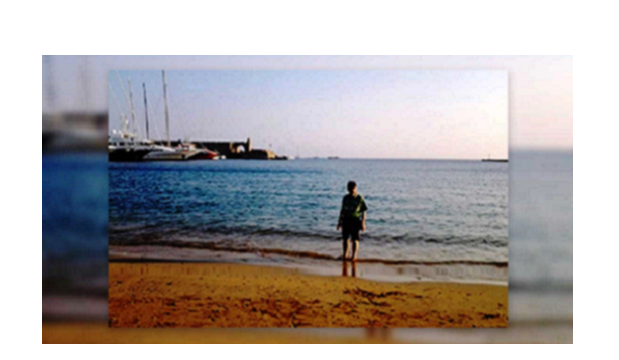
Eliakim Cohen, Rhodes beachfront.


