
(Author: Michael Bagraim, Vol. 68, No. 2, Rosh Hashanah 2013)
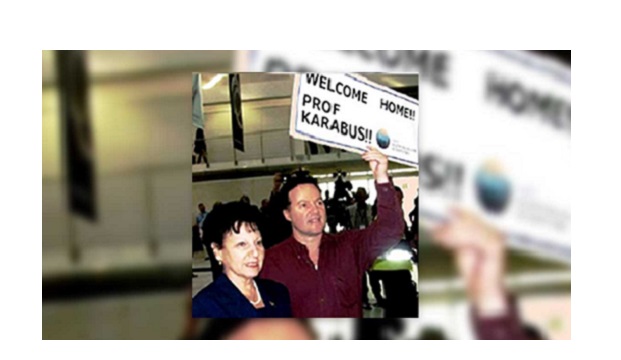
- Feature image: SA Jewish Board of Deputies – Cape Chairperson Li Boiskin and Executive Director welcome Prof Cyril Karabus at Cape Town airport, 17 May 2013
“Someone must have slandered Josef K., for one morning, without having done anything truly wrong, he was arrested.”
Franz Kafka, The Trial
“The freeing of captives takes precedence over feeding and clothing the poor” wrote the 12th Century sage Maimonides. Indeed, he wrote five letters to Jewish communities in Lower Egypt asking them to pool money to ransom Jews captured by a Christian king besieging an Egyptian town. Yet who would have expected that in the 21st Century, Jews would again have to collect money to free a Jewish captive, one held in an autocratic Muslim country in defiance of accepted rules of justice and human rights?
It took far more than five letters to free this particular captive. Twenty-four fat files of letters and media reports, to be exact.
When I was first phoned at three in the morning on 18 August 2012 to learn that my wife’s cousin, Prof Cyril Karabus, had been arrested in Dubai, I thought it was probably a visa problem that I could quickly fix up. His family were in shock and highly traumatised, but being a positive person, I tried to calm them down, saying that it would all be sorted out within a few hours after which he would be on the next plane home.
Cyril, his wife Jenny, daughter, son in law and two grandchildren were returning to Cape Town from Canada after attending his son Matthew’s wedding. When checking in at Toronto airport, a staff member told him that there was a ‘security alert’ against his name. After checking with a superior, she came back and told him he was ‘free’ to board.
In transit at Dubai International Airport, Prof Karabus was in for a nasty shock. His family was ushered through customs to catch a connecting flight home, but he was taken to an airport holding cell, told he was under arrest and spent the night sleeping on a steel bench in an adjoining room. “We are keeping you because you are a murderer,” a customs official told him curtly. He was “totally bloody shocked” and bewildered, too. Cyril Karabus, after all, is a highly respected doctor with an international reputation. He is a professor Emeritus of paediatrics at UCT and former head of the Oncology and Haematology unit at the Red Cross Children’s Hospital. As a specialist in both paediatrics and medical oncology, he had taught a generation of medical students at Red Cross. Devoted to caring for children with cancer, he had spent almost his whole life saving young lives, although inevitably and heartbreakingly, nothing could be done in some cases.
Who would have thought that it would take nine months, an international campaign, protests and support from a large number of people – Jewish, Muslim and Christian – before we would be able to get him home? The best description of what he went through can be found in Franz Kafka’s book, The Trial, about an innocent man arrested and prosecuted by a remote, inaccessible authority.
It took days before we discovered that Prof Karabus had been arrested for murder and forgery. Retired, he had been augmenting his pension by doing locums overseas. Twelve years previously, he had worked at the Sheikh Khalifa Medical Centre (SKMC) in Abu Dhabi in the United Arab Emirates (UAE). There, he had taken over the care of three year-old Sara Al Ajaily, terminally ill with acute myeloid leukaemia. He had no idea that in October 2002 he had been charged in the UAE, let alone tried and convicted in his absence, for her death. No one had told him then or since and the hospital never contacted him. Her father probably laid charges out of anger. He was looking for someone to blame for her death and he chose Prof Karabus, because he was there for her last moments.
Dr. Philip Lanzkowsky, Karabus’ predecessor as Chief of Oncology Paediatrics at Red Cross Hospital in 1965 and an expert witness at several landmark malpractice suits involving childhood malignancies (including leukaemia), has stated that it is ‘an unfortunate fact that children with leukaemia often die from the disease, complications of the disease or complications of therapy’.1
When she was first admitted to the hospital in April 2002, Sara’s South African physician, Dr. Lourens de Jager, had given her a two-week course of chemotherapy, starting 24 June. As that treatment did not help, on taking over on 19 September when de Jager went on leave, Karabus gave her more chemotherapy on 22 September and 2 October, over a dozen units of platelets and several units of red blood cells. Between 21 September 21 and 19 October, according to a copy of her medical evaluation provided by de Jager, she developed a brain haemorrhage, and taken, on 15 October to the intensive-care unit, where she died four days later. On 1 November, Karabus’s locum finished and he returned to Cape Town. Ten years later, he found himself under arrest for murder and forgery.
Karabus is furious with Emirates airline – he would never have boarded the aircraft had it warned him of the significance of the security alert or that he faced arrest. “They were complicit in having me arrested so they’re not a bloody airline, they are a police force”, he commented. The airline’s head office has ignored requests for comment as has Emirates South Africa, saying that it was a ‘legal matter’ that had nothing to do with the airline.
Karabus also discovered that in his absence, the Abu Dhabi Court of First Instance had, on 23 March, 2004, found him guilty of manslaughter and forgery for falsifying documents to show he had provided Sara with platelets. He had been sentenced to four years imprisonment and a Dh100 000 fine, to be paid to Sara’s family as blood money. He had “wrongfully caused the death of Sarah Abdulla Mohammed as a result of his violation of professional ethics as he failed to give the victim the required platelets precipitating her death as indicated in the papers,” the court report said, “On 15 October, 2002, a nurse called Rillin informed Mr Mohammed of his daughter’s death as a result of a brain haemorrhage and that the defendant failed to provide her with the required platelets to save her and stop the haemorrhage”.
That was rather odd as Sara was still alive four days later. Furthermore, no nurse called Rillin De Liola, had worked with the child. But odd or not, there were two witnesses to those charges – her father, Adel Abdulla Mohammed, 42, a Yemeni working for Albahia Trading and Yehia Rabai, an Egyptian medical examiner.
It was also odd that no attempt had been made to contact Prof Karabus to tell him of the charges or his sentence. Justice usually requires those who are accused to be given an opportunity to defend themselves in court. To quote Kafka again: “These books are probably law books, and it is an essential part of the justice dispensed here that you should be condemned not only in innocence but also in ignorance.”
From the airport, Cyril was transferred to two different prisons for the following two nights and then to the Al Wathbah prison. There he remained in the medical unit for 57 days, where he was denied access to a telephone or a razor, and so had to grow a beard. With the heat reaching 45°, the strain on his health was enormous – he has a pacemaker and a stent in a coronary artery and his 78th birthday was spent there. He passed his time helping some prisoners with minor ailments, reading English newspapers and a book on how babies learn to talk. We were warned by people experienced in the Abu Dhabi legal system that he could spend the rest of his life there, that he would never come out. I heard many terrible stories of non-Emiratis who had been caught up in a dreadful judicial system where there was a total lack of concern for non-Emiratis.
The local Abu Dhabi legal team appearing for Karabus insisted on a retainer deposit equivalent to R1 million for a trial, an appeal and a subsequent appeal. Cyril had no legal indemnity cover, but generous international and local colleagues came to the rescue and lent the money, a la Maimonides’ injunction. We also launched some fund-raising events including a packed concert in Cape Town’s Baxter Theatre.
At first it seemed best to keep the matter quiet, in the hope that Abu Dhabi, recognising his innocence, would release him sooner than it would if it were embarrassed and needed to save face. Approaches to the Foreign Minister Maite Nkoana-Mashabane and her deputies were fruitless – this was consistent with the general reluctance of the Department of International Relations and Cooperation (DIRCO) to intervene where it might be thought to be tampering with sovereignty or judicial process. We had no report-back, no suggestions, nothing.
After two months, when I found that the diplomatic and legal process was taking us nowhere, I decided that we would have to tackle it differently – through the Government, through lobbying, and through the power of the press, TV and Internet. I embarked on an e-mail campaign and probably sent out over five thousand personal e-mails, working from 7 a.m. to 7 p.m., my legal practice on the back burner. At first, it was difficult to get people interested. I contacted an Argus reporter, who was reluctant to take on the story as there was nothing ‘sexy’ about a retired doctor jailed for manslaughter. I offered her an exclusive on an upcoming labour strike in return for a story and her initial small paragraph was taken up by a Muslim radio station, and then by other media and soon more and more focus was being given to it until the reporter, Nontando Mposo, found herself being called “Mrs Karabus” by her colleagues.
But things started to happen. A Facebook petition and page was set up by Laurence Seeff and Mike Fisher. Without the press we would not have gotten anywhere. The Emirati press gave it little publicity and the facts were often wrong. The fugitive Dr Karrapos’s [sic]2 was said to have absconded two weeks before the end of his contract and the ages of Sara and ‘Karrapos’ varied from paper to paper.
An anonymous London doctor who treated the Dubai Royal Family phoned to say that he was going to Dubai, would be dining with the President and would try to help. The very next day Cyril was moved from jail to a medical ward. This he shared with 16 other prisoners, including a foreign psychiatrist accused of dispensing too many anti-depressants and two brothers accused of murder after being involved in a motor accident with a drunk Emirati policeman who had died of a heart attack. None of these had appeared in court nor been granted bail.
Several people urged Cyril to plead guilty, pay a negotiated sum of ‘blood money’ and secure a ticket home. This he flatly refused to do. He is proud of his well-deserved reputation and would not lie. He would not say “I did wrong” when it was not true, even if it meant a get-out-of-jail card, and when I made that suggestion to him, he basically told me to put it in my pipe and smoke it. His good name was worth more to him than his freedom– that’s the type of guy I was dealing with.
“It’s absolute rubbish,” he told me, “I’ve been treating leukemia for 30-40 years and I know what I’m doing. The girl was having a relapse when I took over her treatment. Her survival rate back then was about 15 percent at most. I took over when she’d been on [chemotherapy] for about two months, and she was still not in remission, which means chances (of survival) are not great. During the treatment, she had a stroke and died.”3
To Professor Heather Zar, Head of the Department of Paediatrics and Child Health at the Red Cross Children’s Hospital, the notion that Prof Karabus could have been negligent was outrageous. He had a ‘sterling reputation’, having pioneered treatment access for South African and African children and trained many of the leading healthcare professionals in the field today.4
An effort to get Karabus’s initial conviction overturned succeeded, but from 3 October he had to stand a new trial for the same charges. These were a) manslaughter for having caused Sara’s death by failing to give her platelets, and b) forgery for having fraudulently written out instructions for the platelet administration after she had died. He faced a minimum three-year jail term imposed by a criminal justice system in which the burden of proof lies with the defendant.
To make matters worse, his employer Interhealth Canada denied responsibility for legally assisting him saying it ceased operating the hospital in 2003 and had transferred all records to UAE authorities. Its spokesman said: “The charges which… were brought against Dr. Karabus were brought under the criminal law and the costs of his defence against criminal charges would not have been covered by our or any other medical malpractice policy”. He maintained that no claim was made under IC’s medical malpractice policy and it was never informed of any complaints. Yet Cyril had a letter from the Hospital director who was in attendance when the patient’s chart was requisitioned in October 2002 and closely reviewed by the police. The former SKMC head of paediatrics told him he knew the police were probing the child’s death. SKMC stopped answering our e-mails and phone calls and warned their doctors not to contact us and their e-mails and phone calls would be monitored. Cyril’s phone was also bugged.
Shelter Offshore,5 an on-line publication for expatriates, has asked whether a tax-free salary in Abu Dhabi was worth the sacrifices concerning lack of freedom and justice that come with it. It described the legal system in Abu Dhabi as outmoded, unforgiving, sexist and prejudiced on many levels, having remained unchanged for many hundreds of years. The legal system did not support modern day Abu Dhabi’s values and a massive culture clash existed. This was the massive discrepancy between painting a picture of Abu Dhabi as a free, Western, civilised, open and cosmopolitan society and the actual laws that governed that society that were archaic, antediluvian and downright primitive in some cases. And this is what we were to find in our relationship with the justice system. It made me really appreciate the benefits we have living here in South Africa with our legal system.
Five times Cyril appeared in court to apply for bail. Each time he would be lined up in the prison courtyard in the burning sun, shackled hand and foot, with between 50 – 100 prisoners, waiting for his name to be called.
We were soon inundated with support from many quarters – his friends, his colleagues, his former patients and their parents. UCT Professor of Gastro-Enterology, Prof Solly Marks, suggested that I get in touch with the SA Medical Association (SAMA) and the chairman Dr Mzukisi Grootboom and vice-chairman Mark Sonderup were very helpful. In October SAMA asked the Minister of International Relations and Co-operation to urgently intervene stating that the 78 year old man had repeatedly been denied bail which was inconceivable for someone who could not leave the country as his travel documents had been confiscated and who was unable to access any records to present as evidence in his re-trial. It also launched a petition and approached the World Medical Association (WMA) and through this body, Amnesty International. South African doctors were strongly advised to be aware of the medical liability risks if and when practising medicine in the UAE.6
Then I received an anonymous call from London giving me the London number of an anonymous woman telling me to phone her just once, as her simcard would be destroyed immediately after the call. I did, and the next day when the shackled Cyril arrived in court shortly before the court was due to open, the Registrar informed him that bail had been granted.
It took me time to gather from a generous donor the R250 000 bail demanded, so Cyril had to remain in prison until 14 October. He then needed somewhere to stay and I contacted Solly Marks. Within a few minutes he had phoned back to tell me his colleague in Abu Dhabi, Dr Elwin Buchel, the former head of gastroenterology at the University of Pretoria, would host him in his apartment. Little did they realise that this stay would last for the next seven months. Also very helpful was Rev. Canon Andy Thompson of Abu Dhabi Anglican Church whom Archbishop Desmond Tutu had contacted and who would visit him and sit beside him in court. Sadly, Prof. Marks did not live to welcome Cyril home.
Cyril’s daily routine was very boring. There were 13 adjournments. Sometimes the lawyers did not come. Sometimes the translator was not called. Once, no return date was given, so he had to return daily in the hope that the judge, noticing him, would remember to make a return date. The court wanted to see the hospital documents, but after twelve years, the hospital could not or would not find the papers. We wondered whether the mysterious disappearance of the vital supportive notes dealing with the period when Cyril had been looking after Sara had been destroyed – or ‘doctored’. No post-mortem examination had been done and the legal advisor to the hospital said the 2003 ‘in-absentia’ court had ordered the hospital records destroyed. The delays were frustrating, agonizing and demoralizing. Even the judge became irritated.
Cyril spent days hanging around in court, but apart from the court and the mosque, there was nothing exciting to see. He was not interested in shopping centres although he did get the opportunity to watch Novak Djokovic in the Mubadala World Tennis Championship.
By November, lobby groups, lawyers and Karabus’s family were all critical at the lack of action by DIRCO, beyond basic consular support on a regular basis and visits in Abu Dhabi from the friendly consul Fanus Venter who was a real star for us over there. Fanus visited Cyril in jail and brought him essential medicine. He did so much and it was not as if this was the only work he had to do. His Pakistani driver who drove Cyril back and forth to court was also very helpful.
The Treatment Action Campaign got involved in the scandal of his detention and issued a statement asking for his release: “We are disappointed by the failure of the Minister of International Relations and Cooperation and the South African embassy in the UAE to do anything substantial to secure the release of Professor Karabus.” The TAC spokesperson said the SA embassy had done ‘almost nothing’ to assist and expressed ‘astonishment’ that the Emirates airline failed to warn Karabus that he was wanted in the UAE. They called on all travellers ‘who share our abhorrence for the UAE’s justice system to stop flying Emirates and to not visit the UAE’.7
One thing that is clear, however, is that DIRCO came relatively late to the party in attempting to secure Karabus’s release through diplomatic means. He was arrested in August but it was not until 20 December that Minister Nkoana-Mashabane wrote to her UAE counterpart expressing South Africa’s concern and requesting the UAE authorities to deal with the case in an expeditious and fair manner.
Under Sharia law, Karabus needed corroborating evidence (the missing hospital notes) to prove his innocence but the first time our legal team saw the medical file was at the 20 November hearing, three months after his arrest. Conspicuously absent were supportive notes (clinical records, laboratory blood count results, blood bank forms, nursing notes and infusion charts) – everything that was necessary to prove that he had given the child red cell and platelet transfusions. The judge’s anger at the prosecution’s failure to produce them at two consecutive hearings probably worked in our favour
Finally, Dr de Jager found a clinical record of Sara’s last admission which Cyril had dictated on 29 October 2002, which for some inexplicable reason he had kept all these years. He sent it to him with a document showing that her blood platelets increased from 1000 to 19 000 the day before her cerebral episode – something that only a platelet infusion could have induced. This was proof that the blood transfusion was given and would exonerate him of negligence, but our documents were thrown out because they were photocopies, not the originals and they needed the hospital records, with the clinical notes, blood counts and blood bank records, to confirm it.
The judge asked a Higher Committee for Medical Liability to give its verdict on the case. Cyril’s release now hinged on its confirmation that he had given the patient a blood transfusion as her platelet count had risen. We had no say in the selection of the committee, which had neither haematologist nor oncologist (people who would understand the medical records) because there were no such Emirati specialists in Dubai, but we hoped that the medical panel would realise that there was no truth to the charges in what had become, with all the adjournments, an on-going horror story.
Then, on 6 December, the prosecution failed for the second time to produce clinical notes made during the critical two weeks Karabus treated the child. The delay was the result of human error, Abu Dhabi Criminal Court was told, after SKMC staff overlooked a set of medical notes that the Higher Committee wanted to review and use to help make its findings.
For the first time in the nearly four months Prof Karabus was allowed to take the stand. He told the judge that the prosecution’s failure to produce the notes amounted to ‘an insult to the ruling Sheikh (Khalifa bin Zayed bin Sultan Al Nahyan) and the court’. The judge concurred, and expressed deep dissatisfaction at the on-going impasse which prevented a court-ordered medical committee from reviewing the case properly. We hoped Cyril would be cleared in time for his grandson’s birth at the end of January, but it was not to be.
The DIRCO director-general called in the UAE ambassador on 10 January and issued a démarche. “We believe it is in the best interest of all if the professor can be released on humanitarian grounds,” said Deputy Minister Fransman.8 Note that it was called for on humanitarian grounds, not on grounds of his innocence. But the UAE ignored the démarche as it had ignored the petitions, the threats of boycotts and the international protests. With its oil and its money, it was a law unto itself and remained unmoved. Fransman met the UAE authorities on 3 March for further discussions regarding the continued detention of Prof Karabus, with as little response.
One of the concerned people who offered to help was a former student of Dr. Karabus, Dr Iqbal Survé of the Sekunjalo Group, who flew to Abu Dhabi and appealed, via intermediaries, to the crown prince Sheikh Mohammed bin Zayed for help. They say that “it is not what you know but who you know that counts”, but the day after a dinner that Dr Survé attended with a high-ranking member of the royal family, the medical committee issued a statement saying that Dr. Karabus had been cleared. Survé had used his knowledge of how things work in the Middle East. 9
On 19 March, the Medical Committee cleared Dr. Karabus of any wrongdoing in the treatment of Sara, a verdict that was echoed by the Abu Dhabi Criminal Court in April. His R250k bail money was repaid on 6 May and promptly returned to the generous benefactor. At last we could start to make plans to bring Cyril home! We thought we would have him home for Pesach but the battle was still not over because, incredibly, the UAE prosecutors decided to appeal this decision. No reasons were given and it seemed as though he would be remaining there indefinitely.
SAMA then called for a boycott of the UAE by doctors and all health professionals both in terms of working there as well as in an involvement with any UAE linked organization or business. This included the upcoming Africa Health Exposition and Conference. It also called on its members to boycott airlines such as Emirates and Etihad and to sign a petition calling for his release.10
“The decision by the UAE to prevaricate and postpone the case is disgraceful and inhumane at all levels. The manner in which Professor Karabus is being treated is inexcusable and condemned by SAMA. The aim in this instance is clearly not the pursuance of justice” said Dr. Grootboom. He did not know what to make of the prosecution’s decision to appeal Karabus’s acquittal. “We’re not sure if this is done to spite him,” he said.11
Dr Sonderup said: “It just emphasises what it’s really about. It is not about seeking justice and closure. It’s now torture. If we had a little army, we’d send them in (to get Karabus). But we don’t.”12
Two weeks went past and the prosecution had still not announced why it was planning to appeal. Pesach came and went. The case was postponed to 29 April to allow the court to “establish the veracity” of a statement by Karabus’s lawyers that Karabus had no part in a decision to stop treatment of the child shortly before her death. We were shocked because this should actually be a knowledge of court, not something that needed to be verified. It was known that Dr Karabus was not on duty at the time when the medication to the child was stopped by the neurosurgeon on duty.
Then the case was postponed for another two weeks. This time the reason was that a medical translator was not available – but no one asked for him. It was an absolute travesty of justice.
A WMA council meeting in Bali passed a resolution saying it believed Karabus was being treated in a manner “which fails to meet international fair trial standards and he should be allowed to return home immediately” and “in the light of this experience, the WMA will publish an advisory notice in the World Medical Journal and on the WMA website advising doctors thinking of working in the UAE to note the working conditions and the legal risks of employment there. The WMA will also encourage its 102 member associations, spread across North and South America, west and east Europe, Asia and some African countries, to publish similar advisory notices in their national publications, and publish the advisory in the World Medical Journal.”13 Dr Grootboom, who was involved in the resolution, said he had been told the association had “never done anything close to this” before. Cyril was touched by the unprecedented advisory of the WMA but was not hopeful that it would have any traction with the UAE authorities.
We started receiving e-mails from medical associations across the globe expressing outrage and backing Karabus’ integrity and reputation. These were from friends and family, from strangers, from patients and staff who had worked with him and from professional bodies. As well as from SAMA and WMA they included the British and American medical associations, the SA Haemophilia Federation, the Western Province Blood Transfusion Service, the School of Child and Adolescent Health at UCT, Amnesty International and Human Rights Watch.
I started protesting in the streets outside the Emirates Airline offices in Cape Town. I wrote to international sports stars due to attend sporting events in Abu Dhabi alerting them to Cyril’s plight. When the 6th World Congress of Paediatric Cardiology & Cardiac Surgery took place in Cape Town in February, we picketed outside the convention centre in FREE KARABUS t-shirts and posters, receiving media attention. When we learnt that the United Arab Emirates would be competing in the 2013 International Ice Hockey Federation World Championship tournament in Cape Town in April and it would be covered by Middle East TV channels, we bought tickets for the front row and we sat there with our t-shirts and posters in full view of the cameras. When the security approached us, I took their head around the corner and delayed him in discussion as long as I could to allow our group to get as much exposure as possible. They confiscated our posters but allowed us to remain seated in our t-shirts. One Red Cross paediatrician in our group kept his poster – he had dressed in Emirate clothing and pretended he did not speak English.
Finally, on 24 April, the UAE lost the appeal, the appeal judge finding Cyril not guilty on all charges. Amazingly the press published the news before the judge had even appeared in court to announce his verdict! Now we could really anticipate having him home soon but his trial by bungling had not yet played itself out. He had to wait for the authorities to get his paperwork done so that he could reclaim his passport. That was sooner said than done and the delays and confusion were very upsetting. He waited five hours at court for his papers and was then told to go to the prison to collect his passport. He waited there for them to find the correct forms and hand them in, but he could still not get his passport because, unbelievably, he was still listed on the UAE database as a “fugitive of justice” and, as we had discovered, the wheels of justice and bureaucracy move very slowly in the UAE.
Database eventually corrected and passport eventually collected, Prof Karabus went to book his ticket home. But Emirates Airlines wanted him to buy a new ticket to South Africa, Cyril, as stubborn as ever, refused – after all it was not his fault that he could not use his original return ticket. He also refused a donation of a business or first-class flight by one of my clients. After a fight, Emirates agreed to reinstate the ticket to Cape Town and he was finally booked on a plane.
But he had not seen the last of the bureaucratic bungles. His passport visa was wrong. He had been granted a 24-hour visa in August so that his family could travel to their hotel for the overnight layover in the city. Now someone had backdated his date of entry to October, when he got bail – leaving a two month gap which made it appear as if he had stayed in the country illegally from August to October (in jail!). The UAE authorities would not allow him to leave if his visa was not in order.Fortunately the ever-helpful Fanus Venter noticed the error. It was just another UAE botch-up. If it was not for him running around and getting things done, I doubt whether Cyril would have been able to do it. So once again plans to welcome him home had to be put on hold and his ticket postponed until the visa could be changed.
In an article in Daily Maverick on 20 May “Karabus case: Totalling up the bill”, Rebecca Davis pointed out that “One positive outcome of the Karabus case … has been the light it has cast on the UAE’s medical liability laws. Prior to the case these laws were already the subject of controversy: in 2012 the Dubai Health Authority and the executive committee held talks on possibly amending the legislation. The attention paid to the Karabus case, however, has brought the consequences of the laws for medical professionals into much starker relief – culminating in the World Medical Association advising physicians around the world about the risks of working in the UAE under those conditions. If the UAE wishes to continue attracting world-class medics, it will likely have to expedite its legislative reform in this regard.”14 His daughter Sarah, also a paediatrician, has warned colleagues using locum agencies employing doctors in foreign countries that ‘they may not assist when it comes to the crunch’.
Davis also pointed out that although the case against Prof Karabus was perceived to be scandalously unjust, she wondered whether DIRCO’s intervention would have taken place to the same extent without the support of the international medical fraternity, the resources to launch a legal battle for his freedom, though much was raised through donations, and the ear of the media. Without these, she concluded, Karabus might still be languishing many kilometres from home (as was the case of so many other unfortunate victims drawn to the honey pots of UAE employment whose plight has been brought to my attention).
The Shulchan Aruch15 states that the freeing of captives takes precedence over feeding and clothing the poor and there is no commandment greater than this. One could not imagine the joy and excitement, the tears of happiness, at the Cape Town International Airport when Cyril’s plane touched down at last before a large crowd gathered to witness the freeing of the captive. There were helium balloons and a minstrel band, “Welcome home Cyril Karabus” t-shirts and people singingShalom Aleichem and the presence of the many happy people who had played a role in bringing him back.As well as his family and his grandchildren, Dr Iqbal Survé, who had played a major role was there, as was Deputy Minister Fransman, Dr Grootboom and Dr. Sonderup, members of the Board of Deputies and the SA Zionist Federation, teenagers from Hope (an HIV/Aids NGO), patients, their parents, former colleagues and many many others. The emirate’s crown prince, Sheikh Mohammed bin Zayed even telephoned Deputy Minister Fransman soon after the flight had landed to ask if Cyril had arrived safely.[/vc_column_text][/vc_column][/vc_row] SAJBD (Cape Council) Chairman Li Boiskin and Executive Director David Jacobson welcome Cyril Karabus at Cape Town International Airport. The release of Prof Karabus was due to the help of so many people who assisted during his trial – both legal and bureaucratic – but sadly there is not space to thank them all here. A big thanks is also due to the media for maintaining a focus on Cyril’s detention. As well as our local papers we got coverage in the Wall Street Journal, the New York Times, the Guardian, even on Al Jazeera. Hopefully some positive things have emerged from Cyril’s nine-month nightmare trapped in a judicial system in which, to quote Charles Dickens’ Mr Bumble, “the law is an ass”. It is a bizarre judicial system and there is not much lawyers can do. The international coverage has made it embarrassing for UAE medical institutions that rely on international doctors for their staffing. Prospective doctors are now asking awkward questions on how safe they would be if they worked there. The WMA has not withdrawn its first-ever cautionary notice to doctors warning them to be fully aware of the possible restrictions in foreign jurisdictions and that they must have proper insurance. I salute the many Muslims who rallied to Prof Karabus’s defence, seeing this not as a Jewish but as a human rights issue. Muslim media were very supportive. I had a weekly programme on the local Muslim radio station Voice of the Cape and appeared on Chanel Islam International, Islam News, Islamic TV stations, was interviewed on Pakistani news and on Hindu TV. I hope we shall have other opportunities to work together as communities on the many issues we have in common. What have I learnt from this? That high salaries can come at great cost and in the UAE come with costs that include lack of human rights and justice. I have learnt that Emirates will not warn passengers in advance that they will be arrested on arrival. I have learnt that Abu Dhabi is so wealthy it feels no need to care about negative public opinion and world disapproval. I have learnt that there are many good people of all faiths, kind, caring and prepared to go the extra mile to help. I have learnt how important it is that the media continue to play this kind of watchdog role, and that we must appreciate the system of law under which we live in South Africa. And I have learnt the happiness that one gets in welcoming home a friend that one had begun to fear would never be seen again. Michael Bagraim is a Cape Town-based labour lawyer. His many years of Jewish communal involvement include serving as National Chairman and President of the SA Jewish Board of Deputies (2003-2007). As Cyril Karabus’s attorney in South Africa, he was centrally involved in the global campaign to bring about his release and return to South Africa after his wrongful arrest and detention by the United Arab Emirates in 2012. He thanks Gwynne Schrire and Tony Shapiro for their assistance in preparing this article. 

NOTES


