
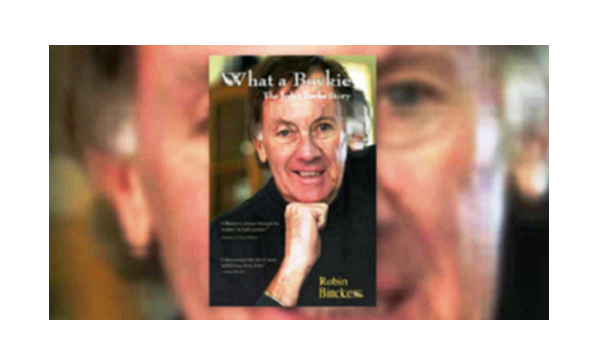
(Reviewer: Ralph Zulman, Vol. 71, No. 3, Chanukah 2016)
Many youngsters today will not have heard of John Berks (born Berkowitz), but there are few of the over forties who do not remember Berksie with warmth and affection.
The author Robin Binckes mentions that he had to peel away layers to expose the true John. He describes him as “one of the most impossible human beings with whom to work. He hates talking about himself and is constantly afraid of speaking about anyone else, fearing that he will hurt their feelings or that they will sue him. He has a deep commitment to decency and family values. He can be forgetful, unreliable scatter-brained and stubborn”.
In interviews with people who worked with John, or knew him socially, the author came across “a common thread: that of affection for his character”. None of the persons interviewed had anything detrimental to say about him, and everyone who had worked with him acknowledged him as a ‘radio genius’.
The book contains a prologue, forty-five distinct and appropriately titled chapters, an epilogue and an appendix and a number of photographs.
Fifteen months after John’s birth in Krugersdorp on 24 August 1941, the family moved to Klerksdorp, where his father, Louis, set up a foundry business with his brother, Jack. A handful of less well-off Jewish families, including the Berkowitz family, lived in downtown Klerksdorp, whilst the more affluent Jewish families lived in a suburb named Irene Park.
John hated school. It was only English that held his attention. His first real interest was the radio. Unlike other boys his age, he hero-worshipped such radio commentators as Rex Alston, John Arlot, Charles Fortune and others. From early on he learned to mimic them.
Chapter Eight relates John’s first rejection by Springbok Radio to become a radio announcer. This was followed by his working in a soap factory. John’s new career started in 1963, when he moved back to Klerksdorp to take up a job with the Klerksdorp Recorder. However, he continually telephoned radio announcers John Silver, Mervyn John, Frank Douglas, Stanley Raphael and Colin Du Plessis in the hope of joining Springbok Radio. Eventually he was invited to by Du Plessis to come to the SABC offices. Du Plessis tested his pronunciation of the word ‘just’. John pronounced the word with a strong Klerksdorp accent – ‘jist’. Du Plessis spent the next six months giving him elocution lessons, but he showed little progress. In 1963, John attended a conference of small newspapers. There he met David Bray, who said he was looking for a cub reporter for the Germiston Advocate. John jumped at the chance and moved to Germiston. Whenever he got the chance he telephoned Springbok Radio or the independent radio station in Mocambique – Lourenco Marques Radio (LM Radio). He was interviewed by his nemesis, the Programme Development Manager Rob Vickers, who declined to give him an announcer’s job. His big break came two months later when Gary Wilmot, a legendary Canadian radio announcer, replaced Vickers. John was eventually employed as an announcer at LM Radio. After some time, from an insecure young announcer, he blossomed and began to make his mark. He shared his microphone with the radio greats like Clarke McKay, Gary Edwards, David Gresham and Robin Alexander.
In 1967, John was promoted to Programme Development Manager in Johannesburg. In April 1969 he married Celeste – described as a typical South African kugel – at the Berea Synagogue. John resigned from LM Radio and joined Springbok Radio as a continuity announcer, but battled financially. He made a very unsuccessful trip to the USA in an attempt to get a job there, before returning to Springbok Radio. However, his name was becoming known on a national basis.
In October 1972, following an approach from Issie Kirsh, John left Springbok Radio and joined Swazi Music Radio. The station did not last long, and he returned to Springbok Radio as a part time continuity announcer. In October 1975 LM Radio closed and was re-launched as Radio 5, which John eventually joined.
On air John began to call himself ‘Long John Berks’. By 1979 he had become a celebrity and a doyen of the media. His next career move was to join Capital Radio, which broadcast out of Port St Johns. He spent time there bonding with his two children (he and Celeste having by then divorced).
On 29 June 1980 Channel 702, founded by Issie Kirsh, went live. On the advice of Bob Hanabery, a top radio consultant in the USA, Kirsh approached John to join the station. According to Hanabery, a talent like John came along once or twice in a hundred years; he rated him alongside the all-time greats in the USA.
As soon as he joined 702, John became a different person. Freed from the conservative restraints of Radio 5, he was able to do much as he pleased. He had a direct line to Issie Kirsh, and was handled with kid gloves. Bookings for public appearances and charity events poured in. He became the most talked about DJ in the country. Any celebrity that came to South Africa sought an interview with him. At the beginning of 1987, the Sunday Times rated John at number 32, with Pik Botha as number 1 and Gary Player as number 2, in a poll of the most admired South Africans.
In April 1986, John said that he was ‘burn out’ and needed to take a break. He left on a two year sabbatical, on full pay, and went to Portugal. 702 suffered as a result of his absence, with listenership figures tumbling dramatically. (An article entitled Come Back Berksie appeared in the Sunday Times). After just one year of his sabbatical, John returned to 702. He chose the 0900 to 12h00 slot with his friend Gary Edwards (“His prank calls set the whole country chuckling. One such hilarious call was to Dr Harry Seftel about gas in the colon. The response to Talk Radio on John’s shows was overwhelming. However, there were elements who disliked this new form of liberalism”).
On 2 February 1990, President de Klerk announced the unbanning of the ANC and imminent release of Nelson Mandela. After years of restrictions, the public craved truthful news reports. 702 provided them. While many South Africans embraced the changes that were taking place, many did not. John was one of them; the rate of change was too fast for him. As the decade progressed, his concerns about the future of South Africa increased. Like many others, he felt that he might be better off in another country.
702’s listenership figures fell and it lost direction. In 1997 the deck chairs there were rearranged. John resigned from the station, but later accepted an offer of an annual salary of R1 million and perks and returned. He found, however, that 702 had changed. On air, he sounded jaded and tired. In 2006 he accepted an offer from Kirsh to operate a radio station in Israel. He spent a year in Israel before resigning and returning to South Africa, where he was inducted into the Radio Hall of Fame and honoured with a Lifetime Achievement Award. In February 2008, John hung up his headphones for the last time. Since then, there have been various attempts to lure him back into the world of radio. None have been successful.
The statement in the title of the book What a Boykie is convincingly answered in the pages of the book. They show a man possessed of dogged and persistent determination to succeed and how he rose from obscurity to become a national figure. The book makes interesting and easy reading. It is highly recommended to all, especially to the ‘golden oldies’.
What a Boykie: The John Berks Story by Robin Binckes, 30 Degrees South publishers, Johannesburg, 2015, 256pp.
Mr Justice Ralph Zulman, a long-serving member of the editorial board of Jewish Affairsand a frequent contributor to its Reviews pages, is a former Judge of the Appeal Court of South Africa.


