

(Author: Gwynne Schrire, Vol. 77, #1, Summer 2022)
The Women’s International Zionist Organisation (WIZO) was established in 1920. Within eight years it had attracted 34 worldwide federations consisting of 40 000 members, enabling the organisation to establish a strong educational and social welfare infrastructure in Mandatory Palestine. Its South African branch started in 1932.
Rebecca Sieff is usually credited with founding WIZO South Africa, with annual Rebecca Sieff awards given to long-time members. WIZO, however, was established by Rebecca Sieff AND Vera Weizmann AND Edith Eder, and it seems unfair that some people are recognised while the contribution of others equally involved, particularly Edith Eder, are ignored or forgotten. This article will be dealing with all three founders as well as some arbitrary connections with South Africa.

I was alerted to the name Eder when I read a letter in a book of Anglo-Jewish letters from 1158 to 1927.[1] This letter was dated 2 September 1896 and was sent by the popular novelist Israel Zangwill to his cousin Monty Eder:
Dear Monty
“…Have I told you that there lives amid the brutality of Johannesburg, a couple of Jews whose acquaintance is worth making – a Mr. & Mrs. Wolf Myers, she is a cousin of Amy Levy. I am not friendly with the husband else I would give you an introduction, but it should not be difficult for you to know them, especially as they complain of lack of intelligent society. She is very charming, a poetess suppressed in a mother of two infants. He has a watch making establishment or something of that sort, was once at Cambridge”.
Continues Zangwell, “Father is, as you know, living in Jerusalem, & by latest accounts seems to be praying happily there”.
The Johannesburg Directory of 1890 lists W. Meyers, 1177, Jeppe Street. Johannesburg under ‘Watchmakers and Jewellers”.[2] The accomplished genealogist Paul Cheifitz [3] has managed to trace Wolf’s details and family tree. He was born in Graaff-Reinet in 1865, his father, Joel, a Jewish merchant from Chelmsford, Essex, having settled in the Cape in the 1860s. Wolf married Adah Saunders in London in 1893; they had two sons and settled in Johannesburg where Wolf died in 1924. Adah and the sons returned to London.
Zangwill, a popular speaker, was a member of the Chovevei Zion society and the “Wanderers of Kilburn”. This was a group of Jewish intellectuals that included Rabbi Dr Solomon Schechter [4], whose daughter Ruth was to marry Morris Alexander, founder of the Cape Jewish Board of Deputies and a keen Zionist. The Board recently donated to the Friends of Zion Museum in Jerusalem a chanukiya given to Alexander by Rev Hechler, a Christian Zionist supporter of Herzl, at the 1907 Zionist Conference when Alexander was on honeymoon. In 1909 Rabbi Schechter came to Cape Town to visit them [5].
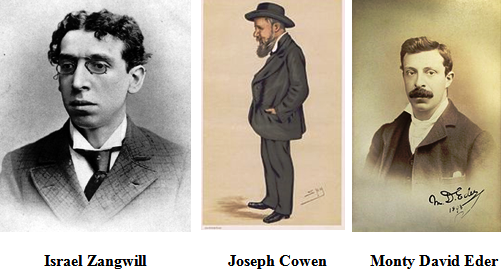
Living in London at the time were three cousins, Israel Zangwill, Joseph Cowenand Montague David (Monty) Eder, all of whom became prominent in Zionist affairs.[6] Zangwill’s father was a smous (pedlar), Joseph’s a pawnbroker and Monty’s a shipping merchant. When Monty’s father died in 1886, leaving him comfortably off, he stopped working and, a committed socialist, devoted himself to social issues. He took part in a huge workers’ protest in Trafalgar Square which was viciously stopped by the police, leaving him with a scar on his forehead and so decided the best way he could help the poor was by becoming a doctor. Accordingly, he enrolled at the University of London, sharing digs with his cousin Israel.[7] Psychoanalyst Ernest Jones later wrote of Monty that he “would sacrifice all he had, time, money, labour and health, without a moment’s reflection, not only for social, but also for any personal causes that engaged his sympathy[8].”
By the time Monty qualified, a personal cause engaged his sympathy. He had fallen in love with Florence Herring. Unfortunately she was already married. Adultery and divorce were frowned upon in Victorian England and their affair, described by the judge as ‘shocking and repulsive’, made news headlines for five days. It was also alleged that the adulterer had been involved with Mr Herring and his wife in an insurance fraud.[9] The case against Monty was not proven, but the scandal was ruinous for the reputation of a young doctor. Dr and the new Mrs Eder thus decided to move to Johannesburg, where no one would have heard of them, and where Monty used his middle name David instead.
Zangwill used the knowledge gained from his cousin to write a story ‘Anglicization’, set against the background of the South African War[10] as well as a political novel Mantle of Elijah, which attacked the belief that cosmopolitan Jewry was behind the war. This was the fourth most popular book out of 38 in the January 1901 Bookman list.[11] In 1896 a Zionist Society was established in Johannesburg – the Chovevei Zion. Whether David Eder (as he now called himself) had anything to do with this is not known but as he was living in Johannesburg at the time and the Johannesburg Chovevei Zion wrote to Zangwill, a member of the London Chovevei Zion, for advice on how to operate, this is certainly possible[12].
As for Johannesburg, it was not long before the materialism of the city of gold had offended Eder’s socialist sensitivities and he and Florence moved to Columbia, where he had an uncle in the sugar industry. They did not like Columbia either, so returned to England where Eder became a Medical Officer in a Cumberland mining village. They did not like the mining village either so he became a medical officer in Bolivia. There he was suspected of being a spy for Anglo-American concession hunters, so back they went to London where he became a school doctor.
As for Israel, he had a visitor. Zangwill wrote: “One day a black-bearded stranger knocked on my study door like one dropped from the skies and said, ‘I am Theodor Herzl – help me to rebuild the Jewish State.’”[13] Like Monty, Israel championed liberal causes – from the women’s movement to human rights, from the exploitation of workers in the Belgian Congo to the genocide of the Armenians, and he became an ardent Zionist, bringing along cousins David Eder and Joseph Cowen. Zangwill introduced Herzl to potential supporters, traveled around England lecturing on Zionism and helped Herzl establish the World Zionist Organization in 1897. Joseph founded the English Zionist Federation in 1899, becoming its President as did David later.
In 1901 Herzl decided to approach Cecil John Rhodes for money and asked Joseph to invite Max Langerman to arrange a meeting with Rhodes. Langerman was a prominent Johannesburg pioneer and communal leader who had been involved with the Uitlanders and in the Jameson Raid. Monty had probably met him in Johannesburg. Joseph preferred the English journalist WT Stead. Herzl wrote a flattering letter to Rhodes, which Israel translated into English. Joseph was to give it to Stead, but Rhodes died before that could happen. In March 1902 Herzl wrote in his diary: “Cecil Rhodes is dead. I thought of him as a man who could have given us the money. I was not successful in meeting him.”[14]
In 1902 Joseph accompanied Herzl to Constantinople to meet the Sultan and Israel joined Herzl in a ‘pilgrimage’ of English Jews to Palestine. The following year Israel attended the Sixth Zionist Congress in Basle, where Herzl disclosed to the horrified audience that he was thinking of moving the Jewish State to Uganda. On his return Zangwill reported back to the English Zionist Federation that he had met South African Jews and received mandates from Jews from Cape Town and that although South African millionaires were comfortable enough, it was a South African Zionist millionaire who had provided funds for a Hebrew Encyclopaedia.[15] The names of that millionaire and the Cape Town Jews were not disclosed.
That year Zangwill married suffragette and writer Edith Ayrton. Like Florence Eder, she was not Jewish, although she had a Jewish step-mother. The couple joined the Women’s Social and Political Union. When criticised for supporting the militant tactics of its ‘unwomanly’ members, Zangwill responded that “ladylike means are all very well if you are dealing with gentlemen; but you are dealing with politicians”. The Zangwills also helped form the Jewish League for Woman Suffrage, whose members disrupted Shabbat services demanding religious and political suffrage for women and had to be forcibly removed. The Anglo-Jewish press called them “blackguards in bonnets”.[16]
Zangwill thought the Uganda proposal a good one. To that end he founded the Jewish Territorial Organisation with a branch in Cape Town that included anti-Zionists like the Rev AP Bender of the Cape Town Hebrew Congregation and Hyman Liberman, Cape Town’s first Jewish mayor, as its honorary presidents.[17] A branch was established in Johannesburg in 1905 with Alfred Cohn as chairman.[18] Zangwill was slotted to be the keynote speaker at the 1905 SA Zionist Conference, but had to cancel. He spent the next seven years searching for somewhere to serve as a Jewish homeland, looking in Argentina, Australia, Canada, Iowa, Mesopotamia, Nevada, Paraguay, Rhodesia, South Africa, Tripoli and Uganda. He also sent David to Brazil to scout out a suitable territory and to West Africa the following year. An American newspaper reported on 2 December 1904[19] under the heading “Israel Zangwill who favors colonizing South Africa”, that he was much interested in the project to colonise the Jews on a tract of land in South Africa donated by Great Britain.
Back in England, David fell in love with another married woman, this time a Jewish one. Edith was a teacher married to drama critic Dr Leslie Guest and was the New Woman personified: a vegetarian, who walked around in flat heels and a jibbah, a long coat worn by Egyptian men. Smitten, David abandoned Florence and ran off with Edith. Following Edith’s divorce, the couple married in 1909 and went to Vienna, where David was psychoanalysed and Edith studied psychology. Afterwards they returned to London, with David now being a psychiatrist. As for poor Florence, who had gone through a humiliating divorce and been schlepped back and forth to Africa, South America and England, this was the last straw and she committed suicide.
Edith Eder, Rebecca Sieff and Vera Weizmann were all active in England’s suffragist movement. Rebecca, daughter of Marks of Marks and Spencer and married to Israel Sieff, was already a member of a Zionist women’s group called Bnoth Zion. Married to prominent Zionist leaders, these women wanted a greater voice for women in the growing Zionist movement. Rebecca organised all-men fund-raising dinners for her husband, a close friend of Chaim Weizmann who had worked with the British Palestine Committee, which prepared the ground for the Balfour Declaration. As a woman, Rebecca was not allowed to listen to the after-dinner speakers. So she dressed up as a waiter. Sieff said his wife had the attitude of “let the men get on with it and we’ll do the real work”[21].
Then the First World War intervened. David joined up and was posted to Malta, where he wrote the first book on what is now called post-traumatic stress disorder,called War Shock. Rebecca began collecting money for the Charity Fund for Polish Jewry and was a founder of the Rehabilitation and Preparation Fund, a precursor of Keren Hayesod (founded in London in 1920). Weizmann was appointed scientific adviser in chemistry to the British Admiralty and the British decided that the Balfour Declaration would be just the thing to get the Jews on their side as the Ottoman Empire had sided with Germany. Weizmann wrote that after the Balfour Declaration Zangwill’s Territorial Organisation had become meaningless, but the one fortunate result was the accession to their forces of Dr M D Eder, the distinguished psychiatrist[22]. In 1918 Rebecca and Vera Weizmann were among the three women members elected in their own right to the Council of the English Zionist Federation.
Until its surrender on 1 November 1918, the Ottoman Empire had ruled Palestine with avarice, oppression and corruption. Jews, as second class citizens, had few rights. During the war, Jews were forcibly drafted into the Ottoman army, which deported the entire civilian population of Jaffa and Tel Aviv, many to Egypt. This included over 40 000 Jews, some dying on their way, and not all of whom were able to return after the British conquest. Many Jews in Palestine died of hunger and maltreatment – my mother’s paternal grandparents both died of starvation in Jerusalem and the food parcels the family sent were confiscated. On 9 December 1917 the British forces occupied Jerusalem.
Here is a little-known story: After the war, the Cape Jewish Board of Deputies was asked if the Jewish community would lay a wreath at the Castle to honour the Coloured soldiers who died in the Battle of Square Hill, which it did. In this decisive battle, Turkish forces blocking the Jerusalem-Nablus road were defeated and the way to Jerusalem was opened to the British troops. Within a few days the Turkish armies in Palestine had practically ceased to exist. And whose victory was it? A Cape Corps squadron of coloured soldiers. British Regulations at the time stated that coloureds could not fight against whites (i.e. Germans) but could fight against Turks, who were deemed to be “non-white!” What bizarre forms racism can take!

The cousins David Eder and Joseph Cowan were also Chaim Weizmann’s friends. In April 1918 they were sent by the British government as part of a Zionist Commission under Weizmann with Israel Sieff as secretary to survey the situation in Palestine and prepare recommendations for applying the Balfour Declaration.[23] Israel remembered how angry Rebecca was because she was not allowed to go along. She saw no reason why she should not accompany them, rightly insisting, he said, that she could do his job better than he could.[24]
Led by Rebecca, Vera and Edith felt the men did not include them in the decision making process and vowed to start something of their own. That same year they formed a “Ladies Committee” within the British Zionist Federation to plan a programme for women and children with funds they intended to raise.[25] On 12 January 1919, they held the founding conference in London to set up the Federation of Women Zionist in England and Ireland with Rebecca as president, and started collecting clothing for orphans in Palestine. Sieff emphasized two issues which became central in the activities of the new women’s organisation: the establishment of an international Zionist women’s organisation and the founding of a school for home economics in Jerusalem.
In September 1919 Weizmann and Israel Sieff returned to England, while Edith Eder remained in Palestine with David living on an orange farm.[26] But when Weizmann and Sieff returned to England, their wives went off to Palestine in order to collect first-hand information on the situation of the Jews there. Joined by Edith, they formed a Women’s Representative Committee that traveled the length and breadth of the territory during October and November 1919. Wrote Vera Weizmann, “Mrs Eder, Mrs Sieff and I … were very impressed by the hard work done by our pioneer working women. But we were no less perturbed, and even appalled by the arduous physical conditions of their lives. Their homes, bare and simple, were neglected: cooking was haphazard at best, and the result of their culinary efforts anything but satisfying: dietary standards were neither known nor taken care of. To our mind these enthusiastic, idealistic women were mortgaging their future motherhood and even risking their health for this ‘equality’ principle. They worked ten or twelve hours breaking rocks and stones for road making and repairing, carrying heavy loads, performing superhuman tasks. They and their menfolk snatched whatever food they could lay hands on.”[27]
Looking at the problems they saw around them, each woman viewed the needs through their own frame of reference. Vera and Rebecca thought the young women-pioneers must be taught to use modern technologies through a vocational training institute. Rebecca, the feminist, wanted to see the women organised, active, and equal to the men. Edith, the teacher, wanted to improve the education of the children. Vera, the doctor, a paediatrician, was shocked at the high rate of infant mortality and the poor state of health amongst the women and children.
A Zionist Congress was to be convened in London, the first after World War I. The women of the Federation of Women Zionists wrote to the Organising Committee of the Zionist Congress saying that an independent international Jewish women’s organisation should be established and the suggestion was supported by Leo Hermann, the organisational secretary.
Early in July 1920, the women held a ‘salon’ meeting to prepare for this. Edith told them, “We need to establish Infant Welfare Centres in Jerusalem, Safed and Tiberius to keep the babies who are born, healthy. They are so intent on building the land they neglect their own welfare and that of their children. We have to do something about this! A domestic training school for wives and mothers was also very necessary; the women came from diverse backgrounds and cultures and many did not know the basics of healthy eating and home economics.”[28]
Through their Federation of Women Zionists, a few days later, on 11 July, Rebecca, Vera and Edith called a conference as part of the Zionist Conference in London where Vera’s husband Dr Chaim Weizmann was elected President of the World Zionist Organization. Women from South Africa, Palestine, England, Germany, Poland, the Netherlands and Russia were present.
Rebecca Sieff was an excellent speaker with a brilliant mind and a forceful personality.[29] At the conference she spoke at length about women needing to work together in an organised fashion in areas of Education, Home Economics, Legislation, Health and Social Services, all areas that had been completely neglected under Ottoman rule. Like Rebecca, Edith Eder was also famous for her impassioned and inspiring speeches. She spoke at length on education and proposed forming an agricultural school. When children were discussed, it was decided that alternative care needed to be provided for them so that the mothers could go out to work, and that mothers needed professional guidance in child care and nutrition so that they could look after their children to the best of their ability. Also discussed was the position of Jewish woman in Jewish law and the desire for equality; it was hoped that a central Rabbinical Authority would emerge that could deal with these problems.
A resolution was passed to “form the Women’s International Zionist Organisation to promote the welfare of women and children in Mandate Palestine and to carry out specific works in the reconstruction of Palestine”. Edith was elected onto the WIZO’s executive as co-Treasurer and became vice president of the Federation of Women Zionists while Rebecca alternated with Vera as WIZO president for forty years. Israel said Vera and his wife were “basically life-long friends who fought each other all the time.”[30]

What happened afterwards? The international organisation has recently celebrated its centenary. By 1926, WIZO’s first agricultural school, at Nahalal was a reality. A network of crèches was started. The first WIZO South African Sponsored project was the Mothercraft Training Centre in Tel Aviv, established in 1957, which cared for premature babies and trained paediatric nurses.
But, when it came to establishing a rabbinical authority to change the position of Jewish women in Jewish law, it failed but they are still working at it.
What happened afterwards with the founders?
The Eders moved to Palestine, where David served as a political officer and doctor for the Zionist Commission and helped in the absorption of the first groups of immigrants of the Third Aliyah, displaying great understanding for their pioneering spirit.
Weizmann said “What mattered was his real kindness, his tolerance and humanity, his eagerness to understand the other’s point of view and these qualities soon gained for him the deep respect and affection of even the most recalcitrant among them. To nobody but Eder would they open up, he seemed possessed of some sort of intimate personal magic which charmed away their fears and suspicion… He took charge of the Commission and, whenever difficulties arose… it was he who was called in to straighten matters out. He always gained his point by persuasion and never resorted to threats or bluster… He was a tower of strength to us in those days. He understood the British better than most of us, was always able to reason matters out, to explain difficulties, and to advise.”[30] From 1921 to 1927, David was elected onto the Zionist Executive in Palestine as diplomatic representative with Edith always at his side.
The first of the cousins to die was Zangwill in 1926, of pneumonia following a depressive illness for which he was hospitalised. His funeral was conducted by visiting American Zionist leader Rabbi Stephen S. Wise, co-founder of the National Association for the Advancement of Colored People and president of the Zionist Organization of America. He was probably the best known Jew in the English-speaking world at the start of the twentieth century and his friends included H. G. Wells, Rudyard Kipling, and Arthur Conan Doyle.
In 1932, Chaim and Vera Weizmann visited South Africa on a Keren Hayesod tour and Joseph visited Palestine. Vera was determined to establish a WIZO branch in South Africa. It was not easy because men dominated the Zionist organisations and did not want a women’s branch but they went ahead despite opposition and established WIZO here. While they were in Durban, Weizmann took ill and got a telegram from Joseph enthusing about what he had seen in Palestine and that he was thinking of moving there. However, Joseph died soon after he returned home. He had regarded his friendship with Herzl as the greatest thing in his life and his name was one of the last things Herzl muttered on his deathbed.[31] The day after Weizmann returned from South Africa, a memorial service was held for Joseph with eulogies from Weizmann and David Eder.[32]
With the rise of Nazi Germany, Vera established Youth Aliyah in England[33] and David helped hundreds of Jewish refugees find medical positions in England and the Commonwealth.[34] Young refugees from German and Austrian hachsharah camps were placed on the David Eder farm bought in 1935 in Ringelstone, Kent, so that they would qualify for Palestinian agricultural visas (future Jerusalem mayor Teddy Kollek was sent there in 1938 to work with the Habonim members).
Four years after Joseph’s death, in 1936, it befell Weizmann to speak at David’s funeral after his death from a heart attack.[35] Tributes were received from David’s friends, who included Albert Einstein, H.G. Wells, Rebecca West, D. H. Lawrence and Sigmund Freud (who described him as a pioneer figure in three of the great modern movements of his age: socialism, psychoanalysis and Zionism[36].
Rebecca travelled extensively, speaking on behalf of WIZO and organising its branches all over the world. In 1936 she arrived in Cape Town as the Keren Hayesod delegate. The Palestine Post on 1 April 1936 reported that over 600 women were present at a luncheon in London held the day before in honour of Rebecca Sieff prior to her departure for South Africa on behalf of the Palestine Foundation fund. Lady Simon sent a message stating that she had always been a Zionist and she wished Mrs Sieff success. It is sad today that it is no longer fashionable to state that one is a Zionist and as in 1936, antisemitism is on the rise.
Vera’s involvement with Youth Aliyah helped her with her grief when the plane of her son Michael, a pilot in the British air force, plunged into the sea in 1940 while pursuing a German submarine. That year Nazi police officers in Berlin placed Rebecca on their list of dangerous or important people to be arrested as soon as they occupied Britain. Rebecca was especially active in the 1940s as a campaigner against British rule in Palestine. As for Edith,she was not well and died in 1944.
I came across the name Eder once more when I met Florrie Cohen, who showed me an exercise book in which she had written her experiences on a wintry day in 1940. She was living in Ireland and wanted to go on aliyah so had joined a hachsharah farm, hoping the experience would gain her a precious permit to go to Palestine. She joined the David Eder Training Farm in Kent and wrote about the many refugees there from Germany. She writes with humor about struggling through knee deep snow one freezing day to feed chickens and the sheep which knocked her over in their eagerness to get the food, After supper, tiredness forgotten, they all joined in singing and dancing the hora. Her memoirs were published in the special issue of Jewish Affairs[37] celebrating the 70th anniversary of Israel. Florrie married there but unfortunately her husband was killed in a tragic accident leaving her with a baby.

After the war, Rebecca visited DP camps in Germany, advising Holocaust survivors and helping them immigrate to Palestine. During the 1948 War of Independence, Vera volunteered to help in the rehabilitation of the injured and raised funds for the establishment of the Tel Hashomer Hospital. She became First Lady when Chaim Weizmann became first President of Israel. After her husband’s death in 1952, she continued working for Youth Aliyah, the rehabilitation of those disabled in the war and Magen David Adom, serving as its president. She died in 1966 and is buried next to Chaim in Rehovot.
Rebecca lived mainly at her home in Tel Mond. In 1967, her home was attacked by terrorists who murdered the gardener but she refused to move out. Like her lifelong friend Vera, she also died in 1966 and was buried in Tel Mond.
It is a pity that Edith Rebecca, and Vera cannot see how the Jewish homeland has developed, despite many wars and challenges, emerging as a modern miracle known as the start-up nation, whose achievements are cause for pride.
At their founding conference they had spoken about wanting to improve the education, home economics, legislation, health and social services for children. All that has been accomplished.
These three women wanted a greater voice for women in the growing Zionist movement and women have certainly shown what they can do. In Israel today WIZO cares for 25000 babies and children, runs a hundred programmes for 13500 teenagers, provides enrichment and empowerment programmes for 13000 women and runs foreign language groups, a retirement home, second hand shops and family life enrichment centres. It also supports the absorption of new immigrants, advances the status of women in Israel and strengthens the bond between world Jewry and the State of Israel.
From small acorns mighty oaks grow. The organisation that Edith, Rebecca and Vera started a hundred years ago is now supported by 250,000 members in fifty federations worldwide with tens of thousands of volunteers in Israel. WIZO is recognised by the United Nations as a non-governmental organisation for the advancement of the status of women and for the welfare of infants, children, youth, women and the elderly for all sectors of Israeli society with consultative status at ECOSOC and UNICEF.
They are indeed “women of valour whose price is far above rubies”.
Gwynne Schrire, a veteran contributor to Jewish Affairs and a long-serving member of its editorial board, is a former Deputy Director of the SA Jewish Board of Deputies – Cape Council. She has authored, co-written and edited over twenty books on aspects of South African Jewish and Western Cape history.
NOTES
[1] Roth, Cecil (Ed), Anglo-Jewish Letters (1158-1917); Soncino Press, London, 1938, 318
[2] Johannesburg Directory, 1890, Dennis Edwards & Co. With thanks to archivist Naomi Musiker, Beyachad Archives, 29 April 2013.
[3] E-mail from Paul Cheifitz, Historical researcher, genealogist, heir hunter paulcheifitz@gmail.com 21.8.2021
[4] Rabbi Schechter was a lecturer in Talmudics and reader in Rabbinics at Cambridge University. He rescued the papers stored in the Cairo Genizah and later became President ot the Jewish Theological College in America.
[5] Herrman, Louis, A History of Cape Town Jewry, in Morris de Saxe (ed.)The South African Jewish Year Book, Directory of Jewish Organisations and Who’s Who in South African Jewry 1929, 5689-90. Johannesburg, Jewish Historical Society 1929, 69
[6] The cousins Zangwill, Eder, Cowen – the causes they championed and the South African connection Jewish Affairs, Rosh Hashanah 2014. 69:2
[7] Thomson, Mathew, “The Solution to his Own Enigma: Connecting the Life of Montague David Eder (1865–1936), Socialist, Psychoanalyst, Zionist and Modern Saint”, Cambridge Journal of Medical History, 2011 January; 55(1): 61–84. * Mathew Thomson, Centre for the History of Medicine, University of Warwick, Humanities Building, Gibbet Hill Road, Coventry CV4 7AL, UK. Email: m.thomson@warwick.ac.uk
www.ncbi.nlm.nih.gov › Journal List › Med Hist › v.55(1); Jan 2011 PMCID: PMC3037215
[8] Galpa, Mark, “Dr.M.D.(Montague David) (1866-1936)”, Modernist Journals, a Joint project of Brown University and the University of Tulsa, www.modjourn.org/render.php?view=mjp_object&id=mjp.2005
[9] The details of the Herring v. Janson and others case are accessible in reports in The Times between 7 and 15 November 1895. See Thomson,
[10] First published in Pall Mall Gazette in February 1902 and later included in Ghetto Comedies
[11] Rochelson, Meri-Jane, A Jew in the Public Arena: The Career of Israel Zangwill, Detroit: Wayne State University Press, 2008; books.google.com/books?isbn=0814333443 pp 134-138
[12] Gitlin, Marcia, The Vision Amazing, Menorah, Johannesburg, (1950), p 17
[13] Schneiderman, Harry, “Israel Zangwill, A Biographical Sketch”, www.ajcarchives.org/ajc_data/files/1927_1928_5_specialarticles.pdf
[14] He wrote in his diary: “I tried to communicate with Cecil Rhodes who will perhaps give me the money I need.” Rhodes’ comment to Stead on hearing that Herzl wanted to meet him was “if he wants a tip from me, I have only one thing to say, and that is, let him put money in his purse.” Marcia Gitlin, The Vision Amazing: The Story of South African Zionism, Menorah, Johannesburg 1950, 20
[15] Simon, Maurice (Ed) Speeches, articles and letters of Israel Zangwill, Soncino Press, London, 1937, 191
[16] Edith Zangwill : Biography – Spartacus Educational
[17] Three months after the conference a branch of Ito was established in Cape Town by David Goldblatt
[18] Gitlin, Marcia, op cit, 132-133
[19] Israel Zangwill, Who Favors Colonizing Jews In South Africa”. The Evening News, 2 December 1904” news.google.com/newspapers?nid=1982&dat=19041202&id.
[20] Rebecca Sieff – Centre for Jewish Studies, http://www.manchesterjewishstudies.org › rebecca-sieff
[21] Weizmann, Chaim, Trial and Error: The Autobiography of Chaim Weizmann, First President of Israel. Harper. New York, 1949,160
[22] Weizmann, Chaim, Trial and Error, 213
[23] Rebecca Sieff – Centre for Jewish Studies, http://www.manchesterjewishstudies.org › rebecca-sieff
[24] Rebecca Sieff – Jewish Women’s Archive jwa.org/encyclopaedia/article/sieff-rebecca
[25] Walter, A History of Zionism, Schocken, New York, 1976, 240-241
[26] Rebecca Sieff , Jewish Women’s Archive, https://jwa.org › encyclopedia › article › sieff-rebecca
[27] World WIZO – Edith Eder, one of the famous trio together… https://www.facebook.com › WIZOWorld › posts › ed
[28] Rebecca Sieff – Jewish Virtual Library https://www.jewishvirtuallibrary.org › sieff-rebecca
[29] Rebecca Sieff – Centre for Jewish Studies, http://www.manchesterjewishstudies.org › rebecca-sieff
[30] Weizmann, Chaim, op cit., 226-.228
[31] Dr Siegmund Werner, who aided in nursing Herzl and as editor of “Die Welt” was close to him, in describing Herzl’s last hours, wrote: From time to time he mumbled in his sleep. Then he straightened up again and stared at me. “Did you inform Cowen?”. I answered “Yes”. http://www.jta.org/1932/05/26/archive/death-of-joseph-cowen#ixzz2ZnMmuKCC
[32] Dr. Weizmann at Joseph Cowen Memorial Meeting, June 1, 1932: http://www.jta.org/1932/06/01/archive/dr-weizmann-at-joseph-cowen-memorial-meeting#ixzz2Zqow60sm
[33] https://en.wikipedia.org › wiki › Vera_Weizmann
[34] Galpa, Mark, op cit
[35] He said that Eder’s wise and experienced mind was at the service of the London Executive up to the time of his death, but that to replace him in Palestine would not be a simple matter, Weizmann, Chaim, op cit, p 295
[36] Dr M D (Montague David) (1866-1936) – Modernist Journals www.modjourn.org/render.php?view=mjp_object&id=mjp.2005
[37] Cohen, Florrie, A day on Hachsharah, 1940, Jewish Affairs, Vol 73: 2, Rosh Hashanah 2018. 39-42


