
(Author: Marcia Leveson, Vol. 68, No. 2, Rosh Hashanah 2013)
In terms of South African Jewish writing, this is a book I have been waiting for. Although Anthony Schneider immigrated to America at an early age and is therefore not strictly a South African author, and although the Jewish component in the novel is quite slight, yet it encapsulates so well the principle themes that have engaged contemporary South African writers that it can surely be included under that umbrella.
Perhaps because the acceleration of crime and the effects of affirmative action have cast doubt on their presence and future in the country, many South African Jews – like their forebears – have once again picked up their packs and emigrated. Consequently the Jewish population has halved, although paradoxically writing remains vibrant. Jewish writers tend to deal with issues plaguing their community as a whole, especially the search for a new stability and a new identity to respond to a changing South Africa and to changing global issues. One senses in the writing a pervasive sense of displacement. And since about 2004 this has meant dealing with issues of memory, history and race. Often writers hark back to memories or imaginative recreations of the shtetl and of emigration to South Africa. And for some it is the new remigration that concerns them – whether to the USA, Israel, or more frequently to Australia.
A Quiet Kind of Courage picks up many of these strands and seamlessly gathers them together in one single novel.
The plot centres on Henry Wegland, who was born in Lithuania and immigrated to England. The childhood of a little Jewish boy in Liverpool is something new in our writing and wonderfully evocative. He moves to South Africa, grows up under apartheid, and becomes involved as an activist in the liberation struggle of the sixties. In fact he is a “kaffirboetie” – that well-worn South African literary stereotype. His idealistic and rather naïve participation will test his values and change his life. He is forced to make the choice to go into exile in America, taking his wife and son with him. The reader becomes involved with the aging Henry’s displaced life “on the other side”, with his assimilated son, daughter–in-law and grandson.
Then there is a parallel story of the journey of the grandson, Saul, back to South Africa, to make a documentary and to explore some of his grandfather’s history. Here Saul has to confront present day violence while unfolding hidden aspects of his grandfather’s story – his camaraderie with the black people and his forbidden love affair.
Because Schneider himself is the son of those who immigrated to America, the perspective of the young Saul has the stamp of authenticity and is refreshingly that of the younger generation looking in. Further, the recreation of the involvement of the young people of the sixties in the struggle and the way in which some real life personages are woven into the tale gives it a texture of faction, almost of history. The superior quality of the writing and the political concerns bring Gordimer to mind here, and indeed Schneider acknowledges that he learned a lot from reading her work. The pacey and compelling double narrative, the acute insight into human emotions and the lucid prose are all hallmarks of superior fiction.
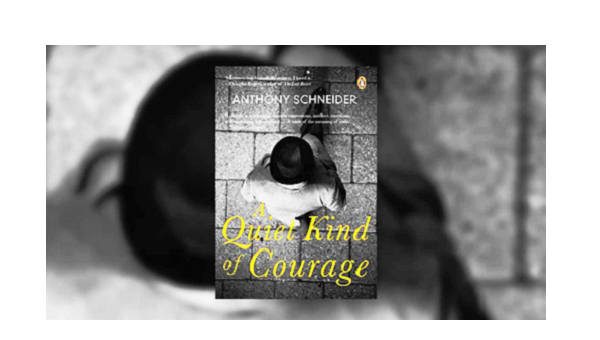
A Quiet Kind of Courage by Anthony Schneider, Penguin Books, 2013.
Dr Marcia Leveson, a long-serving member of the editorial board of Jewish Affairs, is a former Professor in the English Department and currently an Honorary Research Fellow at the University of the Witwatersrand. She has written extensively in the area of South African fiction and edited a number of anthologies of fiction and poetry. Her most recent book, South African Odyssey – The Autobiography of Bertha Goudvis, was reviewed in the Rosh Hashanah 2011 issue of this journal.
[/vc_column_text][/vc_column][/vc_row]


