
(Reviewer: David Saks, Vol. 66, No. 1, Pesach 2011)
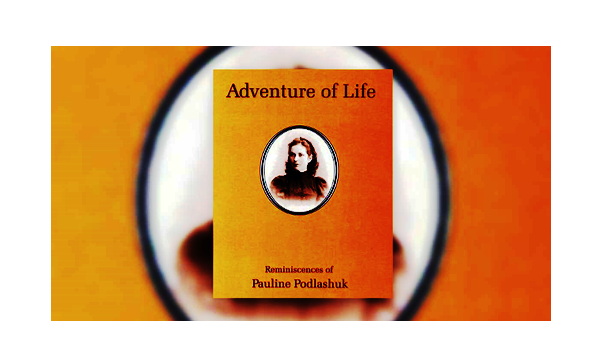
A controversy currently raging over apparent suggestions in a new biography of Gandhi that he and the German-Jewish architect Herman Kallenbach may have had a homosexual relationship lends an added dimension of interest to these recently published memoirs of Pauline Podlashuk, who was associated with both men around that time. Podlashuk briefly came into contact with Gandhi, and in due course with Kallenbach as well, when she was engaged to translate from the Russian the last of three famous letters written to Gandhi by Leo Tolstoy. Her account of these interactions, as well as the text of her translation, is amongst the many items of interest in her posthumously published autobiography Adventure of Life – Reminiscences of Pauline Podlashuk. Written shortly before her death in the early 1960s, these have been prepared for publication by her two grand-nieces Judy Nasatyr and Effie Schultz, with input from other members of her family.
This is not to say that Podlashuk has anything specific to say regarding the supposed gay love tryst. Rather, her account is valuable for providing insightful glimpses into an extraordinary friendship, one that impacted significantly on Gandhi’s own life and therefore on the course of 20th Century history itself.1
Regarding the alleged love-that-dare-not-speak its-name aspect of the Gandhi-Kallenbach relationship, it is probably sufficient here simply to note that Gandhi’s adoption of a life of strict celibacy in middle age is well known, and that Kallenbach, who completely changed his lifestyle through Gandhi’s influence, evidently followed his example. (The last would seem to be confirmed by a letter he wrote to his brother, Simon, saying that through Gandhi, he had given up his sex life eighteen months before).
Pauline Podlashuk herself was an interesting personality who, like Herman Kallenbach, lived her life very much on her own terms. Exceptionally intelligent with a strong personality, she overcame considerable obstacles to become a medical doctor at a time when both her sex and personal circumstances made this extremely difficult. She qualified at the University of Glasgow and lived and worked abroad for a time, travelling extensively throughout Europe before returning to South Africa in 1926.
The Gandhi-Kallenbach sections of the book inter alia describe Podlashuk’s visit to Tolstoy Farm, the commune established by Gandhi, with Kallenbach’s financial support, to house and sustain Indian civil rights activists. On that occasion, she also met Dr Pixley Seme, co-founder and TreasurerGeneral of the newly established African National Native Congress (as the ANC was originally called). Seme had been invited by Gandhi to hear about the Indian Passive Resistance movement against unjust laws that he was heading up.
The memoir ends with Podlashuk about to embark on her return journey to South Africa. Of interest in this latter section is her description of her return visit to her birthplace of Shavli, Lithuania, where she was born in 1881. Here, she describes how much the country had changed and was changing from when she had left it some two decades before. The newly independent Lithuanian state at that time was asserting its own national identity, which entailed very deliberately effacing evidence of the previous centuries-long period of Russian imperialist domination. To the end of her life, Podlashuk maintained a strong connection to the Russian cultural heritage that had nurtured her.
Most of Adventure of Life comprises Podlashuk’s account of her work and studies in Europe, while a substantial part of the remainder describes her youth in Lithuania and visit to turn-of- the-century Palestine en route to South Africa. The South African section, apart from the above-noted Gandhi association, is of interest as a record of the challenges and opportunities facing young Jewish women immigrants like herself in the early years of the 20th Century. It further shows how someone sufficiently bold and resourceful could rise above the constrictions of language, sex, religious minority status and comparative penury to embark on a distinguished professional career.
Adventure of Life – Reminiscences of Pauline Podlashuk, edited by Judy Nasatyr and Effie Schultz, Johannesburg – 2010, 283pp.
NOTES
- See this reviewer’s ‘Right-hand Man of the Mahatma – Herman Kallenbach, Gandhi and Satyagraha’ in Jewish Affairs, Autumn, 1998.
[/vc_column_text][/vc_column][/vc_row]


