
(Author: Naomi Musiker, Vol. 66, No. 1, Pesach 2011)
A newspaper, as defined by the Oxford English Dictionary, is ‘a daily or weekly publication containing news and articles on current affairs’. This is as opposed to a periodical, which is a ‘magazine or newspaper published at regular intervals’. The history of the Jewish press in South Africa features both newspapers and magazines, but this essay focuses only on the former.
The earliest attempt to list serial publications, including newspapers, occurs in the South African Jewish Year Book of 1929 in an article by J S Judelowitz entitled ‘The Jewish Press in South Africa’.1 This list was updated by J A Poliva in his book A Short History of the Jewish Press and Literature of South Africa.2
The Yiddish Press
Some of the earliest descriptions of Jewish immigrants in South Africa are found in two Hebrew journals published in Eastern Europe, namely Hamelitz (St Petersburg) and Hatzefirah (Warsaw). These articles take the form of letters published by recently arrived immigrants giving an account of life in South Africa for the benefit of those considering emigration.3
The earliest Jewish newspapers to be published in South Africa were produced in Yiddish by late 19th Century East European immigrants. For anyone wishing to capture the atmosphere of Jewish life in South Africa during the period when the East European immigration was at its height, the writings of a number of Jewish journalists are of particular significance.
The pioneer of local Yiddish journalism was Nehemiah Dov Baer Hoffman (c.1857-1928), who founded the short lived Der Afrikaner Israelite in 1890. Hoffman was born in Kovno and in Vilna came into contact with many of the leading Jewish intelligentsia of the period of enlightenment of the late 19th Century. He trained as a journalist in Koenigsberg under Michel Levi Radkinson, editor of the Hebrew journal Hakol, and himself wrote several books in Hebrew and Yiddish. In 1882, he was engaged to write for the Warsaw journal Hatzefira (which was published in Hebrew) and in 1885, spent nine months working for the US Yiddish weekly Der Yiedishe Gazetn before returning to Europe to edit the Hebrew weekly Hamagid.
took, unsuccessfully, to peddling. In 1890, he brought over the first Hebrew Yiddish type to South Africa and printed various short-lived Yiddish newspapers, including Der Afrikaner Israelit, Ha-or, Der Yiedisher Herold, Der Afrikaner Telegraph and Yiedishe Folkszeitung. His final venture was the monthly Der Afrikaner, which he edited from 1909 to April 1914. In his articles and book of memoirs Sefer Hazikhronos, Hoffman gives a colorful and interesting picture of the pioneering Lithuanian Jews of the late 19th and early 20th Centuries.
Co-editor and co-owner with Hoffman of Der Afrikaner Telegraph was David Goldblatt (18861945), another pioneer of Yiddish journalism and ardent champion of Yiddish language and literature. Hoffman had grown up in Radom, Poland, and lived in Warsaw, Berlin and London before moving to South Africa. In London, he had come under Russian socialistic influences and trained as a journalist by writing for the Yiddish publication Der ArbeiterFriend. In 1898, he arrived in Cape Town and was invited by Hoffman to write for Ha-Or, the only existing Yiddish weekly. In 1899, Goldblatt founded the first Yiddish daily Der Kriegstaphet, which consisted of a single page, published daily, giving an account of the Anglo-Boer War, an editorial and news of interest to Jews. This publication lasted from 16 October to 13 December 1899. Goldblatt’s most successful venture was Der Yiedisher Advokat, which appeared from 1904 until 1914. The following year, he left for the United States. He is best remembered for his struggle to gain recognition for Yiddish as a European language. His pamphlet Yiddish, is it a European Language? was instrumental in persuading legislators at the Cape House of Assembly to accord Yiddish equal status with other European languages in the admission of immigrants to South Africa.4
Hyman Polsky (1871-1944) grew up in a shtetl near Grodno and in 1891 left for London, where he became a successful photographer. In 1911, he immigrated to South Africa and travelled through many towns and villages recording Jewish life. These experiences appeared in various sketches for Jewish periodicals. Polsky contributed regularly to Der Afrikaner and was its editor from 1920 until 1933, when it merged with the Afrikaner Yiddishe Zeitung. He wrote with great compassion of the struggles of Lithuanian Jewish immigrants, but was less tolerant of the more prosperous, assimilated Jews who flaunted their newly acquired wealth.5
DER AFRIKANER
This weekly Yiddish publication first appeared on 10 November 1911. It was founded, edited and published by Samuel Vogelson, who came to South Africa from Dvinsk before the Anglo-Boer War (1899-1902). He was honorary inspector of the Hebrew Schools (Talmud Torahs) and honorary secretary of the Gmilat Chasidim. To finance Der Afrikaner, he sold his house and attempted to produce an illustrated literary newspaper of a high standard. The paper concentrated on politics, literature and science. In July 1916, an attempt was made to produce an English supplement, called The African Jewish World under the editorship of Percy Cowan. When Vogelson died in July 1920, the afore-mentioned Polsky became editor. The last edition of Der Afrikaner was published in December 1933, after which it merged with the Afrikaner Yiddishe Zeitung (or African Jewish Newspaper). This was edited and published by Dr Benzion Almoni, who founded his own shareholding company, Jewish Daily Press. The paper was subsequently taken over by Boris Gersman.
In 1937, the African Jewish Newspaper incorporated Der Yiddisher Express, which ceased publication in 1942. From 1942, it was published as a weekly. From 1939-1949, the editor was J. Batnitzky, followed by Gersman until his death in 1953. From that date on, it was edited by Levy Shalit who, along with Shmaryau Levin, was also its publisher from 1955. Levin also wrote extensively for the paper.
Four to five thousand copies were printed. The paper had its own printing press with linotype setters from Israel to do the Yiddish setting. It was established at 100 Market Street and distributed through the CNA. Four big supplements were issued at Rosh Hashanah, Pesach, Israel’s Day of Independence and Chanukah. In 1971, the paper celebrated its Golden Anniversary. It finally ceased publication in 1985.6
THE JEWISH ENGLISH LANGUAGE PRESS IN SOUTH AFRICA
Prior to 1902, the Jewish Chronicle (London) was a valuable source of information on events in South Africa as it contained regular news items supplied by local correspondents from the various British colonies. In Johannesburg the Standard and Diggers’ News, edited by Emanuel Mendelssohn, contained many articles of Jewish interest and descriptions of important events from 1887 to 1900.
The South African Jewish Chronicle was the first Anglo-Jewish newspaper to be published in South Africa. It made its first appearance on 7 February 1902 and continued until 12 August 1904 as a fortnightly. The founder and editor was Birmingham-born Lionel Goldsmid (son of Michael Goldsmid, president of the Birmingham Jewish Congregation). He studied at the University of Sydney before coming to South Africa in 1895, at which point he took up journalism and became Reuter’s agent in South Africa. At the time of the outbreak of the Anglo-Boer War, he was assistant-editor of the Transvaal Critic. After the war, he started the South African Jewish Chronicle. Originally published Cape Town, this was subsequently published, now as a weekly, in Johannesburg after his move there in May 1905. Two years later, a company was formed under the name of the SA Jewish Chronicle Publishing Syndicate, with Goldsmid as managing director. Percy Cowan edited the paper from October 1909 to May 1912.
In 1913, The SA Jewish Chronicle was linked up with Die Yiddishe Fohn (Jewish Standard), founded by Benzion Hersch. A new company, called the SA Amalgamated Jewish Press, was now formed, with Goldsmid and Hersch as managing directors. From 1924, the paper was published in three editions in all four South African provinces, as well as in Rhodesia and the Portuguese colony of Mozambique.
In January 1928, the SA Jewish Chronicle was purchased by the SA Jewish Press Pty Ltd and the journal was moved to Cape Town. It was edited for the next few years by Jack Carasov and was then taken over by the Dorshei Zion Association. It served as the official organ of the Western Cape Zionist Federation, but also covered all aspects of Jewish life in the Western Cape. The first editor of the renewed company was Marcia Gitlin, afterwards succeeded by Rebecca Gitlin. In August 1959, the SA Jewish Chronicle was merged with the Zionist Record to form the Zionist Record and SA Jewish Chronicle.
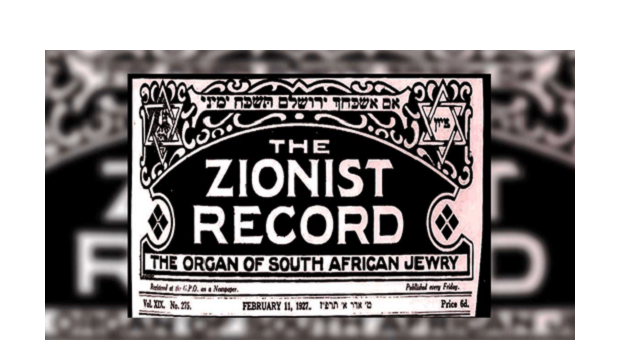
The origin of the Zionist Record dates back to 1898, when the Transvaal Zionist Association announced its intention to publish, in English and Yiddish, a Jewish newspaper to be called the African Jewish Chronicle and Zionist News. It was not until the end of 1908 that the Federation carried out its decision to publish a printed monthly report containing the minutes of the Federation and all affiliated societies together with other matters of Zionist interest.
Although this publication was only a circular, it was entitled The Zionist Record, issued by the South African Zionist Federation. A press committee was appointed in charge of production and the editor was also the secretary of the Federation, at that time Isaac Abrahams (1908-1911).7 The first issue, consisting of five pages, appeared on 15 November 1908. In August 1911, it became a monthly magazine with news of general Jewish and Zionist interest and occasional contributions from overseas Zionists, including Otto Warburg, Norman Bentwich and Leonard Stein. The first original article published, entitled ‘The true spirit of Zionism’, was by Manfred Nathan. A Children’s Page was also added that year. In 1914 a Yiddish supplement was included, edited by Jacob Solomon Judelowitz.
The production of the paper imposed considerable financial strain on the Federation. An attempt was made to secure advertisers, but it was not until 1919 that a profit was shown. Jack Alexander, who took charge of the head office of the SA Zionist Federation in 1919, was largely responsible for the development of the Zionist Record into a robust monthly journal. The bulletin was growing too large to be handled by the secretary of the Federation, and a decision was taken to appoint a separate editor. Alexander continued to contribute editorials, however.
An Editorial Board was set up in 1923, with Benzion Hersch at its head. Hersch was given a separate office in the same building and personally supervised all aspects of production, editing, advertising and circulation. A gifted writer, he translated articles and stories from Yiddish newspapers and wrote original stories of his own. Under his guidance, the Zionist Record developed into a widely distributed and respected newspaper. His death in 1935 was a great loss to the Jewish community and the Zionist cause.
From 1923 to 1943, the editorial and business management of the Zionist Record was in the hands of David Dainow, who developed the newspaper into a fortnightly and subsequently a weekly publication. Dainow encouraged writers such as Chaim Gershater to write in English (he did so under the pen name of ‘Mr Spodik). Edgar Bernstein served his apprenticeship in Jewish journalism under Dainow. Other prominent writers included Rabbi Dr Arthur Saul Super, the poet Chaim Lewis, Henry Katzew and Amos Ben Vered. Sarah Gertrude
Liebson (later Millin) wrote about ‘The Jew in English literature’ while Bertha Goudvis published her translations from Y.L Peretz and others.
Dainow was succeeded as editor by Gershater.8 After the 1959 merger with the SA Jewish Chronicle and the subsequent death of Gershater in November of that year, Azariah Mureinik served as acting editor. From 1960, the editor was A S Super.
During the 1950s, the Zionist Record also had a monthly supplement, including a Hebrew page, called the SA Menorah. This was the official organ of the SA Zionist Youth Council.9
By the late 1980s, the paper’s circulation had dropped to about 10 000 and the SAZF management committee sought some means of enhancing its financial situation. In 1989, an attempt was made under the chairmanship of Abe Abrahamson to bring about improvements by means of more advertising and patronage and increased subscriptions. A new editor, Leslie Winnett, was appointed in 1987. In 1992, as a result of a ground breaking agreement between the management board of the Zionist Record and the publishers of the Jerusalem Post, a number of pages from the weekly international edition of the latter appeared in every issue of the Zionist Record.
Despite this, the Zionist Record’s fortunes continued to dwindle. In part, this was due to the launch in March 1990 of the monthly Jewish Voice, which created additional competition for the existing Jewish papers. The final blow was the termination, at the end of 1993, of the subsidy which had hitherto been granted to the Zionist Record by the SA Zionist Federation.10 The last issue of the Zionist Record appeared in December of that year.
The SA Jewish Times and Jewish Herald were two publications with interlinked destinies. They were both founded at approximately the same time, i.e. the period 1936-7, when German fascism and antisemitism was peaking and impacting on world events. There were various organizations in South Africa, the so-called ‘’Shirt Movements’, sympathetic to Nazi German propaganda, and there was a definite need for the Jewish community to have its own mouthpiece to counteract this.
The founder of the SA Jewish Times was Leon Feldberg, a Yeshiva trained Lithuanian immigrant who had written for the Yiddish press in Europe. In 1933, he went into business in Johannesburg, and saw the need for a vigorous, independent Jewish newspaper to uphold South African Jewry’s rights and hit back against antisemitism. He obtained the support of Dr B Almuni and also brought in as a third partner, Alexander Ovedoff, editor of a small monthly publication, Ivri.
The first issue of the SA Jewish Times appeared on 17 July 1936. The paper was under-capitalized at first, but Feldberg’s persistence won over financial support from Dr Bernard Friedman and Sam Kruger. After the departure of Almuni and Ovedoff, Feldman undertook complete editorial and management supervision of the paper. He was greatly assisted by the appointment of Hans Guggenheimer as
Advertising Manager. In 1939, the SA Jewish Times acquired its own printing plant at the corner of Pritchard and Nugget Streets. During this time, Edgar Bernstein joined the paper as journalist. The war years resulted in economic difficulties, forcing the owners to sell the printing plant and moved to smaller offices in His Majesty’s Building.
By 1948, the situation improved with the arrival of Izzy Sacks and Harold Blumberg to carry out administration and join the board of directors. A new company, Eagle Press Ltd, was formed, with printing and publishing house in Doornfontein. This subsequently became Caxton Ltd. Harold Blumberg also served on the editorial board and contributed the paper’s popular ‘Talk of the Town’ column. Others who joined the Jewish Times included Bernard Sachs (until 1968), Arthur Markowitz and Benjamin Bennett as the Cape Town correspondent. 11 During the 1940s, one of the paper’s employees was the renowned short story writer Herman Charles Bosman, who also wrote a number of opinion articles for it.
On Feldberg’s retirement in December 1968, his controlling interest was acquired by Felix Stark, who merged his own company, Felstar Publications, with Caxton. Edgar Bernstein succeeded to the post of editor and Arthur Markowitz became assistant editor. In 1971, Bernstein left to join the SA Jewish Board of Deputies. He was succeeded by Markowitz, with Azariah Mureinik as assistant editor. In 1983, the SA Jewish Times became the first Jewish newspaper to introduce its own in-house computerized typesetting, photographic and processing facilities, based at Van Der Stel Place, Corner Melle and De Korte Streets, Braamfontein. The publisher was Reuben Shapiro12. In 1985 Suzanne Belling, former Associate Editor and Cape Regional Editor of the SA Jewish Times, succeeded Markowitz as editor. A year later, the paper announced its merger with the Jewish Herald to become the Herald Times.
The Jewish Herald, the official organ of the Zionist Revisionist Organization of South Africa, was first issued under the title The Eleventh Hour on 12 March 1937. The instruction for launching the publication was conveyed by Ze’ev Jabotinsky through his representative Nahum Levy, who came to South Africa to make preparations for Jabotinsky’s visit. It was so named in order to warn the Jewish community of the critical state of European Jewry threatened by the advance of Nazism.
The first editor of The Eleventh Hour was Jedidiah Blumenthal, a pioneer of the Revisionist Movement. The first full-time Editor, and also General Secretary of the New Zionist Organisation, was A A Menkin. It was he who was responsible for changing the name of the publication to The Jewish Herald, which undertook to report Jewish affairs in ‘a true and unvarnished manner’. The paper upheld the political views of Jabotinsky, who wrote the first editorial columns. It supported the efforts of the Irgun Zvai Leumi resistance movement and later, the party of Menachem Begin.13
Successive Jewish Herald editors were Reg Rudolph, Ronnie Misheiker, Joe Kuttner and Harry Hurwitz, while deputy editors included David Abel. The editorial board was chaired by Jedediah Blumenthal, then President of the Zionist Revisionist Organisation of South Africa. Contributors included Abraham Abrahams, editor of the London Jewish Standard as guest editor in 1955, Ivan Greenberg, former editor of the London Jewish Chronicle and Joseph Leiserowitz, one-time intelligence officer in the Hebrew Underground. The last editor of the paper prior to its merger with the SA Jewish Times in 1986 was Maurice Dorfan.14 The Jewish Herald was initially printed by Excelsior Printers, directed by the Picker family.15 After the 1986 merger, publication was entrusted to Publico, under the control of Reuben and Jack Shapiro. The Publico Board also comprised Bertie Lubner and Joseph Rabinowitz.16 The merger of the Jewish Herald and SA Jewish Times to form The Herald Times was welcomed by the Jewish community. Maurice Dorfan was appointed editor, with Suzanne Belling as consultant editor. Reuben Shapiro became managing director, Dr Jack Shapiro served as chairman and the chairman of the editorial board was Jedidiah Blumenthal. This arrangement lasted until 1994, when most of the existing Jewish newspapers ceased publication.
The final decade of the 20th Century led to the emergence of a new type of Jewish newspaper, less concerned with party affiliations and directed more to serving the interest and needs of every section of the Jewish community. The first attempt at this communal paper was the Jewish Voice, a monthly publication launched by the SA Jewish Board of Deputies and the Israel United Appeal-United Communal Fund (IUA/UCF) and published by the Shapiro brothers of Publico Ltd. Gerald Leissner served as chairman of the editorial board while Suzanne Belling was the editor. The stated aim of the newspaper was ‘to cry out against injustice, strive to counteract misconception and highlight what the ethics and tenets of Judaism stand for in terms of truth and respect for human life and dignity’.17 The Jewish Voice was intended to be a free publication distributed to every Jewish household. By 1993, the cost of the newspaper was about R20 000 per month, of which one third was paid by the SA Jewish Board of Deputies and the balance by the IUA/UCF. The final issue appeared in February/March 1994. The editorial comment of this issue gave as reasons for termination, financial pressure and the need for the rationalization of existing newspapers.
In 1993, discussions were started with the object of publishing one major newspaper consisting of a merger of The Herald Times, Zionist Record and Jewish Voice. This led to the re-launch of a ‘new’ SA Jewish Times, published by Publico. The editorial board consisted of six community members, of whom three represented the Zionist Federation and one each the IUA/UCF, SAJBD and Revisionist Zionist Organisation. This paper was published once every two weeks and expressed the views of all three sponsoring organizations. It did not prove to be a successful newspaper and was discontinued after Publico were bought out by Kagiso Press in 1997.
In 1998, the SA Jewish Report came into existence, facilitated by the SAJBD. A company, The SA Jewish Report (Proprietary) Ltd, was formed to carry out this undertaking. The original Board of Directors included Chief Rabbi Cyril Harris, Abe Abrahamson, Sam Abrahams, Denis Maister, Marlene Bethlehem, Issie Kirsh, Seymour Kopelowitz, Bertie Lubner, Herbie Rosenberg and Ivan Levy. The first editor was Janine Lazarus, followed by Suzanne Belling and then by Geoff
Sifrin.
ROLE AND INFLUENCE OF THE SOUTH AFRICAN JEWISH NEWSPAPERS
From the end of the 19th Century South African Jewry, though relatively small in numbers, were blessed with a succession of talented and dedicated journalists who strove against all odds to serve the needs of the Jewish community.
The early Yiddish newspapers voiced the concerns and aspirations of the East European immigrants, struggling in a foreign country to establish themselves, often against great odds. At the same time, the Yiddish journalists were also authors of renown and the papers contain many original stories which have become pearls of Yiddish literature giving successive generations a window into the lives of their forbears.
The English newspapers had to rely on the sponsorship of organizations such as the Zionist Federation for existence. However, the Zionist Record and Jewish Times also served as a record for SA Jewry, covering every aspect of communal events and history and commemorating Jewish leadership in all spheres of political, social and economic life. For this reason the newspapers, although now defunct, continue to provide a valuable source of information for historians and researchers. In many cases, no other source of information is available.
Perhaps it is fitting to close with the words of Abe Abrahamson mourning the closure of the Zionist Record in December 1993:
When the righteous dies ‘tis the earth that weeps with loss. The jewel will forever be a jewel but it has passed from the possession of its former owner. Well may the loser weep.18
Naomi Musiker, a frequent contributor to Jewish Affairs and long-serving member of its Editorial Board, has contributed numerous biographical articles for the Dictionary of South African Biography and the Standard Encyclopedia of Southern Africa and, as an indexer, has worked for some of South Africa’s leading publishers and indexed many important reference works. She has held the position of archivist at the SAJBD for over fifteen years.
NOTES
- S. Judelowitz, ‘The Jewish Press in South Africa’, in South African Jewish Yearbook, edited by Morris de Saxe and I.M. Goodman, Johannesburg: South African Jewish Historical Society, 1929, pp249 -256.
- Joseph Abraham Poliva, A Short History of the Jewish Press in South Africa from its Earliest Days until the Present Time, Johannesburg: Prompt Printing Press, 1961.
- For an example of such letters, see The Writings of Meyer Dovid Hersch: Rand Pioneer and Historian of Jewish Life in Early Johannesburg, edited by Joshua I Levy, Johannesburg: Ammatt Press, 2005
- Liptzin, Sol, Yiddish Literature in South Africa’ in African Jewish Newspaper. Golden Jubilee Supplement 22 January 1971, pp10-11
- Ibid.
- Joseph Sherman, ‘South Africa’s Last Yiddish Newspaper: An Interview with Levi Shalit’, Jewish Affairs, Spring 1993, pp.49-54
- He was followed by I H Harris (1912 and 1913-1918), Isaac Goodman (September 1912 – February 1913) and Jack Alexander (1919-1924).
- The publishers were Kadimah Press, under the chairmanship of B. Rheinhold
- Zionist Record Golden Jubilee edition 1909 1958 contains a full history of the first century of the newspaper.
- Abrahamson, Abe, ‘Well may the loser weep’, Message from Hon Abe Abrahamson, chairman, South African Zionist Federation and Chairman, Zionist Record Management Board. Zionist Record, 17 December 1993.
- For the early history of the SA Jewish Times see Southern Africa Jewish Times Silver Jubilee Issue 1936 to 1961. A supplement published on 22 December 1961
- ‘Jewish Times embarks on major modernization programme’, South African Jewish Times April 8, 1983
- ‘Origins and role of the Jewish Herald’, Jewish Herald. 40th Anniversary Supplement pp15-16
- For a concise history of the Jewish Herald see ‘The Men who Moulded the Jewish Herald’. Jewish Herald Supplement. 40th Anniversary Year, 21 February 1978.
- ‘Excelsior Printers – expertise and sophistication’, Jewish Herald. Supplement 2/9/1980. Rosh Hashanah 5741
- Herald Times 5 August 1986, p1
- Jewish Chronicle, 11 May 1990, p35
- Zionist Record 17 December 1993, p.3
[/vc_column_text][/vc_column][/vc_row]


