
(Reviewer: Marcia Leveson, Vol. 71, No. 2, Rosh Hashanah 2016)
“When the history of our transformation is written, his name will be among those who lent a hand in the efforts to establish democracy, to heal divisions, and to start the process of building a better life.” These are the words of Nelson Mandela. He was referring neither to a native-born South African nor to a fellow ANC member, but to Rabbi Cyril Harris, a man born in Glasgow and educated in London, who took up his position as Chief Rabbi in South Africa in 1987. It says much about the impact that this exceptional person and unique spiritual leader made during his tenure, which ended with his retirement in 2004.
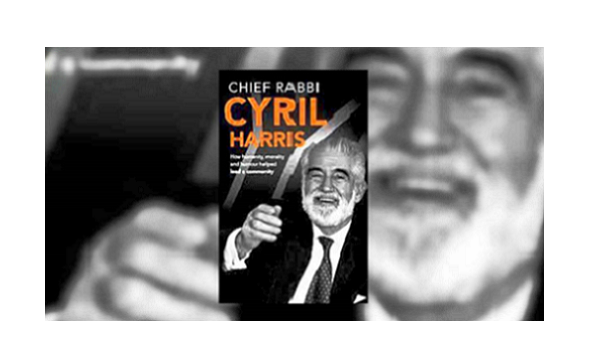
To commemorate the 10th anniversary of the death of Rabbi Harris, Geoff Sifrin has compiled a vivid portrait of the man and his service. He skillfully and sensitively weaves together interviews and memories from those who knew him or who were involved with him in his multiple activities. He includes key passages from Harris’s own memoir of his life, published in 2000, and contributions from his wife and sons. This book is therefore not merely the record of the work of a Chief Rabbi; it is a document for all those interested in the history of South Africa.
During the mid-1980s, many in the Jewish community felt threatened by the upheavals in the country and the atmosphere of impending change. Numbers dwindled due to emigration, and the position of Chief Rabbi was vacant. A selection committee spearheaded by Mendel Kaplan and under the guidance of Lord Jakobovits, Chief Rabbi of the United Kingdom, settled on Rabbi Harris, who by this time, through his special qualities of wisdom and leadership, as well as his charisma and gift for oratory, had already built up three large congregations in London. Harris accepted the challenge to take office in territory unfamiliar both politically and communally, and in a tense country on the brink of dramatic transformation. He saw it as an opportunity to put into practice his strongly-held belief in “being a religious Jew in the real world”.
Sifrin describes how Harris and his wife, Ann, travelled throughout South Africa, visiting every Jewish community, and how his towering presence provided invaluable guidance and support. As his son, Jonathan writes, “with his physical and moral energy… he transformed the attitude of the bulk of the Jewish community away from their sometimes passive acceptance of apartheid”.
Because South African Jews were not accustomed to a Chief Rabbi of this nature, his engagement with controversial issues took courage, which he had in abundance. This was evident when he attended the eulogy at the funeral of a prominent Jewish educationalist and humanist, Franz Auerbach, even though it was a Reform ceremony. He gave an address at the funeral rally of the leading member of the SA Communist Party, Joe Slovo, even though Slovo was outspokenly opposed to Jewish religious orthodoxy.
Although Harris was fundamentally rooted in Orthodox Judaism, he had the all-too-rare quality of a generous “compassionate universalism” which extended to an acknowledgement of other branches of Judaism and to members of other faith groups and races. He was an active participant in many interfaith initiatives. But while he was neither narrow-minded nor bigoted, he was unflinchingly committed to the principles of Halacha.
The book is no mere hagiography; despite his immense gift for friendship – encapsulated in the iconic photograph of his embrace with Nelson Mandela – it is clear that indeed, he also ruffled some feathers. When he felt that his deeply held beliefs were being challenged, his fiery temper flamed out and, to the consternation of some, he sometimes went out on a limb. In contrast to his predecessors, he actively encouraged Jewish engagement in the political process, and even earned the nickname of “Comrade Rabbi”. At the SA Board of Deputies conference in 1990, although mindful of the historic and political background of South African Jewry, he nevertheless called on the Board “to up its whole image”. He went before the Truth and Reconciliation Commission in 1997 and apologised for “the evil of indifference which so many in the Jewish community professed” during apartheid. His address to the TRC is quoted in full.
Harris was not content to concentrate solely on the Jewish community’s internal affairs; he threw himself into the social and economic problems of the country as a whole. The book relates how in 1994, together with Bertie Lubner, he founded the important organisational outreach programme Tikkun (later Afrika Tikkun), which incorporated existing Jewish programmes and developed new projects to alleviate poverty, illness and unemployment. As Lubner puts it, “Mutual values, embodied in the African concept of ubuntu and the Jewish concept of tikkun olam were to be the guiding light that set Afrika Tikkun on its road to success”.
Even from childhood, Ann Harris had been involved in community outreach. She became a partner in an English law firm, and in South Africa worked in legal social welfare. Quite soon she became a driving force in Tikkun, which has vastly grown and now boasts six centres of excellence. She continues as a director to the present day. Her account of these times gives the reader a sense of the development of Tikkun, of her energetic, resolute spirit, and the vital and creative partnership between her and her husband.
Harris emerges from the pages as open-spirited, hugely principled and wise, with a great sense of humour, warmth and innate empathy for those less fortunate. As well, he had a rather unrabbinical partiality for cricket and 17th Century English metaphysical poetry. He won much admiration and great respect, and not only from South Africans. His legacy is an enduring one. It is fitting that in 2003 he was awarded the Jerusalem Prize for services to the Jewish people.
The concluding chapter deals with how, in honoring his memory and in the spirit of his particular vision, The Chief Rabbi CK Harris Memorial Foundation was set up in 2007. This aims to create partnerships with and offer assistance in training personnel in a variety of services. Areas of involvement are the mentoring of rabbanim; medical care for children with cancer; support for Jewish communal organisations and the nurturing of a large range of developmental groups working with disadvantaged communities.
This readable and enlightening book, filled with photographs that evoke the man and his work, is both record and tribute. Gideon Shimoni wrote of Rabbi Harris as having been “the right person in the right place” and “a … gift to the Jewish community”. But as Sifrin amply shows, the gift was equally to South African society as a whole.
Chief Rabbi Cyril Harris: how humanity, morality and humour helped lead a community, ed. Geoff Sifrin, Chief Rabbi CK Harris Memorial Foundation and Batya Bricker, 2015
Dr Marcia Leveson, a long-serving member of the editorial board of Jewish Affairs, is a former Professor in the English Department and currently an Honorary Research Fellow at Wits University. She has written extensively in the area of South African fiction and edited a number of anthologies of fiction and poetry.


