
(Reviewer: Ralph Zulman, Vol. 71, No. 2, Rosh Hashanah 2016)
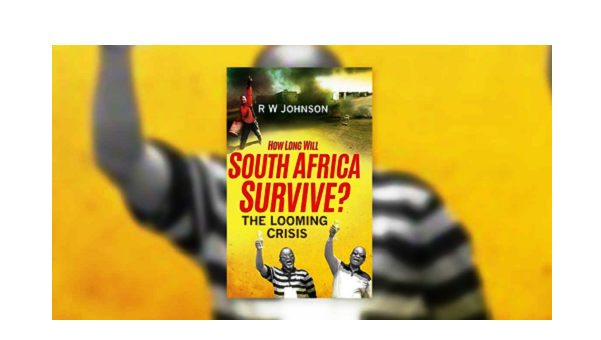
R W Johnson, an Emeritus Fellow of Magdalen College Oxford, has published twelve books, scores of academic papers and innumerable articles for the international press. In his best-selling book How Long Will South Africa Survive? (1977), he provided a controversial and highly original analysis of the prospects of the apartheid regime. Now, after more than twenty years of ANC rule, he believes the situation has become so critical that the question must be posed again, hence the title of his latest book.
How Long Will South Africa Survive? The Looming Crisis consists of a list of abbreviations and acronyms, a preface, ten chapters, notes and an index. It is dedicated to Professor Lawrie Schlemmer, described as “a friend, a colleague and great South African”. Schlemmer, who was of part Jewish extraction, was a former Director of the Helen Suzman Foundation and an eminent sociologist and political analyst.
In the preface, the author describes how Jacob Zuma once sat in his classes. Zuma never expected to be president. Migrating to Durban from “a bone- poor rural background (his mother was a domestic, his father a policeman who died young)”, he told Johnson that he “used to polish the verandah, you know, jobs like that”. In the Durban of those days, the Zulu “house-boys” wore white calico uniforms trimmed with red on their sleeves and shorts and were barefoot. “The very existence of such a group of men as these Zulu house-boys bespoke the humiliation of the Zulu nation” Johnson observes. He remembers Zuma as being “full of bounce and life, always a very jovial man, and also politically aware”.
The Jewish lawyer Rowley Arenstein was Johnson’s great mentor. He remembers him and his wife, Jackie, with great warmth. They were both banned communists and placed under house arrest. The only person to whom he owes as much as he does, and as previously stated, to whom he has dedicated his book, is Schlemmer, in his estimation “a truly irreplaceable man” who was never given the appreciation or recognition that he deserved.
The ‘iron law’ of South African history is that the inflow of foreign investment has to continue for the country to go forward. Chapter One (entitled ‘Then and Now’) concludes with these sobering words:
After 1994 South Africa entered into a euphoric era – which slowly turned sour. For the promises that it had learnt while in exile in independent Africa, the ANC in fact repeated all the classic mistakes of such regimes. There was a lot of misgovernance but perhaps even more than that, there was simply no governance. For years the government was protected by a friendly international environment, by a long commodities boom and by growth which resulted simply from the opening of the rest of Africa to South African trade and investment. After twenty years of almost complete fecklessness, an extremely serious situation had been reached by 2014. It is the contention of this book that South Africa is now heading for another investment crisis, which will in turn end in another regime change, as crises always have in the past.
Chapter Two (‘KwaZulu-Natal, the World of Jacob Zuma’) begins with a description of the taxi wars of the 1990s. It goes on to deal with armed robberies of cash in transit and the ANC’s struggle in KwaZulu-Natal, which was far more violent than in any other province because it came up against “the entrenched strength of Chief Mangosuthu Buthelezi’s Inkatha movement”.
This was the world that Zuma confronted when he returned from exile in February 1990. Most of his income probably came from the Indian businessman Schabir Shaik and tycoon Viviam Reddy. Zuma “blithely incurred large debts ….. His family and lifestyle required more money than he could ever pay from his salary”. The pattern of sympathetic Indians subsidizing Zulu politicians was, Johnson points out, “almost tradition in KwaZulu-Natal…ever since Gandhi funded the Natal Indian Congress”. Zuma’s “rock-solid base was his own Zulu heartland but this was not enough”. He was greatly helped by the special relationship between the Zulus and the Indians. Johnson describes Zuma as “an extremely pleasant and genial man, almost universally popular among those who know him. His fine singing voice and joviality meant that he was in great demand to sing at weddings and funerals”.
President Thabo Mbeki had a low opinion of Zuma and at first tolerated him. Once he was re-elected in 2004, however, he wanted him out. This was not to be – in the end, Zuma ousted Mbeki. His sweeping victory was “an epochal victory for grass-roots democracy”. Much of the story that followed took the form of paying off debts incurred in the desperate years of 2005-7.
The Ishebe group of companies was founded by the Zuma family as a major vehicle for its interests and uses the Zuma name to push for contracts. No fewer than five family members either sit on the board or serve in executive positions. Zuma’s nephew, Khulubuse, is involved in over thirty companies. He works alongside Zuma’s lawyer, Michael Hulley, who was “apparently rewarded for helping Zuma to escape various charges against him”. The pattern which emerges is characterized by Johnson as a “dense forest of family corporate behavior” in which Zuma’s family “has seen his ascent to political leadership as a once-in-a-life-time opportunity to get rich quick…” The Zuma era, he writes, has “brought about the sweeping criminalization of the South African state”.
Chapters Three through to Nine describe in detail the ANC under Zuma, the 2014 Mangaung conference, the new class structure, culture wars, the state’s repression of economic activity and the Brics alternative respectively. In Chapter Eight, the point is made that in response to Julius Malema’s “set of magic formulae”, his ANC competitors produced their “own magic”. This situation inevitably caused “frissons of anxiety among the minorities (especially Asians and Jews), but South Africa’s ruling elite appears to be blithely oblivious to it, as also the damage done to the investment climate”.
In the final, tenth, Chapter, entitled ‘The Impossibility of Autarchy’, Johnson concludes with these somewhat bleak views:
… the whole ANC experiment is top-heavy … in power the ANC has actually become more chiefly, more tribal, a giant federation of political bosses held together by patronage, clientelism and concomitant looting and corruption. This has created a political regime which is quite incapable of managing and developing a modern state. It may take great social convulsions to change that because the groups now in power will not easily let go of it. Indeed had they played their cards more cleverly they might have consolidated their rule. But they have done the opposite. The result is an imminent crisis on many fronts… My own hope – supported by certain optimism – is that, as in Portugal, this will ultimately see the consolidation of liberal democracy here in South Africa too.
Elsewhere in the book, Johnson states that “… everything suggests that South Africa under ANC rule is fast slipping backward and that even the survival of South Africa as a unitary state cannot be taken for granted”.
I agree with the view that Johnson’s analysis is “strikingly original and cogently argued”. His analysis is lucid and shows a complete lack of deference towards the conventional wisdom. He writes without fear or favor. His book is commended not only to every South African but to all who are interested in the future of South Africa.
How Long Will South Africa Survive: The Looming Crisis by R W Johnson, Oxford University Press, 2015, 266pp
Mr Justice Ralph Zulman, a long-serving member of the editorial board of Jewish Affairs and a frequent contributor to its Reviews pages, is a former Judge of the Appeal Court of South Africa.


