
(Author: Glenda Woolf, Vol. 73, No. 2, Rosh Hashanah 2018)
I remember well that first Yom Ha’atzmaut celebration in Bloemfontein. The most lasting memory I have is the prediction my mother made about the future. Other memories too, come flooding back. So, to start at the beginning: I remember waking up early one Sunday in May 1948, and hearing, “Wake up. Quickly, get up. Today is a very special day. We Jews have our own country again. Soon we are going to the shul to celebrate. The children must wear fancy dress. Hurry, we don’t want to be late.”
So the day began. We went to the enclosed porch where my mother kept a bagful of old clothes. My sister and I were dressed in old woollen skirts. A flowered tablecloth was draped around my head and shoulders. My sister had a scarf draped around her shoulders and a scarf tied on her head. So off we went.
My father had gone off to attend to a patient. He had practiced medicine in Thaba N’chu and recently moved to Bloemfontein. We were new in town, bereft of the warm supportive Jewish country community we were used to, and thrust into a larger Jewish community consisting then, I think, of about three hundred families.
People were gathering around a high flag pole talking to one another excitedly. Girls and boys in the khaki uniform with a blue and white tie were busy assembling a home-made blue and white flag on the rope of the flagpole. Girls in sparkling dresses from ballet performances pranced around. Little boys in a variety of costumes ran about. We stood in a tight small group and watched them.
To our right was the beautiful old shul, to our left the shul hall and classrooms. Silence was called for. Speeches began. I don’t recall who spoke or what they said. Then the children were told to parade before a group of judges. Well, I was mortified.
There were my sister and I, in a motley collection of old clothes and scarves and tablecloths, and there were the girls, our contemporaries, in their glittering costumes.
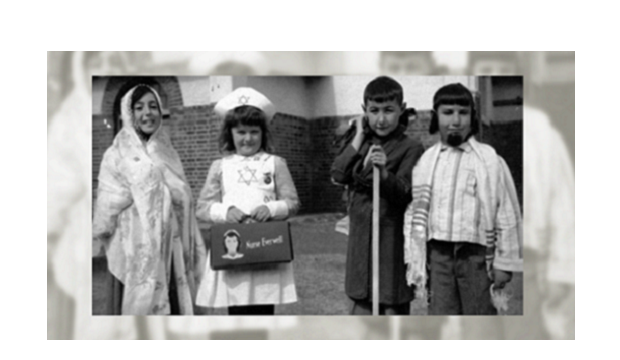
When the names of the four prize-winners were called out I was hardly paying attention, but suddenly I heard my name. So off we went, two boys and two girls, to have our photos taken. I have the photo still: myself , my friend Rosalind Kayceff, in a nurses uniform adorned with Magen David badges, a boy wearing an old gown, clutching a large staff and a small bundle, and another boy, false beard and a kippa on his head and a tallis covering his shoulders.
Afterwards, we returned to the main group. The flag was raised. We sang Hatikvah, and slowly a murmur of sobs came from here and there among the crowd. It was then that my mother said, “You must always remember this day. For the first time in thousands of years we Jews have our very own country. Your generation will be different to our generation. Our parents knew all our laws and kept them. But we, who grew up here, went to non-Jewish schools. We didn’t learn our laws and we don’t keep most of them. We are the lost generation but your generation will learn all the laws again and keep them. You will live again like our grand-parents and parents did.”
I remember our lifestyle. Like most Jews in the town, we kept strictly kosher. We were very aware of the concept of “Chillul Hashem” (desecration of the Divine Name), though it was usually phrased as “Jews don’t…” So we knew that we had to be honest and polite at school, otherwise it would reflect badly on the other Jewish children. True we didn’t keep all the laws of Judaism, but looking back, I think that what my mother called the “lost generation” was not so lost after all. They did succeed in transmitting to us a pride in being Jewish, and a basic Jewish lifestyle.
Was there a dramatic change in our lives overnight? The answer is a resounding ‘no’. Jewish girls continued to go to Eunice Girls School. We walked into the hall, and listened to announcements. We heard “Jewesses lead out” and went into the small entrance hall. We stood and peeped through cracks in the door until we heard, “Jewesses may now lead in”. We went into the classroom for our names to be read out, and marked as present, and then we went out of the classroom to stand at a closed door, while, the rest of the class had scripture lessons.
The rest of the day was divided into lessons and two breaks, when we ate sandwiches brought from home, the Jewish girls generally playing together.
In the afternoon we went to ballet and tap and speech and music lessons. The boys, of course went to cheder. Every afternoon, the redoubtable Mr Shiffman taught large classes of boys how to read and daven as well as Tanach and halachot. This, of course, ended when they were barmitzvah. Then the ladies committee would make a special Kiddush after shul, and everyone came, and there were speeches
On Sunday morning we went to Habonim, girls and boys in separate groups, together only for the opening ceremony, ending with “Chazak”, from our leaders, and our reply of “Chazak v’ematz. “
Country Jewish children, in their high school years came to the town, to boarding school, the girls mainly to Eunice, the boys mainly to Grey College. So it seems, that events continued for us, much as they had in my mother’s “lost generation”.
We left school, went to Johannesburg or Cape Town to attend University and lived in Residence there. Still, little change.
Then in 1967, our Jewish state was under threat. Jewish awareness worldwide rose up. Once victory was assured change began, slowly at first and then with ever increasing vigor. Now my generation began to fulfil my mother’s prophecy, with the phenomenon that became known as the “Baal Teshuva movement.”
Our children grew up in homes where Jewish law was more closely followed. Was I leading a life like my great grandparents? Maybe we observed the laws more closely, but, I think we could not suddenly catch up on their vast fund of Jewish knowledge.
So now, looking at South Africa seventy years later, I see virtually all Jewish children attending Jewish schools, learning Hebrew and Tanach and halacha. There are no longer girls without a Jewish education. Boys no longer forget about Jewish learning the moment they turn thirteen. The whole range of Orthodoxy is available in shuls.
Ohr Somayach came to Johannesburg many years ago, and began a congregation in a small house with Rabbi and Rebbetzin Auerbach and their family, Professor Charles Isaacson, recently returned from a year at Ohr Somayach Yeshiva, and a handful of Jewish students. Today, Ohr Somayach has a large, beautiful shul and a campus that includes a school. Indeed, a whole range of shuls now exist, both in Johannesburg and other major cities, where all the congregation have the knowledge of their grandparents and lead Jewishly observant lives just as they did.
My mother’s predictions all those long years ago have come to fruition.
But there is more. From Johannesburg the “Just one Shabbos” movement has spread worldwide.[/vc_column_text][/vc_column][/vc_row] The writer (left) with the other best costume winners, Bloemfontein, 14 May 1948. More than that, the Jewish Lithuanian heritage of South African Jews has now come full circle. When the Lithuanian immigrants came to South Africa, they left behind a culture rich in learning, with many yeshivas. From these institutions, rabbis went out to serve different communities throughout the world. South Africa now has its own yeshivot. Many graduates continue to spend more years learning in Jerusalem and elsewhere in the Holy Land. Rabbis from South Africa, great- and great-great grandchildren of those Lithuanian immigrants, exert their influence on many different communities worldwide. Rabbi Akiva Tatz in London and Rabbis David and Daniel Lapin in America come immediately to mind, but there are many more. So I am left a full seventy years later, with my photo of four children in fancy dress, and the memories of a flag slowly being raised and the sounds of Hatikvah filling the air, here, on the outskirts of Jerusalem, gazing out of my window waiting for the sound of the siren to celebrate the beginning of Yom Ha’aztmaut. Our generation regained the lifestyle of our grandparents and great grandparents. Our children and grandchildren, the boys with their long peyos, the girls in their modest dresses, have regained the deep Torah knowledge lost to my mother’s generation, lost to my generation. Maybe my children and grandchildren can take these things for granted. But each time the siren sounds ushering in this special day, I feel again that sense of awe and wonder that enveloped all of us that very first Yom Ha’atzmaut in Bloemfontein.
Glenda Woolf, a frequent contributor to Jewish Affairs, is a novelist and essayist whose articles and stories on Jewish themes have appeared in Jewish publications worldwide. Her novels, published under the name Gita Gordon, include: South African Journeys (2002), Flashback (2007), Mystery in the Amazon and Scattered Blossoms (both 2008) and Guest House (2012).


