
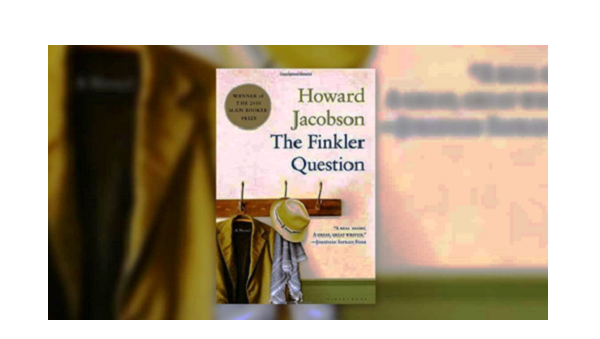
(Reviewer: Michael Belling, Vol. 66, #2, Rosh Hashanah 2011)
Antisemitism isn’t funny, but The Finkler Question is – it is comedy in the classic sense where the jester, with deadly serious intent, uses humor to put important matters in perspective, tells jokes to drive a point home and is funny in illustrating the consequences of how people respond to situations.
It might seem surprising that a work dealing with overtly Jewish issues – antisemitism, Jewish anti-Zionism and self-hatred – could make the shortlist for a prestigious international literary award, let alone win the 2010 Man Booker Prize for Fiction. Yet, the sheer brilliance of the writing, outstanding characterization, wit and often hilarious comedy makes The Finkler Question exceptional, fully deserving the prize and the accolades it has received.
The three main characters approach the issues very differently. Julian Treslove is a would-be Jew, trying to make sense of what it is to be a Jew, but also a “humiliating capitulation to the gods of failure”. Sam Finkler, an old school friend of Treslove’s, is a successful writer of pop philosophy books (The Existentialist in the Kitchen, The Little Book of Household Stoicism), who is full of “confidence, such certainty of right”, a vociferous and very public Jewish anti-Zionist. Libor Sevcik, at almost 90, is forty years older than the other two, their former teacher, a pre-war Czech Jewish refugee who made a successful career as a showbiz celebrity interviewer, taking his central European Jewishness with him wherever he went.
The interaction of the three men – alone and lonely – is central to the story: Finkler and Libor recently widowed, while Treslove has had a life of serial disastrous relationships with women.
Finkler was the first Jew Treslove met, successful, extrovert, clever. “If this is what all Jews look like, Treslove thought, then…Finkler was a better name for them than Jew. So that was what he called them privately – Finklers – giving the novel its title, rather than The Jewish Question.
Finkler and Libor frequently argue about Israel and Zionism. “‘Here we go,’ Finkler says whenever the question of Israel arises, “Holocaust, Holocaust,’…and Libor, in his turn, retorts, ‘Here we go, here we go, more of this self-hating Jew stuff,’ even though Treslove had never met a Jew, in fact never met anybody, who hated himself less than Finkler did.”
Finkler has declared his feeling on a national radio broadcast, when he stated, “‘In the matter of Palestine…I am profoundly ashamed.’” This leads to letters of support from like-minded Jews, whom Finkler gladly leads, suggesting the name for the group, ASHamed Jews, a capital letter allusion to the Jewish past. They write in a letter to the Guardian: “Far from hating our Jewishness…it is we who continue the great Jewish traditions of justice and compassion.”
Some of them retain some vestiges of Jewish observance, others do not: “Those ASHamed Jews who were only partially ashamed – that is to say who were ashamed, qua Jews, of Zionism but not, qua Jews, of being Jewish – were permitted to put their mortification into abeyance on Rosh Hashanah, Yom Kippur and Hannukah, etc, and would resume again when the calendar turned secular.”
Finkler, surprisingly, has his Jewish epiphany during a debate on Israel with Jewish establishment representatives on Israel. He and his female colleague spoke. “The community Jews were no match for her. Which wasn’t saying much. Had they been the only speakers they’d still have contrived to lose the debate.”
However, during question time a non-Jew in the audience poses a question to one of the Jewish panelists, which Finkler quickly steps in to answer:
‘“How dare you, a non-Jew…even think you can tell Jews what sort of country they may live in, when it was you, a European Gentile, who made a separate country for Jews a necessity?…So what empowers racists in their own right is to sniff out racism in others? Only from a world in which Jews believe they have nothing to fear will they consent to learn lessons in humanity. Until then the Jewish State’s offer of safety to Jews the world over – yes, Jews first – while it might not be equitable cannot sanely be construed as racist.”’
From that day, Finkler falls out with his fellow exponents of Jewish ASHamedness with regard to the proposed academic boycott.
The other side of the issue is presented most often through Treslove, Libor or the writings of Finkler’s late wife. One example is an anti-Israel play, Sons of Abraham (an allusion to Caryl Churchill’s notorious Seven Jewish Children, performed in London and the United States recently): “Sons of Abraham, like much else of its kind, was a travesty of dramatic thought because it lacked imagination of otherness, because it accorded to its own self-righteousness a supremacy of truth, because it mistook propaganda for art, because it was rabblerousing.”
Another is: “Jews would not be allowed to prosper except as they always had prospered at the margins, in the concert halls and at the banks….Anything else would not be tolerated. A brave rearguard action in the face of insuperable odds was one thing. Anything resembling victory and peace was another. It could not be borne, whether by Muslims for whom Jews were a sort of erroneous and lily-livered brother, always to be kept in their place, or by Christians to whom they were anathema, or by themselves to whom they were an embarrassment.”
Apart from the Jewish-Israeli argument, which make this book almost required reading for anyone interested in the modern antisemitism and so-called anti-Zionism, Jacobson brings his characters alive, sometimes within a line or two. Thus, Libor takes a rather vacuous woman on an unfortunate dinner date for company over a meal. They discuss political leanings. “Fortunately, Emily wasn’t a Jewish leftist. Unfortunately, she wasn’t anything else. Except depressed.”
The humor jumps off most pages.
“Hephzibah didn’t so much cook as lash out at her ingredients, goading and infuriating them into taste. No matter what she was preparing she always had at least five pans on the go, each of them large enough to boil a cat in.”
Brilliant writing, a superb command of the language, intellectual challenges, insight and just plain intelligence make this a marvelous read.
The Finkler Question, by Howard Jacobson, Bloomsbury, New York, 2010, 307pp
Michael Belling is a Jewish Telegraph Agency correspondent in South Africa and has written widely for many publications here and abroad, including Jewish Affairs. He is a former foreign correspondent for a South African media group in Israel, where he also practiced as an advocate.


