(Reviewer: Reuben Musiker, Vol. 66, #2, Rosh Hashanah 2011)
‘I sometimes wonder if the world has ever seen more startling changes in so short a time as those which have followed in such rapid succession within my own lifespan: two world wars, the conquest of the air, the most amazing discoveries and inventions, and nowadays even the threat of nuclear fallout to extinguish life on earth”.
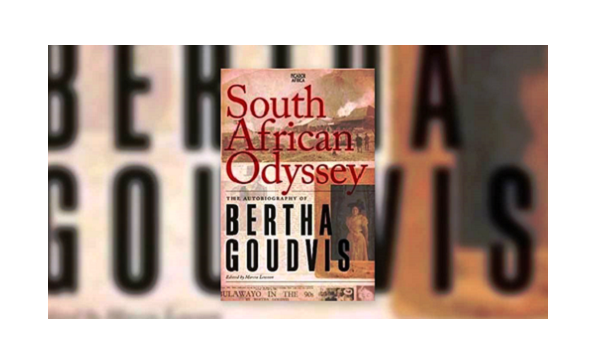
These words, written by Bertha Goudvis in her old age, are a fitting summary of the events which she describes so lucidly and vividly in this reconstructed autobiography, which has been assembled from various typescripts and extracts from publications. The editor, Marcia Leveson, is to be congratulated for assembling these fragments into a compelling narrative, which not only covers the life of Bertha Goudvis but provides new insight into the life of South African Jewry during the late 19th and early 20th Centuries. The book contains a useful glossary and index. A more comprehensive introduction, explaining the socio-historical background to the period covered by the narrative, would have been a welcome addition as would footnotes explaining the historical significance of many towns and personalities mentioned in the book.
As a child of barely five years old Bertha, together with her mother and sister Clarice, set off from Dartmouth in 1881 to join her father, Jacob Cinamon, in South Africa, where he had gone two years earlier to seek his fortune. During the last two decades of the 19th Century, many immigrants were similarly tempted by the lure of diamond and gold discoveries in South Africa, but few attained the good fortune of the promised El Dorado. Bertha described her father in these words: ‘He was honorable and hardworking and of a sanguine and speculative disposition, although in the end he lacked the flair for success -he never knew when to sell in time’. He was also ‘a born autocrat who was convinced that all he did was for the best, but many, including his elder daughter, resented his dominance with some bitterness’. Of all the characters in the book, Jacob Cinamon is perhaps the most clearly defined and described. His growing family led a peripatetic existence, transported wherever the possibility of fame and fortune was rumored to exist.
Bertha herself was an extraordinarily precocious and gifted child with remarkable powers of observation. It is clear that she never enjoyed a normal childhood and was much in the company of adults. Speaking of the period during which the family resided in their first home in the village of Burgersdorp, Bertha writes of her mother, ‘She said in later years that she had made me old fashioned before my time because she needed companionship and I had a lively mind’.
Like many women of her generation, she received little formal education, yet from the age of five she was able to read fluently and during her childhood eagerly devoured whatever books she came across. She recounts that while on a visit to relatives in Pietermaritzburg, her aunt took a dislike to her precocity and forbade her to read the novels in her bookcase, putting them on the top shelf out of reach. ‘But when she and Mother went out together, I climbed on a chair and stood reading until the creak of the gate warned of their return.’ Possibly, this early acquaintance with literature and the fact that her father accustomed her from childhood to his views on religion, politics and general topics also fostered her powers of observation.
Bertha provides fascinating accounts of the various small towns encountered during the family’s endless wanderings. These included Burgersdorp, Middelburg in the Transvaal and, most interesting of all, Barberton. She was particularly adept in her descriptions of personalities. Her first journalistic effort was published in the Daily Graphic,a London publication, and was a graphic description of her experiences during the Matabele Rebellion that occurred during the family’s sojourn in Bulawayo. She was then scarcely twenty years old. A remarkable feature of this account was a shrewd description of Cecil Rhodes.
After her marriage to Leigh Goudvis, Bertha moved with him and their growing family to Lourenco Marques and subsequently to Durban and then Vryheid. In the role of hotelier’s wife, she encountered many interesting personalities. Her most memorable experience was a meeting in Lourenco Marques with the former president of the South African Republic, Paul Kruger, who presented her with a valuable autographed photograph of himself.
The journalist career of Bertha Goudvis began in the 1920s while she was resident in Vryheid. She supplemented the family’s meager income with contributions to the Natal Mercury and she also worked at the Johannesburg-based newspapers, The Evening Chronicle and The Star. In this respect, she was something of a pioneer and innovator, as journalism at this time was mostly a male profession and women were relegated to writing on social columns. She describes an interview with the editor ofThe Evening Chronicle, Herbert Clayton, in which he stated that ‘the paper could not yet afford to employ a woman on the staff, the social work being done by someone who was glad to supply reports in exchange for tickets’. Eventually, Clayton was prevailed upon to ‘entrust me with a variety of jobs, even including the reporting of political meetings.’ For these meetings, lacking a knowledge of shorthand, she relied on her prodigious memory. She also wrote special articles and a weekly interview with a theatrical or music hall celebrity. During the decade 1950-1960, she was asked to supply a weekly column of Jewish interest for The Star. She decided to call it ‘Jewish Notebook’ and wrote under the pseudonym ‘Daniel’ (choosing a male name because she wished to write about matters of general interest and not be confined to descriptions of social functions). During this period she met many Jewish celebrities, including Dr Chaim Weizmann and Chief Rabbi Dr JL Landau. Bertha became a close friend of the Chief Rabbi and his wife. Together with Mrs Landau, she was one of the founders of the Johannesburg Women’s Zionist League and was honored at the 1952 annual general meeting of the League by the presentation of a certificate for eighteen trees.
Bertha Goudvis wrote that she always cherished the hope that someday her plays and stories would win her recognition as a South African writer. Her opportunity arose after she had been commissioned to write articles and sketches on Jewish life for the Zionist Record, edited by Jack Alexander. One of these sketches of Jewish life, entitled A Husband for Rachel,was produced by Bertha herself at the Jewish Guild Theatre. Other one–act plays followed includingAliens, The Way the Money Goes, Patriots and Sergeant in Charge. In 1929, she was persuaded by an Italian musician, Signor Angelo Casiraghi, to write the libretto for a musical comedy entitled Sunshine Land. This production enjoyed considerable success on its first performance at the Standard Theatre. Unfortunately, the libretto was subsequently lost after the departure of Casirighi for Italy.
In 1949, Bertha’s novel Little Eden was published to great acclaim. This was followed by the publication of a collection of her short stories, including The Mistress of Mooiplaas and Other Stories – all of which had originally appeared in The Outspan magazine under the editorship of A Wells. Bertha said of Little Eden that it was based on her experiences and observations during her stay in Louwsburg, a tiny village on the outskirts of Vryheid. In the same manner, the short stories written for the Outspan were based on the kind of life she had known from childhood. “The reader will see that I had learned to write by trial and error, and at best could only tell a round unvarnished tale.’
From 1956, onwards Bertha made the first attempts to work on her autobiography. An early draft appeared in Jewish Affairs in April 1956. This was followed by an excerpt entitled ‘Pages from an Unpublished Autobiography: President Kruger in Lourenco Marques’, which was published in the South African P.E.N. Yearbook 1956-1957. Other autobiographical extracts were included an article entitled ‘What Life has Taught Me’, Rand Daily Mail, 6 April 1956, and in a publication entitled Textures, No.4: Special Bertha Goudvis Issue, University of the Orange Free State, 1987.
The question arises as to why Bertha Goudvis encountered such difficulty in completing her autobiography. A possible reason might be deduced from the following statement:
My own life has inevitably been so closely bound up with that of my family that it has been hard to tell my story without more frequent mention of its members. But their wish for privacy must be respected. My daughter, like my sister, has been insistent on this point. No such restriction applies to my father, however, who died long before this book was contemplated. He was such a character that, when I spoke of him last year to someone who was interested in my early life, she exclaimed, ‘What a man! You could write a book solely about him…’
It is interesting to know what personal philosophy motivated Bertha Goudvis throughout her long life, in which she endured many losses, including the death of her closest family members. ‘It was my fate to live on and even to survive my sister’. In 1956, when she was eighty years old, she was asked by the Rand Daily Mail to spell out what life had taught her. Here are the main points of her reply:
Life has taught me not to be dogmatic, and to refrain from interference with the lives of others. .. I find that I am less easily shocked today than I was in my twenties, or even in my thirties…I no longer believe in Utopias, for there is something in errant human nature which militates against them. Nevertheless, I have seen in my time a vast improvement in living conditions for the majority, and opportunities made available which were hitherto denied…Although the years have tamed my early socialistic fervor, I still believe in the Welfare State, but it must be a free and democratic one… It is better to laugh than to cry, and a gust of laughter may sweep away those hurt and angry feelings which so often spoil a good relationship… When I was young, I believed that once women were emancipated they would change the world. This illusion was soon shattered. I still believe that emancipation is right and necessary, for time has proved the truth of Olive Schreiner’s contention that changing economic circumstances at forcing women out of the home and into the labour market…. Women have gained the franchise and greater freedom, but they have not combined to save the world from war or any other evil, for they are swayed by the same hatreds, passions and prejudices as men…
In 1964, she declared that it was ‘time to bring down the curtain’. Her death occurred in 1966 during a visit to the Cape Town home of her nephew, Mr H H Michaelis.
Bertha Goudvis is recognized as a pioneer South African literary figure. Many of her short stories continue to be reproduced in anthologies, including Michael Chapman’s ‘Omnibus of a Century of South African Stories’ (2007). Tributes have been paid to her by scholars such as Shirley Kossick of the University of South Africa. In 1983, Marcia Leveson of the University of the Witwatersrand presented a paper on her work at the Grahamstown Association of University English Teachers of South Africa Conference. This paper was included as a chapter in the anthology, ‘Women and Writing in South Africa’ (Heinemann, 1989). Leveson’s final tribute was the preparation of this autobiographical work, which Bertha always called her South African Odyssey.
South African Odyssey: The Autobiography of Bertha Goudvis, edited by Marcia Leveson, Picador
Reuben Musiker is Professor Emeritus of Librarianship and Bibliography, University of the Witwatersrand. He has published widely on issues of Jewish and general interest, is Library Consultant, SA Jewish Board of Deputies, and has served for over thirty years on the editorial board of Jewish Affairs.