
(Author: Hadassa Ben-Itto, Vol. 71, No. 2, Rosh Hashanah 2016)
Editor’s Note: This is the final instalment of a three-part feature reprinting (with slight editing) Chapter 10, as well as the relevant section of Chapter 12, of Hadassa Ben-Itto’s The Lie That Wouldn’t Die: The Protocols of the Elders of Zion (Vallentine Mitchell – London, 2005). A best-seller on its publication, the book was quickly recognized as being amongst the definitive studies on The Protocols. It includes a chapter on the famous Grahamstown libel trial of 1934, where the SA Jewish Board of Deputies lodged a case against prominent members of the SA National Party (Greyshirts) movement after they has forged a document with contents closely based on The Protocols and falsely intimated that it was authored by Rev. Abraham Levy of Port Elizabeth. The action was successful, making this one of the first cases where The Protocols was debunked in a court of law.
The second section, published in the Pesach 2016 issue of Jewish Affairs, dealt with the presentation of the plaintiff’s witnesses, including Rev Levy himself and the then World Zionist President Nahum Sokolow, an expert on The Protocols who providentially happened to be in the country at the time. This final section features the defendants’ arguments and the court’s judgment. It concludes with a section from a later chapter in the book relating to the subsequent history of The Protocols in South Africa and how, in 1991, it was placed on the list of ‘undesirable publications’ following an application to the Directorate of Publications by the SA Jewish Board of Deputies and the International Association of Jewish Lawyers and Jurists (SA Chapter).
The Editor thanks Judge Ben-Itto for allowing Jewish Affairs to reprint the relevant sections of her book. The Lie That Would Not Die: The Protocols of the Elders of Zion is available through the publisher (frank.cass@vmbooks.com) from the distributor in the USA (wendy@isbs.com) and at Amazon.
It was time for the defendants to present their witnesses.
From now on he would speak in the name of all three defendants, Von Moltke declared. ‘We all realize outside and inside this court’, he announced, ‘that this case is of a very serious character.’ It was not just a defamation case, he said. As the defendants were pleading justification, in order to expose the international Jewish Plot, it was a case unique in the history of the British Empire.
Turning to the judges he declared, “I must say, Your Lordships have been so lenient with us, seeing we are not represented here, and you have given us all the latitude which has been very favorably commented upon by our sympathizers.”
This is outrageous, Reynolds thought. This case was not tried in front of the Nazi sympathizers, he whispered to his colleague. Don’t be too sure, Stuart whispered back.
Addressing the court Von Moltke announced that they would prove and argue the following points:
- That the Christian people in South Africa were a divided people.
- That the International Jew divided them and will keep them divided as long as he could exploit them.
- That within a few generations all the Christian people in South Africa will have been forced into an unconditional bondage by the International Jew, if they did not awake.
- The Christian Church and the Christian Faith was being disgracefully undermined by the immoral code of the Jew.
- Within the Christian State of South Africa there was a hostile Jewish state. Similar Jewish hostile states existed in all the countries of the world.
Some of the defense witnesses appeared in Grey Shirt uniforms, decorated with swastikas. They had all attended the meetings but the name of the Rabbi was not mentioned; nobody referred to Rabbi Levy.
The defendants’ tactic was clear, Reynolds whispered to his colleague. Fearing that they might have to compensate the Rabbi for defamation, they were trying to minimize the effect of the forged document, at the same time using the court as a public forum for advertising the Jewish International Plot. There was no question now, Reynolds said with satisfaction, that the court would have to rule on the Protocols of the Elders of Zion.
Reynolds had decided to spare the court and keep his cross-examination to a minimum. It would be futile, he explained to his client, to argue with witnesses whose bias was apparent. What do you ask a witness like Joseph Jacobus Van Heerden, a missionary who preaches to natives, who had assured the court he knew the Bible well and that according to the Bible the Jews were out to dominate all other nations. They crucified Christ, he had declared, “because Christ was against dirty morality, and they could not stand his attitude and preachings against them”. Even the judges had looked disgusted, Reynolds reminded the Rabbi; it was much more effective to ignore such testimony c ompletely.
At long last they were done with the witnesses concerning Rabbi Levy. It was now time for the witnesses against the Jewish people.
With a triumphant gesture, Von Moltke invited to the stand and introduced the expert for the defense: Henry Hamilton Beamish. The son of an English Admiral, Beamish had come to Canada at the age of 18 and taken part in the Boer War and World War I. He had also grown tea in Ceylon and worked in the mines in Rhodesia. But his claim to fame lay in his ‘expertise’ on the ‘Jewish question’, as Beamish himself boasted to the court.
He was one of the mentors of the Nazis, Beamish declared, had traveled around the world and visited every continent and scores of countries, to promote Nazi propaganda. For thirty years he had been concerned with the ‘Jewish Question’, and one of his main goals was to combat the Jewish World Dominion. He was one of the leaders of what he called ‘The Nazintern’, and served as president of numerous national as well as international Nazi organizations. He also headed publishing establishments, such as ‘The Britons’ in London, and had published important anti-Jewish books, which had been translated into many languages.
Beamish said that he was personally involved in various publications of the Protocolsof the Elders of Zion; he knew Victor Marsden, who had translated the Protocols into English, as well as Theodor Fritsch in Leipzig. Fritsch was the publisher of the Protocols of the Elders of Zion in Germany, the editor of Hammer Verlag, the publishing house that published the Henry Ford book [The International Jew] and refused to stop publication even after Ford’s retraction.
To top it all, Beamish said, he was personally acquainted with all the important Nazi leaders, who had drawn many of their ideas from his writings and from personal instruction by him. He also knew L. Fry, the author of Waters Flowing Eastward, he volunteered, but gave himself away when he used the masculine gender, speaking of Lesley Fry as if she was a man. He called himself a student of ‘raceology’.
A real honest-to-God admitted Nazi, Reynolds noted on his pad.
The witness was not through with his boasts. To Von Moltke’s question about his formal position in racial movements, he stated unblinking, “I belong to most of the Racist movements in Great Britain. When the League of Gentiles was started some years ago I believe they made me president….and I have been asked to attend the Pan-Aryan Congress to be held in Bavaria. I am also told that I have just been made President of the Bund Volkischer Europaer, which in English is for keeping the European races pure….mainly to keep them free from Jew blood ”.
Western civilization was in a sorry plight, continued Beamish, and these various movements had been established for the avowed purpose of re-establishing European-Aryan control in Government.
What have we here, Reynolds pushed a note in front of his colleague, Protocolsof the Aryan Elders of Europe?
On the stand Beamish was warming to his subject: “I defy anyone to name any government in the whole of Europe today that is not absolutely controlled by Jews, with the exception of Germany, because she set an example”. With a voice of authority, he then delivered his well-rehearsed ‘Expert Opinion’ on the Protocols of the Elders of Zion. Adopting the well- rehearsed ‘Ford tactic’, he stated that the Protocols were true because he can prove how the whole Jewish plan was being implemented.
The plot had not started with the publication of the Protocols. It was, he assured the court, a very old plot, and the Jews had been involved in manipulating world history for thousands of years. Both the court and Reynolds questioned him in detail, politely trying to expose the absurdity of his allegations, but he was undeterred: The Jews had engineered the Russian revolution, the Hungarian revolution, the Spanish revolution. The list was endless. Also the Boer War, the Russo-Japanese War, World War I. The Jews had also financed William th
e Conqueror in 1066, they had used Cromwell – the revolt against Charles the First was arranged and financed by Jews. They corrupted the Church and caused Luther to break away from it. There was not the slightest doubt that Gandhi was manipulated by the Jews, although the population of India was 240 million, and there were only about 10 000 Jews.
He had seen documents that the Jews offered to buy St. Paul’s Cathedral and turn it into a synagogue, and he had seen a photograph of a monument to Judas Iscariot, which the Jews had erected in Russia. The judges looked at each other in astonishment, but the witness, unabashed, continued. He had seen match boxes issued by Jews, having as a trade mark the crucified Christ.
When Reynolds remarked with sarcasm that he assumed the witness did not bring these documents and photographs with him, there were some snickers from the audience, and Beamish turned on the lawyer, whispering audibly “I shall deal with you later”.
Then came the institutions: the Jews were in charge of all governments, all institutions, both political and financial, the press and what not. Name after name were brought up of all the famous world leaders – they were all either Jewish or manipulated by the Jews. When Reynolds asked with a smile: “Is there any institution in England that you are prepared to acquit from Jewish influence?” the witness answered, unabashed, “I candidly do not know of anything except possibly the Church, to a minor extent”.
Q: Take the Archbishop of Canterbury; he said he does not believe in the Protocols.
A: I have written to him and complained.
Jews definitely ruled South Africa, asserted Beamish, in spite of the fact that there were only two Jewish members in Parliament. Only one mosquito gives you malaria, he said.
Beamish occupied the witness stand for three consecutive days, six sessions, morning and afternoon, on 17, 18 and 19 July. His typed verbatim testimony takes up 119 pages of the court record.
I force myself to read every page. I remind myself that it was the year 1934. The world was beginning to realize that Hitler was indeed in power in Germany. Jews in other countries were beginning to be apprehensive. They read their morning papers with a worried expression, and then went on with their lives as usual. They calmed their collective conscience by donating money to help Jews who were smart enough to leave Germany.
Most Jews never took the trouble to read Hitler’s Mein Kampf, I muse, just as they never read The Protocols of the Elders of Zion. What garbage, they said. Had they taken the trouble, I think, they might have seen the writing on the wall. Or maybe they wouldn’t have believed even then.
Coming back to the courthouse in Grahamstown, I try to imagine how it must have seemed then. This was a unique situation, I tell myself. What other forum provided an opportunity for such a frank confrontation in July 1934? Here were prominent Nazis, under oath, describing in detail and with straight faces the essence of their theory. They were also stating in public what should be done to the Jews. Yet, the procedural decorum was perfectly observed. No matter how insulting and threatening a witness sounded, he was treated by the lawyers with the utmost respect. The people in the audience were quiet and well behaved. The judges wore poker faces, allowing a witness like Beamish to make the most outrageous and revolting statements, carefully observing the rules of procedure.
Beamish was treated as if he were a real expert, his revolting statements taken at face value.
When he boasted that he had taught Herr Hitler early in his career and instructed him on the Jewish question, the judges politely asked for details of their conversation.
Beamish was most forthcoming: “We met in 1921”, he recalled, “I said to him ‘How do you propose to deal with the Jews’, because naturally that was the subject, and he said ‘I have made up my mind’, and I said ‘What is that’ – I always get others opinions first – and he said ‘We are going to send all our Jews to the allies’, and I said ‘I think they thoroughly deserve it….But’, I said. ‘That won’t cure the disease, if you have a mad dog and you tie him up in your backyard that does not get rid of the mad dog’. And then Hitler became more reasonable”.
With a smirk on his face Beamish winked at his friends in the audience, who winked back. Nobody said anything. The court decorum was not disrupted.
At the end of the session they all went home to have dinner. The Jews nodded their heads in disgust. What a lunatic, they said to each other, dismissing Henry Hamilton Beamish from their thoughts.
What utter rubbish, the lawyers said to each other, they had succeeded in making him look ridiculous, they boasted with satisfaction. The court would never believe such a witness, they assured each other.
The Jews did not believe him, either.
In front of the courthouse, Nazis in uniform were congratulating Beamish, shaking the hands of the defendants.
The judges will wipe that smug look off heir faces, the Jews said to each other. Wait for the judgment, they said, not realizing that Beamish was not trying to convince the judges with his lies. He was not talking to them, for the real battle was not being fought in the courtroom and it was not the judges who would deliver the final judgment on the Jews.
The same was happening today with the denial of the Holocaust, I suddenly thought. Not realizing the extent of the denial, the growing movements, the hundreds of publications, the massive use of the internet, all flying in the face of the most recorded event in history, learned judges were presiding over trials, hearing testimony of Holocaust survivors, arguing about rules of evidence, not raising their heads from their judicial benches to see what was really happening out there.
ertain facts are usually presumed by courts in all countries, not requiring proof. In the English system courts take ‘judicial notice’ of facts which are uncontested by all. Under this rule a litigant is not required to prove that the earth is round, that the sun shines during the day and the moon at night, that the week has seven days and that the Japanese bombed Pearl Harbor. A litigant who would deny these facts would probably be a candidate for a lunatic asylum. But survivors of the Holocaust are asked to relive their traumatic experiences in courts of law where the Holocaust is denied by growing numbers of Neo-Nazis.
With a start I returned to the Grahamstown courtroom.
Inch and Olivier testified first, interrogated by Von Moltke.
Inch repeated his story of breaking into the synagogue. He presented an almost-too-easy target for the cross examination by Reynolds.
His testimony, which takes up 84 pages of the record, was basically worthless in the eyes of the lawyer. He was an uneducated man and a bad liar, Reynolds explained to his client, he could not have composed the document himself, but he refused to divulge the names of his colleagues, even when ordered by the court to do so. ‘They would be victimized by the Jews’, Inch stated.
‘Yet you will victimize the Jews?’ Reynolds asked.
‘This is a different matter’, Inch responded, ‘this is for the Cause.’
Olivier was more intelligent. He had full confidence in the Inch document handed to him by Von Moltke. He knew from his experience with Jews that these documents were true. There did exist a Jewish conspiracy.
He admitted that the testimony of Inch about breaking into the synagogue “sounded peculiar” but he could not doubt his word for he was a believer in Christ and if he were to lie under oath her would have to be “worse than the worst Jew”.
Von Moltke was the last witness for the defense.
It was immediately apparent that this witness was trying to address the intelligent public.
He started his testimony with a monologue, as there was nobody to interrogate him. When Hitler came to the front, he opened in a conversational tone, he himself started pondering how it was possible that an entire nation like the Germans, one of the most highly cultured people in the world, a nation that had led the Western World, could become barbarians. He ultimately came to the conclusion that if the Jews, who constituted such a small percent of the German population, could wield that stupendous power in Germany it was worth while studying the subject in his own country for the sake of his own race. He began wondering, he said, whether the 7% Jews in South Africa could not possibly be behind all the havoc that was wrought in this country specially during the last thirty or forty years, and whether it could not be their fault that 56% of the European population in South Africa had become ‘poor whites’, living below the breadline.
“It became clear to me”, he said, “that there must be an alien community, a race that would not assimilate with my race, who must be the key to the whole situation. My country, for which my ancestors fought on father’s and mother’s side, some fought under the Republic Flag, others under the Union Jack, my country for which they spilled their blood, the birthright that they thought they were going to give me, was being rapidly taken away from me and snatched from the Gentile posterity of South Africa by a community of people, who are not interested in the tilling of the soil and are only interested in exploiting the labor of the Gentiles”.
The book that convinced him of this truth and opened his eyes was the excellent book of Mr. Beamish, Olivier said. He became convinced that his dear homeland was being ruled and controlled by what he called ‘octopuses’. Quoting from Beamish, he listed ten of these octopuses: the Diamond Octopus, the Gold Octopus, the Land Octopus, the Food Octopus, the Wholesale Octopus, the Retail Octopus, the Schlesinger Octopus, the International Finance Octopus, the News Octopus, and the Press Octopus. They were all ruled by the interests of these International Jews, and were definitely organized to perfection. He then presented a historical lecture, explaining how the Jews ruled everything.
The Jews had four rules, which he had found in documents, Von Moltke declared:
- Whatever we do must be done through others. Use officials such as Prime Ministers, and ministers not quite prime, First Lords, War Ministers, and Christian partners.
- Spend money in improving Parliaments, that is, spend the people’s money in bribing and blackmailing the so-called people’s representatives.
- We don’t want to shell out ourselves, i.e. make Christians pay, make gentiles pay.
- “Now he has gone, his widow has nothing, while we have made a large fortune out of him”.
He understood that last rule to mean that Jews should make fortunes out of Gentile ruin.
Von Moltke went on to mention by name all the Jews in South Africa who were wealthy and prominent, and as such, influenced government although they had only two members in parliament. Perfecting the ‘Ford tactic’ he explained: “If you stand in front of a building with the plan in your hand, and you find the building coincides in detail with the plan, you have every right to believe that the building was put up by the persons responsible for drawing up the plan”.
In his cross examination, Reynolds brought out easily that Von Moltke had only joined ‘the cause’ after he had become unemployed, and that he had left many bills unpaid, including his rent and telephone bills, although he owned a few farms and other assets, as the lawyer proved in detail. He answered that the money was more necessary for the movement than to pay the landlord.
Pretending that he had no income, he said that the movement had no bank account, they got small donations. He and his wife and children lived on a small “few shillings a week” received from Inch. He could not explain how he went around in a luxurious motorcar and kept a bodyguard.
Von Moltke’s blatant racism soon became embarrassingly apparent when he stated that if he were leader of the country, he would know how to deal with the colored people. “They are the sins of our fathers”, he announced; he was in favor of racial purity.
udge Gutsche finally intervened, saying how come he himself had been living in this part of the world for thirty years and had never heard of the ‘Jewish Conspiracy’. Von Moltke replied, “My Lord, you should read the Protocols”.
When the judge persisted, putting to him further questions, Von Moltke suddenly announced that their cause was being put to ridicule by the court, so he was withdrawing from the case. Having said this, he walked out of the court.
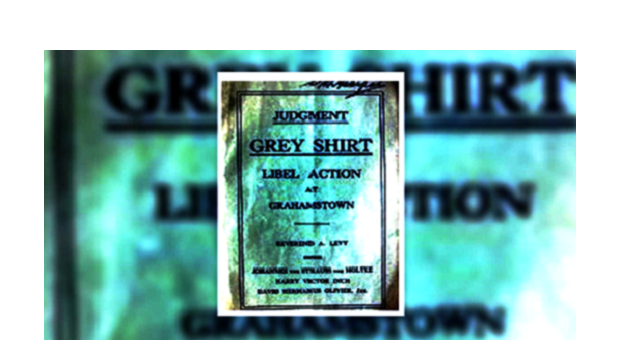
The judges seemed unimpressed. On 21 August 1934, in a somber atmosphere, the court delivered its judgment to a packed courtroom.
Members of the community knew that they had won, but were in no mood to gloat. They were eager to read the judgment, but soon realized that it was too long and contained too many legal terms. The Rabbi suggested that they convene a meeting at the synagogue that same evening, and invite Reynolds to explain the judgment in simple terms.
They had a large audience, including many youngsters.
In the judgment, delivered for the court by his lordship Judge Graham, Reynolds explained, he stated that Inch had not stolen the document, but had concocted it himself or with the assistance of Grey Shirt members, and Von Moltke had deliberately refrained from investigating the truth of the story told by him. Olivier, too, should not have published it without proper investigation.
The court also found that the existence of a so-called “World Plot” organized by the Jews, with the object of destroying “the Christian Church and religion generally and Judaizing the civilized world”, had not been established, the defendants having failed to produce a vestige of proof in that direction.
The court stated that the Inch document could reasonably be construed as referring to Rabbi Levy, and that it was most defamatory. It was not necessary, the court ruled, that the whole world should recognize the libel. It is sufficient if those who know the plaintiff can make out that he is the person meant. A group cannot sue for libel under English law, the court explained, so where whole nations or classes or professions are defamed, and no particular person is directly or indirectly indicated, the defamatory statement is aimed too widely and hits no one and has therefore no legal effect. But where the words refer to all the members of a particular number, group or class, such as “all the officers of this regiment” or “all the members of that jury”, each one of that particular group or class can sue.
The Rabbi, who had studied the judgment, remarked with a sad smile that looking for a legal precedent the court had quoted a Canadian case of 1914, which also concerned the libeling of a Jew. “Indeed, we Jews can claim to be heavy contributors to the laws
of libel in every country” he said.
Even Reynolds smiled at the interruption, but he soon continued. He did not intend to quote all the harsh things the court had to say about the defendants, but as members of the community had been particularly revolted at the testimony of Beamish, he read to them what the court had to say about this witness: “Beamish impressed us as a man obsessed with the views he enunciated. Intolerant in his beliefs, with an exaggerated idea of his own importance….he has greedily swallowed every anti-Jewish publication that he has discovered and accepted as facts every anti-Jewish statement they contained and upon this question he is a fanatic. He has been unable to produce a vestige of relevant evidence in support of his charge”.
They were all disappointed. Beamish deserved to be condemned in stronger language, they said. This is as far as judges, who were raised in the English tradition, will go, Reynolds assured them.
The damages that the court awarded him against all three defendants were of no importance, the Rabbi said; however, the judgment would convince the public that one could not libel Jews with impunity.
“Let us hope you are right”, some skeptics in the audience murmured. The defendants would not dream of paying the damages, they guessed, and knowing the Rabbi they assumed that he would do nothing to enforce the judgment.
A few months later they learned with satisfaction that Inch, at least, was made to pay. In criminal proceedings that followed the judgment in the civil case, after a trial that lasted nine days, Inch was convicted by a jury of uttering a forged document and committing perjury at the first trial. The foreman of the jury asked the judge’s permission to make a statement, in which he said that the jury considered the crimes committed by Inch to be racial and political.
To general surprise, the court sentenced Harry Victor Inch to six years and three months imprisonment with hard labor. Looking straight at the defendant Judge Pittman, who presided over the criminal trial, announced the reasons for this surprisingly harsh sentence:
I am bound to say that I regard your offenses in a very serious light. Your conduct in hatching this plot was one that was calculated, I think, to work disaster of the most serious character on the community. You launched your plot with extreme recklessness as to the consequences, and in your furtherance of it you have been guilty of what I can only regard as a most flagrant attempt in this court to pervert the course of justice….I cannot shut my eyes to the harm you might have brought to a community, and which in some measure you actually did bring about. Other persons who may be disposed to follow in your footsteps….must be warned by the sentence I impose upon you that any such indulgence on their part will meet with the severest retribution.
On 29 October all three Natal newspapers devoted a large amount of space to report on a statement issued by the Minister of the Interior, J H Hofmeyr:
Unhappily, there is no lie so foolish but some witless folk will be found believing it, and no libel so cruel but eager zealots will give it wider currency once they hear it. People talk about the sacred rights of freedom being in peril, but the sacred right of freedom should not carry with it the license to propagate mass attacks upon communities or sections of a community, or any title to put into circulation statements that can only result in setting race against race, creed against creed or faith against faith. Unhappily it proves too often that those who talk loudest about civil freedom…. are those least fitted to enjoy the rights they speak about…..it is the business of the government to see at all times that negligible minorities are not permitted to go outside the bounds of legitimate propaganda and let loose such doctrines as are bound to breed counter-activities among people as earnest as they, with the inevitable result that the peace of the land is temporarily endangered.
Epilogue: Retrial in Johannesburg
The year was 1991 and South Africa was in the middle of the painful process of reform that would finally rid the country of the scourge of Apartheid. For many years books in large numbers, considered to be ‘undesirable’, had been banned by the white regime, which was now un-banning and releasing for publication carefully selected lists of books. To the surprise and consternation of the Jewish community, it was learned that The Protocols of the Elders of Zion, banned in South Africa since 1945, and declared ‘undesirable’ in 1979, were prominent on the list of books to be un-banned. On 12 July 1991, an ad hoc Committee of Publications, acting in its legal capacity, had declared that the Protocols of the Elders of Zion was a book ‘not to be considered undesirable’.
On 2 August 1991, an appeal was submitted to the ‘Publication Appeal Board’ in Johannesburg by the ‘Directorate of Publications’ against the ‘Committee of Publications’, in the matter of the Protocolsof the Elders of Zion. The South African Jewish Board of Deputies and the International Association of Jewish Lawyers and Jurists (South African Chapter) were named as ‘Intervening Parties’. They claimed that this publication fell within three categories of the definition of ‘undesirable publications’ in section 47(2) of the Publication Act, which stated:
For the purposes of this Act any publication…shall be deemed to be undesirable if it or any part of it-
Is blasphemous or is offensive to the religious convictions or feelings of any section of the inhabitants of the Republic;
or
Brings any section of the inhabitants of the Republic into ridicule
or
contempt;orIs harmful to the relations between any section of the inhabitants of the Republic.
Clearly, they argued, the Jewish community of the Republic of South Africa, which constituted a “section of the inhabitants of the Republic”, had a right to protect its interests and to be represented by those who were well equipped to present its views to the board.
Unlike the trial in Grahamstown, they did not need a private plaintiff to prove personal harm. The law applicable in this case protected groups and sections, therefore a group of people whose interests were threatened had a right to be represented.
There was also no need to speculate about the possible danger from the Protocols of the Elders of Zion. This was the post-Holocaust era and there was ample proof of the use the Nazis had made of the Protocols. It was also evident that Neo-Nazi groups were reviving the Protocols and new publications were appearing all over the world.
Their impressive legal brief held 137 pages. It included the history of the Protocols, the revelations of their origin, the description of the harm they had done, and the attitude of prestigious academic bodies as well as governments, parliaments and courts, in other countries, to this particular publication.
On 12 November 1991, the seven members of the ‘Publications Appeal Board’, chaired by Mr. D W Morkel, delivered its unanimous judgment, setting aside the decision of the ad hoc ‘Committee of Publications’. The Protocols of the Elders of Zion was declared an undesirable document, not only its publication but also its possession prohibited.
The lawyers, who had almost closed their offices to the public to prepare in record time the legal brief, convened with their clients to study the decision of the Board.
They had won an important legal battle and they had set a precedent. On the question of representation, the board decided that the Jewish community of South Africa constituted an important section of the inhabitants of the Republic and as the publication in question purported to be an important Jewish policy-document, the Jewish community had a vital interest to make representation. “It would have been contrary to the principle of natural justice and the flexibility and fairness normally associated with the proceedings of administrative tribunals not to afford them the right”, the Appeal Board stated. Had the representations not been filed, he would probably have approached the Jewish Board of Deputies for expert advice, the Chairman added.
They were particularly impressed by the board’s perception of the danger the Protocols created. They had succeeded in convincing the tribunal that South Africa should join other countries which had found it necessary to deal with the publication of the Protocolsin the post Holocaust era.
Now, the Jewish community noted with satisfaction, South Africa was making a clear statement that libelous lies against a group of citizens did not deserve the protection accorded to other forms of speech.
The board had specifically addressed itself to the problem of antisemitism: Unlike other legal proceedings concerning the Protocols, the respondents in this appeal did not argue against the facts presented in the legal brief of the Jewish lawyers, which was highly praised by the board. They openly agreed that the Protocols were a fraudulent document and that they fell within the definition of ‘undesirable publications’. But, the committee said, they had decided to ‘unban’ the Protocols, as they had come to the conclusion that the document had been overtaken by history and that the relations between Jews and non-Jews in South Africa had been so good as to render the publication harmless. Rejecting this argument, the board said it was convinced that in many countries of the world antisemitism was on the rise and that this publication served as the “Bible of antisemitism”:
South Africa finds itself in a fragile and transitory period where attempts to promote racial and ethnic harmony are of the utmost importance”, they said, “…the board is convinced that the publication is inundated with material, which is likely to offend both Jews and non-Jews. It has great potential for fanning racial tension and in the hands of malicious individuals could be used as a tool to that end….both Jews and non-Jews would be mortified by passages in the publication….the fact that the publication has been proven to be fraudulent but can be applied to reality makes it exceedingly dangerous.
The Protocols were not only anti-Jewish, the board declared, accepting the argument of the Directorate of Publications that the book brought the non-Jewish section of the population of the Republic into contempt and ridicule. The ‘Goyim’ were stated to be brainless dupes, beset by drunkenness and immorality. They were the real villains of the Protocols, the Directorate argued. The court agreed stating that South Africa could do without a publication that apart from being extremely antisemitic, also expressly advocated the killing of non-Jews.


