
(Author: Veronica Belling, Vol. 70, No. 3, Chanukah 2015)
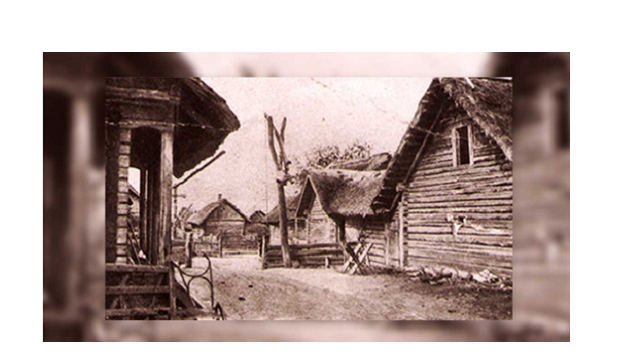
- Feature image: Jewish homes in Ponevezh
On 20 February 1953 A. Sarid, editor of the Afrikaner Idishe Tsaytung (‘African Jewish Newspaper’, 1932-1985), appealed to readers to send in information and photographs of their home towns in Eastern Europe for a forthcoming series, subsequently entitled, Iz Geven Amol a Heym (‘There Was Once a Home‘). This series followed on a photographic series, Bilder Fun der Alter Heym (‘Pictures of the Old Country’), that had begun the previous year – comprising photographs of groups of people in Lithuania taken in Ponevezh, Shavli, Kupishok and Shatt in the 1920s and 1930s. The series of photo reportages that followed incorporated a far larger number of towns: 25 in Lithuania – Aniksht, Birzh, Kelme, Kovarsk, Krakinova, Kupishok, Kurshan, Linkova, Oren, Plungian, Ponevezh, Poshelat, Poshvitin, Posvol, Radvilishok, Rakishok, Rasin, Shavli, Shidlova, Vashki, Vilkomir, Yanishok, Yanova, Yurburg and Zhager, and four in Poland – Lodz, Ostrolenka, Rozhan, Vashilkova. It is very likely that the series was inspired by the appearance in 1952 of the memorial book to Rakishok and its environs, published by the Rakishker Landsmanshaft in Johannesburg.1 Rakishok itself is included among the articles in the series, with an article published in the Rakishok Yizkor book by Berl Stein describing the life of the Chassidim in the town.
My attention was first alerted to this series, the references to which are listed on the Jewishgen website, by Ann Rabinowitz of Miami Florida. It was she who suggested that I translate them. The result was a modest publication by the Isaac & Jessie Kaplan Centre at the University of Cape Town, launched in June this year.
Besides the information, what makes this series invaluable is that they include a total of 67 photographs. With the exception of the towns of Oran, Shidlova and Yanova in Lithuania and Lodz in Poland, there are photographs attached to all of the articles. Of these, seven are of views of the towns and six are individual portraits. The remaining 54 are of groups of people belonging to the various organisations that proliferated during the period between the two World Wars, when Jewish life flourished in an independent Lithuania and in Poland. Each photograph has captions with the names of every single individual and, if the information was available, where they were living at the time of publication – South Africa, Israel, North and South America – or whether they had perished during the Nazi Holocaust.
By far the most popular organisations are those of the Zionists (11 photos), including Ha-Shomer ha-Tsa’ir, Hechalutz Ha-Tsa’ir, Herzlia and Bnoth Zion; next come the Yiddish Theatre groups (8); students and teachers of the Folkshul (6); Maccabi sports groups (5); a kindergarten group in Kupishok (2) and a Hebrew High School or Gimnasye in Yurburg (2). Others are of lesser known groups, such as the Jewish People’s Bank, of which there were eighty branches in Lithuania; an Esperanto Group in Vilna; Linat Ha-Tsedek – the Home for the Sick in Vashki; a Library Committee in Yanishok; the Yiddish reading room in Shatt; the Borochov Study Circle, a Memorial evening to the Yiddish author, Ba’al Machshoves and the Fire Commando (a very important group in Lithuanian towns, where the houses are made of wood and where fires were endemic) in Ponevezh; the Community Council and the Management of Oze – the Society for the Protection of the Health of the Jews – in Radvilishok and a Soup Kitchen in Ostrolenka, Poland.
Some of the people in the photos, such as the musician and composer Hirsh Ichilchik (who became a well-known personality in early Johannesburg) is featured in the photograph of the Fire Commando in his native Ponevezh; Mr Blesovski, who would become a well-known Hebrew teacher in Cape Town, is featured as the Director of the Hebrew school in his native Posvol; another Cape Town Hebrew teacher, Mr Achron, appears among a group of teachers in his native Yurburg. The book has a detailed index of names and places to facilitate a search for relatives. Already, members of our community have identified their relatives in the photographs.

The Fire Commando in Ponevezh. The leader of the orchestra, the musician and conductor, Hirsh Ichilchik, is seated, centre, wearing civilian clothes. Purim-shpils in Ponevezh were often held in the hall of the Fire Commando
The articles are preceded by an introduction that states the purpose of the series:
One often hears people say, Lithuania is no more, the old country is no more. What this really means is that the Jews are no longer there. Because ‘Lite-land’ with everything in it is still there. Woe to us – it is Juden rein, empty of living Jews. The aim of this series of articles, which will begin in the next issue, is not to mourn the unparalleled destruction of the Old Country. However as it is not possible to describe the extermination of the Jews in every shtetl, instead we would like to tell you about the Jews who were living there, and to describe the contours of the shtetl, the landscape, hill and dale, forest and stream, the memories that we who came from there brought along in our hearts.
The selection of the shtetls does not necessarily reflect the main shtetls from where the Jews of South Africa originate, but seems to have been dependent on the editor’s own knowledge, as well as the information that was sent in to the newspaper. The cities of Vilna and Kovno are conspicuous by their absence. On the other hand, there is an article about Vashki, one of the tiniest of the shtetls. Of the larger towns, there is only a very brief report on Shavli, although Ponevezh and particularly Vilkomir are well covered.
Who was the editor, A. Sarid?
The majority of the articles were written by one person, the editor, A. Sarid. Fourteen of the total of 25 villages and towns in Lithuania that are described are based on his personal experiences and his acquaintance with the inhabitants of the shtetls. These are the articles on Aniksht, Birzh, Kovarsk, Krakinova, Kupishok, Kurshan, Linkova, Ponevezh, Poshelat, Posvol, Shavli, Vashki, Vilkomir and Yanova. In the articles on Kupishok, Shavli and Posvol, he describes the desperate plight of the Jewish refugees who had fled Hitler’s invasion of Poland in 1939 and who were massing on the Lithuanian border in the area of No Man’s land. Other articles, such as his piece on Ponevezh and on Aniksht, depict romantic interludes, while the article on Yanova describes how a dispute between two Jews was settled on the eve of Yom Kippur before the Kol Nidre service.
Unfortunately, I was not able to establish the identity of A. Sarid. He is not listed among the official editors of the newspaper.2 The Sarid family in Israel is well known for having been in possession of the Gandhi-Kallenbach correspondence, that they sold a couple of years ago. However, attempts to make contact with them yielded no results. There was some biographical information for A. Sarid in his articles which provided several clues. He was a journalist in Lithuania and had been part of a delegation that was sent to speak to the Jewish communities in the different shtetls at the time of the outbreak of World War II. He was in Lithuania until approximately 1942 when, according to one of his articles, he was in the Shavli Ghetto during the week of Passover. However, there the trail dries up. How he managed to leave and when he immigrated to South Africa is not revealed.
There was always a possibility that A Sarid was a pseudonym, as in Hebrew it means ‘A Remnant’. It is the name that was adopted by the family of the Israeli politician and former leader of the Meretz Party, Yossi Sarid. Since the publication of There Was Once a Home, I became more and more convinced that A. Sarid must have been a pseudonym for Levi Shalit (born 1916), as only a native Lithuanian and a journalist who had made his mark even before the outbreak of WWII could have been privy to so much inside knowledge of his fellow countryman. With the German invasion in June 1941, he was interned in the Shavli Ghetto, where he became active in an underground movement, known as ‘Masada’. In 1944, he was sent first to the Stutthof concentration camp near Danzig and then to Dachau, where he was liberated by the Americans in 1945. After the liberation he went to Israel, where his mother had made her home. His father had been murdered in Dachau. In 1951, he came to South Africa on a cultural mission under the auspices of the SA Jewish Board of Deputies. While in South Africa he was invited to edit the Afrikaner Idishe Tsaytung, which he did until the newspaper’s closure in 1985.3 Levi Shalit died in Israel in 1994.
In June this year I attended a Jewish Library convention in Washington, and through an American author who had researched the Shavli Ghetto whom I met there, I was able to contact Levi Shalit’s brother, Dov, in Israel. Dov Shalit4 had also written for the Afrikaner Idishe Tsaytung and was also in contact with his brother’s wife in Israel. He did not remember the series, and initially completely denied the possibility of A. Sarid, being a pseudonym for his brother Levi. However, when on request I sent him a couple of the articles in the original Yiddish, he acknowledged the similarity in style. Moreover, I subsequently discovered that some of the personalities mentioned in Levi’s Yiddish diary of the Shavli Ghetto, Azey Zaynen Mir Geshtorben – So We Died, published in Munich in 1949,5 are also mentioned in the articles. However, whether the articles were indeed written by Levi Shalit will never be known for sure as the answer has been taken to his grave.
Besides the articles by Sarid himself, another six articles are based on material that was sent in to the newspaper. The information for Poshvitin was provided by L. Chazan (of Port Elizabeth). Mordechai Jubiler (Johannesburg) reported on Radvilishok; Yosef Yitskhok Shein (Johannesburg) described the adjacent shtetls of Shidlova and Rasin; Mr Yakov Lerman, a former teacher at the Hebrew gymnasium in Yurburg, wrote the article on Yurburg; L. Goldberg sent the material for Kelme; Yerakhmiel Green (Boksburg) sent the material for Yanishok; and both V. Sachar (Rondebosch, Cape Town) and Sarid wrote about Kupishok.
The articles on Plungian, Zhager, Oran and Rakishok were written by journalists or writers in their own right. The article on Plungian was written by Zalman Levi, the last editor of the South African Yiddish literary journal Dorem Afrike (1948-1991); that on Oran was by Israel Kurgan, who later published his stories and reminiscences in a book, Zikhroynes fun Shtetl (Memories of the Shtetl, Tel-Aviv, 1971). The article on Zhager was by Solomon Fedler, whose description of his shtetl was published under the title, Shalekhet (Falling Leaves) in Johannesburg in 1971 and the poems of his wife, Chaya, that he quotes, were published in two anthologies, Shtile Gezangen (Quiet Songs, Johannesburg, 1951) and Bleter Fal (Falling Leaves, Johannesburg, 1954). As mentioned above, the journalist Berl Stein was responsible for the section on Rakishok.
Some descriptions are very brief and are confined to a single episode, such as that of Yanova or Shavli. The most comprehensive descriptions of the Lithuanian shtetls are those of Kupishok, Plungian, Radvilishok, Rasin, Shidlova, Vilkomir, and Yanishok.
Almost as a postscript, the series also includes three very brief descriptions of the Polish shtetls of Ostrolenka, Rozhan and Vashilkova, as well as a brief description of the city of Lodz. These were sent in by readers from Poland and, although not as full or as rich as those of the Lithuanian shtetls, they do give one an idea of the place. Sarid apologises for this shortcoming, stating that he knows little about the Polish shtetls and can therefore do little to enhance these descriptions.
As indicated in the introduction, the descriptions are extremely broad. Although there are descriptions of the landscape, and occasionally of the physical layout of the town, the main focus is on the people who were living in the shtetl and who were murdered by the Nazis and their Lithuanian collaborators. They include personalities such as Dr Ganandski, a Jewish military doctor in Vashki, who dedicated his life to treating the Lithuanian peasants as well as the Jews; Shaytele, the beautiful young manager of the Jewish People’s Bank in Vashki, who extended easy credit to the Jews, and who loved to party through the night; Mrs Gelbart, an exceptionally beautiful and fashion conscious woman with excellent taste and European manners, whose home was the most modern in the shtetl of Kurshan; Ari Glazman from Posvol, who wrote full-blooded stories about the Lithuanian people and the landscape, that were not appreciated by his Jewish compatriots; Sore Pogrimanski from Poshelat, a brilliant intellectual, and an activist in the international Orthodox women’s movement, Beys Yankev. But descriptions also include the humblest of Jews, the water carrier, the shul caller, the coach driver, the stoker in the Besmedresh, the porter and many others.
Some shtetls are distinguished by their adherence to a particular type of Judaism. Examples are Ponevezh, famed for its yeshiva, headed by Rabbi Yosef Kahaneman, whose fundraising campaign, extended as far afield as Umtata and Windhoek in southern Africa. Although the Gaon of Vilna, Eliyahu ben Shlomoh Zalman (1720-1797) spearheaded the ideological battle against the spread of Chassidism, as we read in Berl Stein’s description of Rakishok in north-eastern Lithuania, it reigned supreme over there. Lithuania was also famous for the development of the Mussar movement. The latter is attributed to Rabbi Israel Salanter (Lipkin, 1810-1883), whose followers established their own yeshivas, one such is described in the article on Kelme. My successor in the Jewish Studies Library, Juan-Paul Burke, a graduate of the Johannesburg Yeshivah, was particularly thrilled to find an “extraordinary description of an individual, Reb Motel Pogrimanski z”l, who was a legend… A Rabbi and Gaon of whom stories heard in Yeshivah are here corroborated besides those that have been passed down from Telz to Cleveland to Johannesburg.”
But even more than the physical descriptions, the articles convey a feeling of the quality of life: the fear of officialdom, the isolation, the tedium of daily life, where even a fire serves to break the monotony and weddings were week-long celebrations. Yet despite the poverty and the daily struggle, the writers recall their former homes with nostalgia and the longing is poignant, as can be seen in this description of the shtetl of Aniksht: “Give me these Jews, the dim Besmedresh, together with its enraptured listeners and uplifting speeches. You can have your big cities with their brightly lit halls. Oh! If it were only possible to change places!”
Finally more than anything else, the South African connection is evident in the reciprocal relationship that existed between the Jewish communities of Lithuania and those in South Africa. As Sarid portrays in his description of the small shtetl of Krakinova, neither could have existed without the other and each enriched the other in different ways.
The support from Africa was a great help to many families in Lithuania. There were villages – and Krakinova, in particular – where the majority of the families survived only thanks to the help that they received from the other side of the ocean. When one considers the matter more profoundly, one realizes that those who were giving assistance were in turn supported by the ‘inspiration’ of the Lithuanian shtetls. The Jews of Africa exported pounds to the shtetl, but in return they imported Jewish spirituality, warm bonds, and a great deal of love that was conveyed in heart-warming letters and close family ties.
Despite the fact that Sarid states explicitly in his introduction that his intention is not to describe how, when and where the Jews in each individual shtetl were killed, this cannot be avoided and allusions to these tragic events are contained in most of the descriptions. Even before Lithuania was occupied by the German forces in June and July 1941, pogroms that claimed thousands of Jewish lives erupted throughout the country. With the arrival of the armed forces, the deliberate killing was taken over by detachments of German Einsatzgruppen(mobile killing units), supported by Lithuanian auxiliaries.
Jews were incarcerated in concentration points intended to serve as sites for mass shootings. These included the Ponary forest near Vilna, the Kuziai forest near Shavli, and the Ninth Fort near Kovno. By the end of 1941 about three quarters of Lithuanian Jewry had perished in pogroms and organised mass killings. The surviving 40 000 Jews were concentrated in the Vilna, Kovno, Shavli and Shvencion ghettos, and in various labour camps in Lithuania. Yet during periods of relative calm in 1942 and early 1943, social and cultural life was reorganised and religious observance was possible. In September 1943 the Vilna and Svencion ghettos were destroyed, and the Kovno and Shavli ghettos were converted into concentration camps. Some 15 000 Lithuanian Jews were deported to labour camps in Latvia and Estonia. About 5000 were deported to extermination camps in Poland, where they were murdered. Shortly before withdrawing from Lithuania in the fall of 1944, the Germans deported about 10 000 Jews from Kovno and Shavli to concentration camps in Germany.
Soviet troops reoccupied Lithuania in the summer of 1944. In the previous three years, the Germans had murdered about 90 percent of Lithuanian Jews, one of the highest victim rates in Europe.6
Sarid, A.,“There Was Once a Home….”: Memories of the Lithuanian shtetls published in the Afrikaner Idishe Tsaytung – African Jewish Newspaper, 1952-1954. Compiled, introduced and translated by Veronica Penkin Belling. Cape Town: Isaac & Jessie Kaplan Centre for Jewish Studies & Research, University of Cape Town, 2015. Available from the Isaac & Jessie Kaplan Centre for Jewish Studies and Research, University of Cape Town. E-Mail: Janine.Blumberg@uct.ac.za
Dr Veronica Belling is the author of Bibliography of South African Jewry (1997), Yiddish Theatre in South Africa (2008), and the translator of Leibl Feldman’s The Jews of Johannesburg (2007) and Yakov Azriel Davidson: His Writings in the Yiddish Newspaper, Der Afrikaner, 1911-1913(2009).
NOTES
- Bakalczuk-Felin, Meilech, ed. Yizkor Bukh fun Rakishok un Umgegent. Aroysgegebn fun der Rakishker Landsmanshaft in Yohanesburg, Derom Afrike, tsu ir 40 Yorikn Yubiley, 1912-1952.Johannesburg: Rakishker Landsmanshaft,1952.
- Poliva, Joseph Abraham. A Short History of the Jewish Press and Literature of South Africa From Its Earliest Days Until the Present Time. Johannesburg, 1960.
- Shalit, Levi. Beyond Dachau. Johannesburg: Kayor, 1980.
- Shalit, Dov. They were Numbers. Ramat Hasharon, Israel: DAR Press, 2002.
- Shalit, Levi. Azey Zaynen Mir Geshtorben. Munich, 1949.
- “Lithuania”, Yivo Encyclopedia of the Jews in Eastern Europe, http://www.yivoencyclopedia.org/article.aspx/Lithuania


